
Table of Contents
A hospital in Ohio lost patient records for 11 days last spring. Not because of a sophisticated cyberattack. Because one spreadsheet macro, inserted in a routine vendor email, had never been reviewed by the hospital’s security team.
This is the reality of cybersecurity risk management. The focus is not on buying new software or responding to every alert about emerging threats. It is on prioritizing the risks and addressing the ones that matter most before they affect the business.
This guide explains what cybersecurity risk is, how organizations can assess and quantify it, and how the value of risk management efforts can be demonstrated.
What Is Cybersecurity Risk?
Cybersecurity risk is the possibility that an adverse outcome affecting data, systems, or operations will occur due to an exposure, weakness, or vulnerability, and the impact that this adverse outcome would cause.
Now, let’s see what is risk in cybersecurity: It can be represented by the formula:
Risk = Threat × Vulnerability × Impact
- Threats are various factors that could cause harm to systems, data, or operations. This includes malicious actors (hackers, insider threats), non-malicious actors (human error), and events unrelated to people (natural disasters).
- Vulnerabilities are weaknesses that could be exploited by threats to cause harm. These include software or hardware flaws, misconfigurations, or human factors.
- Impact refers to negative consequences that an organization would experience if a threat was successful in exploiting a weakness. For example, a data breach could impact revenue, brand reputation, or legal compliance.
If any of the three components is equal to zero, the risk is zero. A threat that cannot exploit a vulnerability and turn it into an adverse outcome is not a threat. This is the basis of risk management, which helps organizations identify, quantify, and prioritize risks.
What Is Cybersecurity Risk Management?
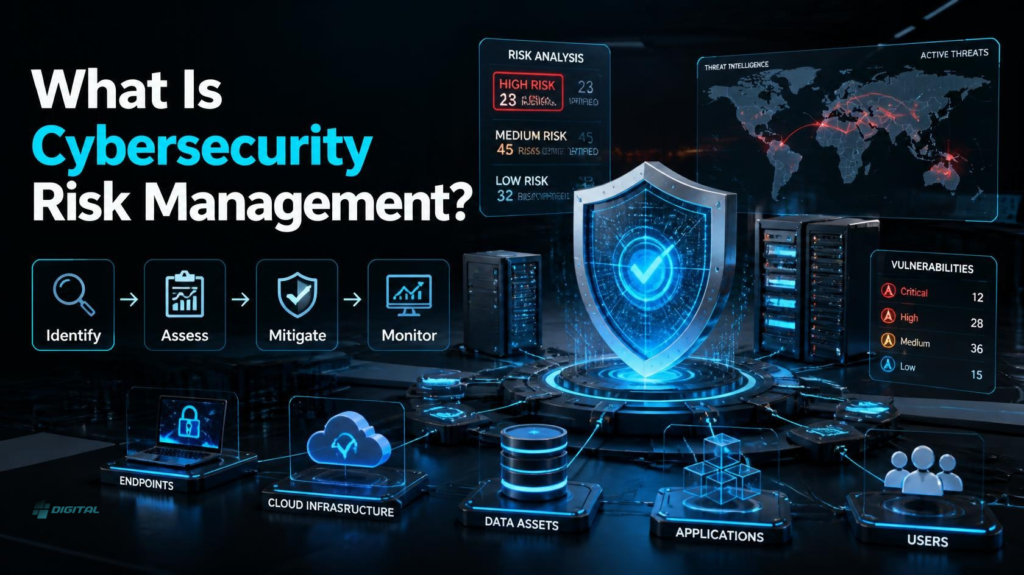
Cybersecurity risk management refers to the process of continuous risk identification, assessment, and prioritization to ensure that risks that require action are addressed in a timely manner. It is a continuous process that consists of stages that can be repeated multiple times:
- Identify – discover organizational assets and potential threats to them.
- Assess – prioritize the discovered threats based on the likelihood of exploitation and impact.
- Respond – address the highest-priority risks through risk reduction, risk transfer (insurance), risk avoidance, or risk acceptance.
- Monitor – continuously evaluate the risk landscape to ensure that no risks are overlooked.
Why Cybersecurity Risk Management Matters?
Cybercrime costs organizations billions of dollars every year, with ransomware attacks being especially expensive. On average, there is a ransomware attack somewhere in the world every 11 seconds. IBM’s 2026 Cost of a Data Breach Report revealed that the average organization loses $4.99 million, a 12% jump from the year before, with U.S. organizations paying more than double that figure. A big driver behind the jump: AI-powered attacks, which rose 56% year over year and added roughly $1 million to the average breach cost when they were involved.
The report also stated that 92% of organizations that experienced an AI-related data breach had no AI access controls in place, which points to a failure in their risk management practices. This highlights the importance of cybersecurity risk management practices, as they help organizations identify and address their cybersecurity risks before they are exploited.
Why Do Organizations Conduct Cybersecurity Risk Assessments?
Organizations conduct cybersecurity risk assessments for several reasons, including:
- The ability to allocate limited cybersecurity budgets to address the risks that matter most. Organizations cannot address all risks at once, and risk assessments help prioritize the ones with the highest likelihood and impact.
- Compliance with legal and regulatory requirements. Many industries have regulations that require organizations to conduct risk assessments (HIPAA, PCI DSS, NIS2, DORA) and demonstrate that they do so.
- Proactive risk identification and mitigation. Organizations can stay ahead of potential threats by conducting regular risk assessments to identify and address vulnerabilities before malicious actors can exploit them.
- Justification of cybersecurity expenditures to executives and stakeholders. Risk assessments provide a clear understanding of the potential impact of threats, which helps justify the need for budget and resources to address them. For example, a risk assessment can demonstrate how a particular vulnerability could lead to a breach that would cost the organization $2 million, and this fix costs $80,000.
- Maintenance of cyber insurance policies. Many cyber insurance providers require organizations to demonstrate that they have a risk management program in place before they can purchase or renew a policy.
What Is a Cybersecurity Risk Assessment?
A cybersecurity risk assessment is a process that helps answer three primary questions: what needs to be protected, what can go wrong, and how bad would it be if it did. A risk assessment helps underpin all risk management activities by actually investigating and evaluating the information needed to make informed decisions about how best to proceed with managing risk. Here what is a risk assessment cybersecurity:
| Step | What Happens | Example Output |
| 1. Asset inventory | List every system, device, dataset, and application that matters to the business | Customer database, payroll system, email servers |
| 2. Threat identification | Identify what could target those assets | Phishing, ransomware, insider misuse, third-party breach |
| 3. Vulnerability scan | Find weaknesses attackers could exploit | Unpatched software, weak MFA, exposed cloud storage |
| 4. Likelihood & impact scoring | Rate each risk on how probable and how damaging it is | High likelihood / high impact = top priority |
| 5. Risk prioritization | Rank risks so the worst ones get fixed first | Ransomware on payroll system ranked #1 |
| 6. Reporting & remediation plan | Document findings and assign fixes with owners and deadlines | IT patches servers within 30 days |
Assessments can take several forms: qualitative (e.g., low, medium, high), quantitative (e.g., dollars, percentage), or a combination of both. Most organizations begin with qualitative analyses because they are often simpler to implement and then move toward quantitative assessments as the security program matures and executive leadership demands greater precision.
How to Measure Cybersecurity Risk
This is the question that often challenges most teams because the concept of risk is not easily measurable, so one has to define what risk means and attempt to quantify it somehow. There are two main approaches to the quantitative analysis of risk, and successful programs employ both.
Qualitative Measurement
This approach involves using a scoring matrix that usually involves assessment of the likelihood and impact of a given risk occurring on a scale from 1 to 5 and then multiplying the likelihood by the impact to arrive at a value for the risk. This approach is quick and intuitive and does not require any complex analysis, thus making it ideal for executives who may not have technical backgrounds. The problem with such analysis is that it is highly subjective.
Quantitative Measurement
This approach is more sophisticated and usually revolves around assigning a dollar value to the risk, which involves the use of more sophisticated models such as the Factor Analysis of Information Risk (FAIR). This method is aimed at providing quantitative analysis of risk that is linked to spend and budget since the results of the analysis are usually expressed as a range of possible losses (for example, $1-$50 million) instead of a color-coded score.
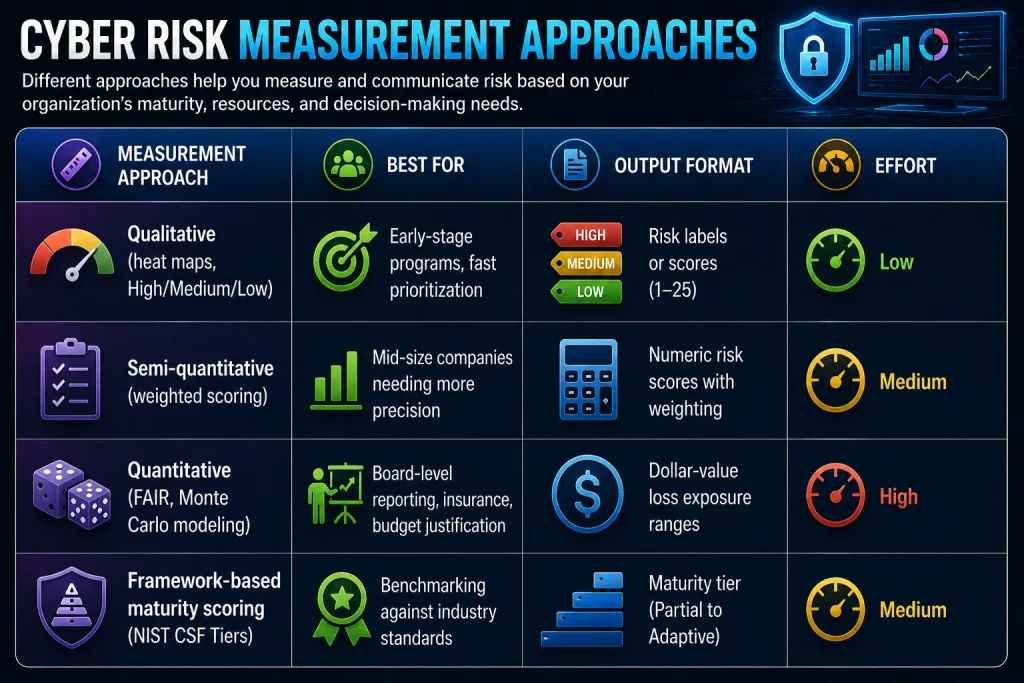
Whichever approach you choose, the key is to apply it consistently. A risk score only makes sense if it’s calculated the same way every time, so that you can see if and how your risk posture is changing over time.
How to Measure Anything in Cybersecurity Risk (Even the “Unmeasurable”)
Security teams often cite certain risks as being immeasurable. For instance, the damage to the company’s reputation, or the risk of insider threat culture. In practice, anything can be decomposed into constituent parts that have some level of measurement behind them. The key is to apply the principle of decision science. Iy states that every nebulous risk factor can be broken into components that have a supporting metric.
The rule of thumb that quantitative risk analysts use is that anything that is worth worrying about, has some measurable impact on something else. The trick is to identify what that something else is.
How Do Macros Pose a Cybersecurity Risk?
Macros are small units of code embedded into Office documents that perform a set of actions automatically. They are exceptionally common. Because they allow users to automate repetitive tasks. However, macros can also be used by attackers to establish a foothold in the target’s system. A macro-enabled document attack works as follows: the attacker tricks the victim into opening a malicious document, usually by phishing them with an invoice, resume, or shipping confirmation. When the victim opens the document, they are prompted to enable macros, usually with a warning that the document will not display its contents without enabling macros. When the victim enables macros, the malicious code runs on their machine, establishing a reverse shell for the attacker.
The reason why macro-enabled documents are so dangerous is that:
- They run with the same privileges as the user who opened them, essentially giving the attacker full access to the machine if the user is a domain administrator.
- Traditional antivirus tools are ineffective at detecting macro-based malware, as they are hidden inside legitimate-looking Office documents.
- Many companies enable macros by default, especially in certain industries where they are common.
- Attackers frequently use macro-enabled documents to deliver payloads, and update their code to stay undetected.
The solution is to disable macros by default and only allow them from trusted sources, such as digitally signed documents. Additionally, employees must be trained to never enable macros, just as they would not allow a stranger to borrow their car.
How to Measure Cybersecurity ROI
Security executives are frequently asked to justify the ROI of cybersecurity investments. Both by the board of directors and by the C-suite executives. Cybersecurity ROI is not measured the same way as traditional marketing ROI, as there is no revenue directly generated by a cybersecurity initiative. Instead, it’s important to look at the risk reduction value, or the value of risk that was mitigated by the investment. Here’s a simple formula that can be used to calculate the ROI of a cybersecurity investment:
Cybersecurity ROI = (Risk Reduction Value – Cost of Investment) ÷ Cost of Investment
In order to use this formula, you’ll need to calculate the risk reduction value – the value of risk that was reduced by the investment. It can be calculated using the risk assessment data from your cybersecurity risk assessment, such as the risk value before and after the investment. The risk reduction value is then compared to the cost of the investment.
For instance, if the cybersecurity risk assessment estimated that the company faced a 20% chance of a phishing attack that would result in a $2 million, so the expected annual loss is $400,000 loss, and the security awareness training program cost $60,000 a year and cuts that likelihood to 8%, dropping expected loss to $160,000, the risk reduction value would be $240,000. ROI = ($240,000 – $60,000) ÷ $60,000 = 300%.
The risk reduction value can be used to determine whether a particular investment is worthwhile. For instance, if the risk reduction value greatly exceeds the cost of the investment, it makes the investment more attractive. IBM’s 2026 report on cybersecurity ROI found that organizations that invested in AI and automation reduced their breach costs by nearly 2,000,000 compared to those that didn’t, and it took them 247 days to detect and contain a breach, compared to the industry average of 295 days. This demonstrates that detecting and containing a breach quickly can provide significant ROI to the company.
Cybersecurity Risk Management Frameworks Worth Knowing
When designing your risk management program, you have several options in terms of risk management frameworks to choose from. The most common frameworks are:
- NIST CSF 2.0 – the most common voluntary framework that has been adopted by organizations around the world. The framework is centered around five functions: Govern, Identify, Protect, Detect, and Respond, with the new emphasis on the “Govern” function, which makes the connection between cybersecurity risk management and business risk governance explicit.
- ISO/IEC 27001 – an international standard that focuses on developing an information security management system.
- FAIR – a quantitative risk analysis framework that focuses on measuring risk in financial terms.
- HITRUST CSF – a framework that is common in the healthcare industry, as it incorporates a number of different standards, including HIPAA, into one unified, certifiable framework.
The choice of framework depends on your industry, as well as your risk management needs. It’s important to choose a framework that fits your organization, rather than trying to force your organization to fit the framework.
Common Mistakes Companies Make With Cybersecurity Risk
Some of the most common mistakes that companies make when managing cybersecurity risk are:
- Thinking of risk assessment as a one-time event – risk assessment should be continuous, as new vendors, tools, and employees are added to the system every day.
- Assessing risk without the business’s input – risk assessment is not a purely technical endeavor, as different departments have different risk appetites and tolerances. It’s important to involve the finance and operations departments when conducting a risk assessment.
- Trying to mitigate all risk – it’s important to prioritize risk based on its impact and likelihood, rather than trying to mitigate every risk equally.
- Not updating risk assessments – risk assessments should be reviewed and updated periodically, as the risk landscape changes, and some risks may no longer be relevant.
Frequently Asked Questions
Is cybersecurity risk the same as cybersecurity threat?
No. A threat is the source of potential harm, like a hacker group or a piece of malware. Risk is the combination of that threat, the vulnerability it could exploit, and the damage it would cause. You can have threats without meaningful risk if there’s nothing vulnerable for them to exploit.
Who should own cybersecurity risk management inside a company?
It shouldn’t sit with IT alone. Most mature programs assign ownership to a CISO or risk committee that includes IT, legal, finance, and operations leaders, with final risk-acceptance decisions made by senior executives or the board.
How often should a cybersecurity risk assessment be updated?
At minimum once a year, but leading organizations reassess after any major change — a new system, a merger, a new vendor relationship, or a significant incident anywhere in the industry.
What’s the difference between risk mitigation and risk transfer?
Risk mitigation means reducing the likelihood or impact of a risk directly, usually through technical controls or process changes. Risk transfer means shifting the financial consequence to someone else, most commonly through cyber insurance, without necessarily reducing the underlying risk itself
Does cybersecurity risk management help with cyber insurance premiums?
Often, yes. Insurers increasingly ask for documented risk assessments, incident response plans, and control evidence before issuing or renewing a policy, and companies with mature programs frequently qualify for better rates.
FINAL THOUGHT
Cybersecurity risk management is only effective when it is treated as a practice that requires discipline, not as a set of goals to be reached. The organizations that suffer the most are those that do not take the time to evaluate a risk before it manifests. The example of the hospital in Ohio at the beginning of the article serves to illustrate this point, as it was a single unchecked macro that allowed the breach to occur, not the absence of tools and budget as one might assume.
Three points stand out as the most important takeaways from the reading:
- Prioritization over coverage
- The importance of numbers
- The constant nature of risk
Prioritization is more important than coverage because it is impossible to address every potential weakness, and the ones that are chosen for mitigation will overshadow the others, regardless of their potential impact. The most critical vulnerabilities, if neglected, will define the organization’s risk profile.
The ability to secure the most important assets is what determines the size of the program’s budget. In order to achieve executive support, the cybersecurity program has to demonstrate its value in terms of prioritization. The risk has to be converted to costs, such as in the example from IBM Security 2026, where the unauthorized use of AI would cost the company $$2M and the fix costs $80K on average. This allows for a more tangible understanding of the potential impact.
The final takeaway is the constant nature of risk, which means that the practice of cybersecurity risk management has to be exercised regularly and repeatedly. The changes in vendors, the adoption of new technologies such as AI, and the evolution of the workforce are all factors that contribute to the continuous changes in an organization’s risk profile. The IBM Security report once again serves as an example, this time to illustrate the point that changes to the environment introduce new risks. 92% of organizations that experienced a breach involving AI did not have any AI-specific controls in place.
The most important sentence in the reading is the one that states that risk should be converted to documented and accepted risk. This is the point that differentiates between organizations that are prepared and those that are not. The ones that can justify the choices they make in regards to cybersecurity get to retain their assets in the case of a breach, while those that cannot document their decisions and assumptions suffer the financial impact of the incident with little to no resistance.
Your Next Readings!
What is a Worm in Cybersecurity?