

Table of Contents
Security teams working in information security utilize terms such as sandbox, honeypot, endpoint, and agent almost every day. This can be overwhelming when learning the foundations of modern cybersecurity. These terms, while initially intimidating, become simple with practice. This article discusses and explains each of the terms, their association with modern security practices, and attempts to answer the most common questions surrounding them.
What Is a Sandbox in Cybersecurity?
A sandbox is an isolated area used to execute files, programs, or URLs. Sandboxes allow security analysts to assess the potential impact of a program without introducing risk to the host system.
Sandboxes are often used to run attachments sent through phishing emails, untrusted programs, or URLs. Once inside the sandbox, the security analyst can observe the inner workings of the application, file, or message. It is critical to emphasize that whatever is placed in a sandbox remains there, unable to leave or affect the host system. The sandbox itself acts as a controlled environment that allows a security analyst to assess the nature and scope of any possible threat.
A sandbox analogy is best demonstrated by imagining a chemistry laboratory. A chemist would place an unknown substance inside a test chamber and observe its behavior using special gloves. This means that the substance is isolated at all times, unable to impact the chemist or surrounding environment directly. The chemist can interact with the substance and test its properties, allowing them to determine what course of action to take accordingly.
What is Sandboxing in Cybersecurity?
- The sandboxing process is a part of a larger procedure that takes place in cybersecurity.
- A file, program, or network traffic is flagged by an initial security assessment.
- The traffic, file, or program is redirected to a sandbox instead of the host system.
- Inside the sandbox, the item is examined, and specific behaviors are noted.
- These behaviors are then assessed to determine whether the item should be blocked or not.
It is vital to note that many malware programs these days are able to avoid traditional antivirus measures. In many cases, they can successfully obscure their presence by imitating legitimate applications. By relying on traditional methods, one would only be able to recognize known malware. However, sandboxing allows analysts to identify suspicious behavior, making it possible to neutralize new, previously unknown threats. This makes sandboxing one of the most useful techniques available to modern cybersecurity analysts.
Why Are Isolated Sandboxing Environments Needed by Organizations and Businesses?
Ransomware, zero-day, and traditional malware attacks present serious threats to organizations and businesses. However, most of them are delivered as attachments to emails, either as traditional phishing attempts or as more sophisticated social engineering methods. A sandbox gives an analyst an opportunity to isolate potentially dangerous files and observe what actions they attempt to execute. This, in turn, allows them to assess the scale of the potential attack surface and take remedial measures.
Email security appliances, firewalls, and traditional antivirus programs often rely on sandboxing technologies to observe and assess the potential impact of files, programs, and messages. Traditional antivirus scanners have limited capabilities, relying on known definitions to identify malware. However, most modern threats are sophisticated, capable of avoiding signature-based scans. That is why organizations, businesses, and even individuals often use sandboxing technologies to protect themselves.
What Is a Honeypot in the Context of Cybersecurity?
A honeypot is a security mechanism that serves as an attractive, bait target. They are designed to lure attackers and analyze their activity and methods. A honeypot is similar to an imaginary database, server, or even a file share, only containing useless data and designed to mislead would-be attackers.
A honeypot can be best imagined as a decoy car left in a parking lot with cameras monitoring who would attempt to steal it. There is nothing of value in the car, and besides being observed, it does not contain any actual technology. However, cybercriminals are often tricked into interacting with it, believing that it is a viable target.
What Is the Primary Purpose of a Honeypot in Cybersecurity?
The primary purpose of a honeypot is to act as an alert system and attract attackers to waste their time and resources. By design, honeypots do not serve an operational purpose and do not contain any valuable information. As such, any interaction with them is a sign of a potential cyberattack.
Using honeypots allows cybersecurity analysts and analysts to gain valuable insight into the tactics and methods used by attackers. Some of the benefits come in the form of:
- allowing analysts to understand new methods and attack vectors.
- deceiving attackers in order to waste their time.
- collecting information related to malware behavior and command infrastructure.
- testing the defensive capabilities against an actual attack.
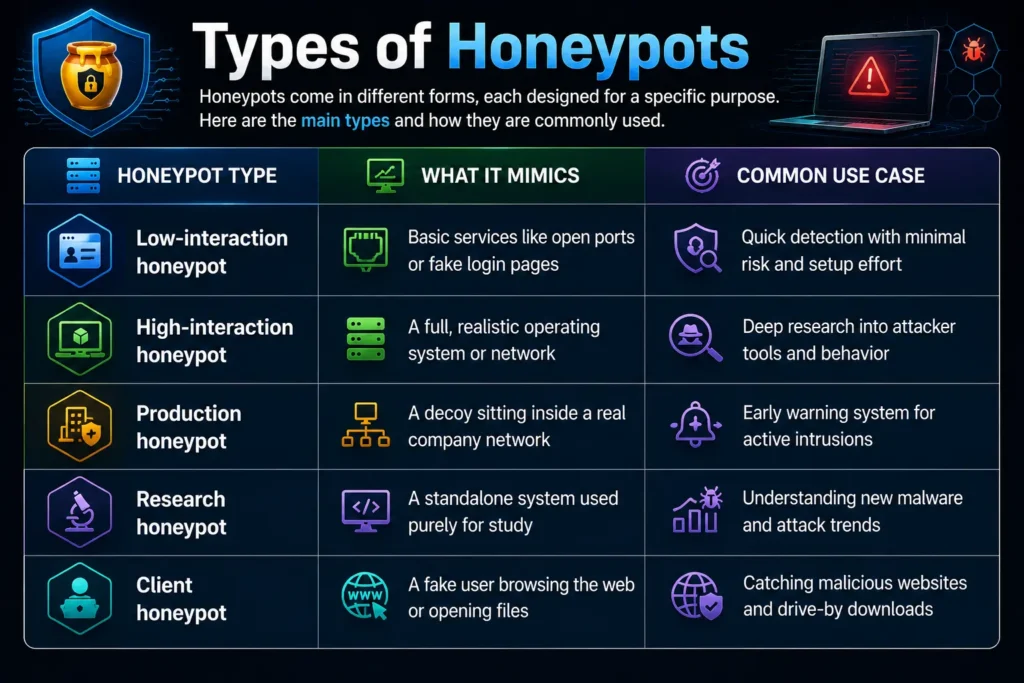
Low-interaction honeypots are easier to use and maintain because they require only a few services to be simulated, whereas high-interaction honeypots are more complex to deploy and host but can gather more information about the attacks.
What is An Endpoint in Cybersecurity?
An endpoint refers to any device that can connect to a network from an external point. This includes laptops, desktops, mobile phones, tablets, servers, and other devices like printers and point-of-sale systems.
In other words, any device that can send or receive data on a network is an endpoint, and all these devices are usually the first line of defense in any network security system.
Why Are Endpoints a Security Concern?
Endpoints are the biggest security concern because they are usually the weakest link in the network security system. This is not because the devices are inherently weak, but because human error can easily compromise them.
For example, if a worker clicks on a malicious link or connects a USB device to a company computer, the attacker can gain access to the network. In fact, research shows that most successful cyberattacks usually originate from endpoints.
That is why most cybersecurity companies offer products that are specifically designed to protect endpoints. These products include:
- Endpoint detection and response (EDR)
- Anti-virus and anti-malware
- Encryption
- Mobile device management
- Patch management
What is An Agent in cybersecurity?
An agent is a software program that runs on endpoints and helps detect any suspicious activity by constantly monitoring the computer or device it is installed on. The agent then relays this information to the appropriate authorities for further investigation and action.
In other words, agents are used to monitor, collect information about, and respond to security threats on a device. Most agents operate in the background and are usually not visible to the user.
They monitor various aspects of the computer they are installed on, such as:
- The files on the device
- The processes running on the device
- The network traffic
- The login credentials
- The applications running on the device
- Changes to the registry
Whenever the agent detects something unusual, it can trigger an alarm, and some can even take action on their own to mitigate the effects of the security threat.
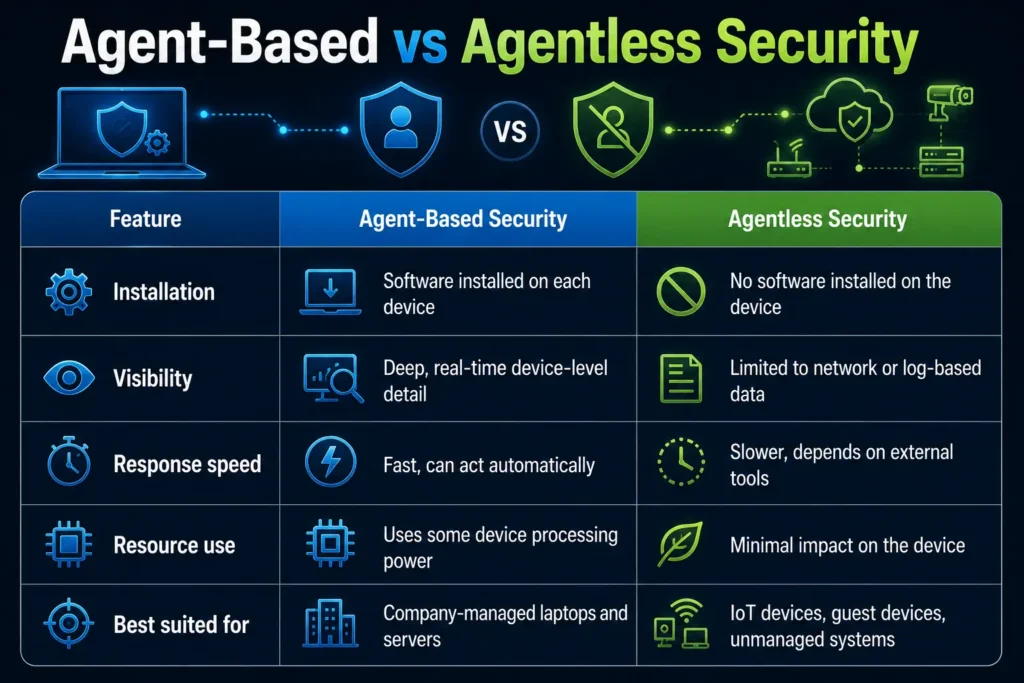
Most enterprise security software makes use of a combination of the two. The agents monitor company-owned devices, while the agentless monitoring covers devices outside of the company’s control or where it’s not possible or advisable to install additional software, such as a guest’s personal phone or a smart thermostat.
How These Four Concepts Work Together
The four concepts are not separate entities, as they are often combined in practice. For example, a single security operation may involve
• an agent that monitors a particular endpoint
• and if it detects something suspicious, it may send the file for further inspection to the sandbox
• another honeypot is deployed elsewhere on the network, waiting for the attacker to probe it
• thus, combining the four elements into a security operation that follows the defense-in-depth approach
• removing any single point of failure, and covering more attack surface than a single solution would alone.
Frequently Asked Questions
Can malware detect that it’s inside a sandbox and hide its behavior?
Yes. Some advanced malware checks for signs of a virtual environment, like unusual hardware IDs or a lack of typical user activity, and stays dormant if it suspects it’s being watched. This is why modern sandboxes try to mimic real user behavior, such as mouse movement and file history, to fool the malware into acting normally..
Is it legal for a company to run a honeypot?
Generally yes, as long as the honeypot sits on infrastructure the company owns and isn’t used to actively lure or entrap outside individuals in ways that cross into legal gray areas. Most organizations treat honeypots the same as any other internal monitoring tool, though legal review is still smart before deployment.
Does every device connected to a network count as an endpoint?
Pretty much. Even devices you might not think about, like a smart TV in a conference room or a networked security camera, count as endpoints. Each one is a potential entry point, which is why many breaches now start through overlooked IoT devices rather than laptops.
What happens if a security agent gets disabled or removed by an attacker?
This is a known attack technique. Skilled attackers often try to kill or blind the security agent first, before doing anything else, so their later actions go unnoticed. Good security agents include tamper protection that alerts the security team the moment someone tries to disable them.
What is a honeypot cybersecurity and a honeynet?
A honeypot is a single decoy system. A honeynet is a whole network of honeypots connected together, designed to look like a realistic company environment. Honeynets are used when researchers want to study how attackers move laterally across multiple systems, not just how they break into one.
Final Thoughts
The concepts of sandboxes, honeypots, endpoints, and agents play different roles in securing an enterprise network. Thus, a sandbox makes it possible to isolate potentially dangerous traffic before it enters the corporate system, while a honeypot acts as an attractive target to lure attackers, from which they can be safely collected. The term endpoints refers to the devices used by workers, which require special protection, and agents are specialized programs that monitor endpoints for any signs of intrusion in real time.
These four components of network security can be used together to ensure more robust protection and detect malicious activity at an early stage. Whether it is a suspicious file, an attacker trying to exploit an employee, or a laptop containing confidential data, this technology complex will intercept and neutralize any threats in time.
You Would Like To Read!
What is a CIA Triad in Cybersecurity?