

Cybercrime is becoming more complex each year. Organizations like businesses, government agencies, hospitals, educational institutions, and even tiny enterprises encounter cyber threats daily. Whether through phishing attacks or hacking incidents, the reality is that organizations require highly qualified professionals capable of safeguarding their systems and confidential information. But security analysts are the ones who make a significant contribution in this aspect.
Then, what does a cybersecurity analyst do? Simply put, a cybersecurity analyst is one who safeguards the organization’s computer networks, hardware, and data from potential cyber threats. They make up the first line of defense by keeping an eye on security systems, tracing back suspicious activities, mitigating cyberattacks, and the like. On top of these, they are also engaged in uncovering weaknesses and suggesting improvements.
If a career in cybersecurity interests you or you are merely curious about this expanding field, then this resource is for you. Here you can find details about a cybersecurity analyst’s everyday work, key competencies, the type of security measures they rely on, career ladder, wage outlook, to mention a few points. Not to forget, you will also be able to figure out what it takes to become one.
Table of Contents
What Does a Cybersecurity Analyst Do?
Cybersecurity analysts are key members of the information security team who secure computer systems, networks, and digital assets from various cyber threats. Their main focus is on highlighting security vulnerabilities before hackers take advantage of them.
By doing so, cybersecurity analysts do not simply react after a cyberattack occurs. They perform regular system checks, trace suspicious behaviors, and help improve the security level of a company. Mainly, they cooperate with IT staff, network operators, and security developers to minimize risk and efficiently react to incidents.
Workplaces of cybersecurity analysts span across various sectors, like:
- Medicine
- Financial services
- Public sector
- IT companies
- Schools and universities
- Sales and e-commerce
- Industrial companies
Since organizations have been integrating cloud-based solutions, work-from-home setups, and IoT devices, the need for cybersecurity analysts has inevitably risen.
A cybersecurity analyst is a professional who safeguards an organization’s IT resources by recognizing threats, analyzing security breaches, discovering security gaps, and providing effective countermeasures that alleviate cyber risks.
Why Are Cybersecurity Analysts Essential?
Organizations of all sizes keep a backlog of valuable digital information. This can be customer records, financial data, employee information, intellectual property, and confidential business documents.
One cyberattack might cause:
- Monetary loss
- Interruption of the business
- Legal prosecution
- Loss of customers’ trust
- Harm to a company’s image
To combat this, understanding what cybersecurity is and how it works is the first step any business must take to protect its assets. Cybersecurity analysts make a difference in averting these issues as they spot threats at an early stage and even intervene before these escalated into major security incidents.
In addition, their efforts enable organizations to meet security requirements and industry guidelines while still running the business efficiently.
Let’s say an employee mistakenly opens a phishing email. The cybersecurity analyst can promptly check the incident, separate the compromised device, and prevent the malware from spreading throughout the network.
In the absence of cybersecurity analysts, organizations would be much more exposed to the attacks of cybercriminals.
Now, let’s discuss the cybersecurity analyst responsibilities.
1. Monitor Security Systems and Networks
One of the key tasks of a cybersecurity analyst is to keep an eye on an organization’s security system around the clock.
These professionals check security alerts that come from various tools like Security Information and Event Management (SIEM) platforms, firewalls, endpoint detection software, and intrusion detection systems.
With this, they aim to spot any unusual activity right from the start so that it doesn’t escalate into a major security breach.
For instance, a cybersecurity person might identify that:
- There have been several unsuccessful login attempts
- Traffic on the network looks suspicious
- There are attempts of an unauthorized nature at accessing systems
- Warning signs of a malware attack
- Behavior that doesn’t fit with the usual pattern of a user account
Detecting these signs early on gives cybersecurity analysts the chance to lessen the damage that could result from the attacks.
2. Investigate Security Incidents
Cybersecurity analysts look into security incidents whenever there is an alarm raised about potential hacking.
They gather all the necessary proof, walk through the system logs, examine alerts, and come to a conclusion as to whether the incident is really a cyber threat or just a false alarm.
During their inquiry, cybersecurity analysts will explore these questions:
- Where did the attack originate?
- Which systems were affected?
- What data was accessed?
- Is the threat still active?
- How can future attacks be prevented?
The quicker a cybersecurity investigation is carried out and the more efficiently it is done, the less the damage and the faster the recovery of the organization will be.
3. Identify Security Vulnerabilities
Cybersecurity analysts keep a regular check on the systems to spot any potential security
flaws that the attackers might exploit to gain unauthorized access. The vulnerabilities may include:
- Outdated software
- Weak passwords
- Missing security updates
- Misconfigured cloud services
- Unsecured devices
- Poor network settings
Security analysts perform vulnerability testing with the assistance of security tools and suggest remediation steps that can be implemented quickly so that hackers don’t have the chance to discover the system vulnerabilities.
4. Reacting to Cybersecurity Incidents
Watching over security systems is just the beginning. When a real hacking incident happens, cybersecurity personnel react instantly to minimize the harm.
This is known as incident response. If it’s a cyber attack that a cybersecurity analyst is dealing with, then the Cybersecurity analyst also may:
- Isolate compromised computers
- Block malicious IP addresses
- Disable compromised user accounts
- Remove malware
- Restore impacted systems
- Record the incident
Priority-based action may cut off a cyberattack that was even in its beginnings stage of spreading throughout the organization.
For instance, if ransomware targets an employee’s computer, an analyst can unplug that particular computer from the network to stop the infection of other systems.
5. Risk Assessments
Each security problem doesn’t pose the same level of risk.
A major task among cybersecurity analysts is figuring out which security threats are so dangerous that they should be dealt with immediately and without delay.
Security risks overall are analyzed by security analysts through examining different aspects, for instance:
- How likely is it that the hacking will be done
- How important is the data that will be compromised
- What is the likely financial impact that can be incurred
- How severely operations can be disrupted
- What kind of legal or regulatory risks can come up
Upon seeing these and other factors, analysts aid the company in fixing their security problems to matters most and are highest in priority. This risk management process is a key part of how GRC protects your business from operational and regulatory penalties.
Such a method enables a company to dedicate its assets to the threats that are most critical first and foremost.
6. Drawing up Security Policies and Best Practices
Merely relying on technology is not adequate to prevent cyberattacks.
Besides that, staff members have a significant part to play in the overall security of an organization.
Cybersecurity analysts are instrumental in drafting security policies that work as a manual or a guide for employees so that they can work in a secure and safe manner.
Some of these provisions may be:
- Guidelines on how to create strong passwords that resist brute-force attacks.
- Implementing and enforcing what two-factor authentication (2FA) is to secure critical user accounts.
- Using emails safely and keeping data secure.
- Keeping data safe
- Security of the device
- Guidelines of remote work
Well-defined security policies help in minimizing the failures of individuals, which Still, continue to reign as one of the main reasons leading to security breaches.
7. Educate Employees About Cybersecurity
Most cyberattacks start with very simple errors, like clicking a fake email or setting a weak password. Cybersecurity analysts can train members of an organization to spot these threats. Educating them could be done through:
- Phishing emails
- Social engineering attacks
- Password security
- Safe web browsing
- Secure file sharing
- Mobile device security
Knowing common cyber threats makes it very difficult for attackers to target organizations.
8. Keep Security Systems Updated
Every day, more cyber threats are emerging. Organizations have to keep their security tools and software up-to-date if they want to stay protected.
Cybersecurity analysts ensure that:
- The software is updated regularly
- Security patches are provided for the operating systems
- Firewalls have the current rules
- Antivirus software is up to date
- Cloud security settings are checked
Frequent updates fix known vulnerabilities that cyber attackers are not able to exploit.
9. Produce Security Reports
Basically, the role of a cybersecurity analyst doesn’t end at problem-solving only. They still record what they have found and share it with the managers and other stakeholders.
Knowing how to write an effective cybersecurity report is a critical skill here to ensure these technical findings are easily understood. Among other things, security reports may provide information on:
- Security breaches
- Threat patterns
- Vulnerability discovery
- Proposed enhancements
- Risk assessment
- Compliance level
Organizations rely on these reports to make security-related decisions and to enhance their cybersecurity program in general.
What Do Cybersecurity Analysts Do Every Day?
| Time | Typical Activity |
|---|---|
| 8:30 AM | Review overnight security alerts |
| 9:30 AM | Investigate suspicious activity |
| 11:00 AM | Perform vulnerability scans |
| 1:00 PM | Meet with IT teams |
| 2:30 PM | Review security logs |
| 4:00 PM | Update documentation and reports |
| 5:00 PM | Monitor new threats and vulnerabilities |
Essential Cybersecurity Analyst Skills
If you want to become a cybersecurity analyst, you should develop the right skills. It is just as important as earning certifications.
The most successful analysts combine technical knowledge with strong problem-solving abilities.
Technical Skills
A cybersecurity analyst should understand:
- Network security
- Operating systems
- Cloud security
- Vulnerability management
- Incident response
- Threat intelligence
- Malware analysis
- Digital forensics
- Security monitoring
- Risk assessment
While knowledge of scripting languages such as Python or PowerShell can help automate repetitive tasks, check does cybersecurity require coding to see how much programming is actually expected for entry-level analyst roles.
Soft Skills
Technical knowledge alone is not enough. Cybersecurity analysts also need:
- Critical thinking
- Communication
- Attention to detail
- Analytical thinking
- Teamwork
- Time management
- Decision making
- Curiosity
These skills help analysts investigate threats and explain technical issues to non-technical teams.
Most Common Tools Used By Cybersecurity Analysts
Here are the most common tools that cybersecurity analysts use regularly:
| Tool | Primary Purpose |
|---|---|
| Splunk | Log analysis and threat monitoring |
| Microsoft Sentinel | Cloud based SIEM |
| Wireshark | Network traffic analysis |
| Nessus | Vulnerability scanning |
| Nmap | Network discovery |
| CrowdStrike Falcon | Endpoint protection |
| Microsoft Defender | Endpoint security |
| Burp Suite | Web application security testing |
What Is the Role of a Cybersecurity Engineer?
A cybersecurity engineer is a security professional who is responsible for designing, deploying, and keeping security systems up to date. Their duties might include several technical tasks like:
- Setting up firewalls, both physical and virtual, to control data flow
- Configuring intrusion detection and prevention systems to protect the network against external threats
- Protecting data in cloud computing environments by implementing different security measures
- Creating networks with built-in security features to minimize vulnerabilities
- Controlling access to resources by setting up identity and access management systems
- Assisting in the development of an automated security system for handling tasks such as threat intelligence and incident response
However, while cybersecurity analysts mainly work on threat intelligence, identification of security incidents, and response. Cybersecurity engineers spend their time building the security infrastructure to make the systems much less attractive for cybercriminals to attack.
It is normal for a cybersecurity analyst to upgrade professionally to cyberengineering, cloud security, or security architecture positions. Once a certain amount of hands-on experience, understanding, and skills are gained.
Cybersecurity Analyst vs Cybersecurity Engineer
| Cybersecurity Analyst | Cybersecurity Engineer |
|---|---|
| Monitors security systems | Designs security systems |
| Investigates security alerts | Builds security infrastructure |
| Responds to incidents | Implements security solutions |
| Performs vulnerability assessments | Configures security technologies |
| Focuses on daily protection | Focuses on long-term security architecture |
Cybersecurity Analyst Salary
Cybersecurity analysts have become highly sought-after in the tech field. As cyber threats grow more elaborate and organizations need protection, many are increasing their budgets to hire top-level security teams. It is a high-paying career opportunity in a field that is also expanding rapidly.
The salary of a cybersecurity analyst is influenced by these factors:
- Your level of experience
- Professional qualifications that you obtain
- Skills that you have with different technologies
- Work sector
- Size of the company
- Local area
To name a few examples, professionals working in finance, healthcare, data centers, cloud, and government tend to be paid more because they are handling the safeguarding of extremely confidential information.
Average Cybersecurity Analyst Salary
| Experience Level | Typical Salary Range* |
|---|---|
| Entry Level | Competitive starting salary |
| Mid Level | Higher earning potential |
| Senior Level | Premium compensation |
Salary varies based on your professional qualifications or even your number of years in the field. It is always wise to compare and see which ones provide the most attractive conditions before accepting the jobs by going through various local job portals for the latest salary insights.
Besides offering a good pay scale, some companies also offer employees perks like opportunities to work from home, bonuses based on results, support for getting certifications, and different programs for your career growth.
How to Become a Cybersecurity Analyst?
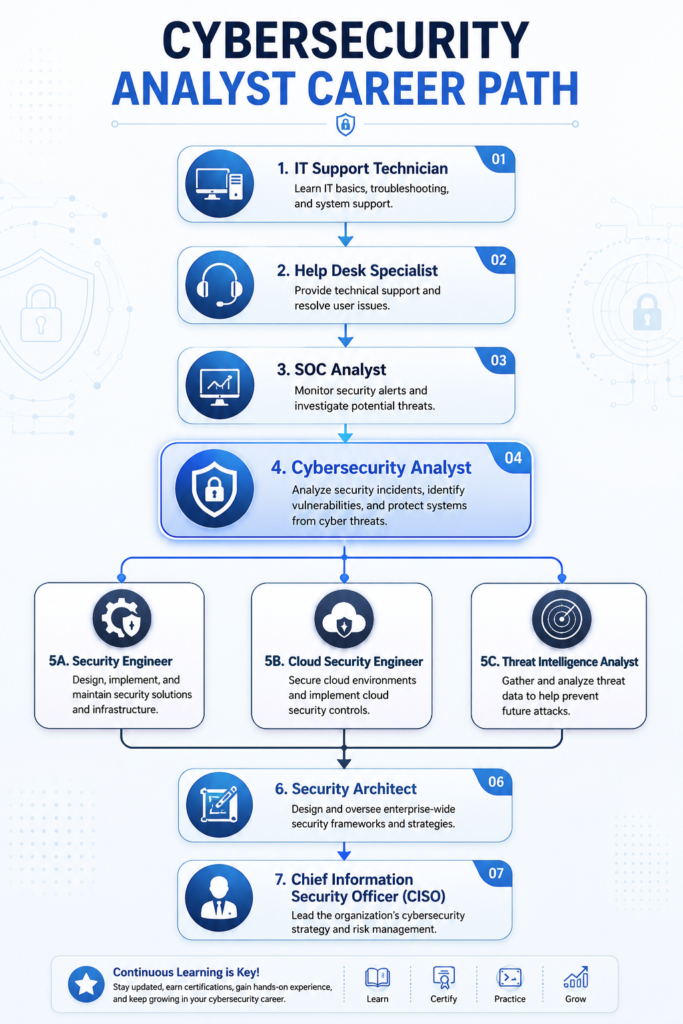
A common question people ask is, “How to get a job in cybersecurity.” The thing is, you can get in with many different educational backgrounds.
In fact, it has been witnessed that many top cybersecurity analysts were in IT, or networking, or even came from very unrelated careers at all.
Following a good training schedule can definitely fast-track you into cybersecurity.
1. Lay Down a Good IT Background
You should first get to know the fundamentals of how computers, operating systems, and networks function.
You should make yourself familiar with:
- Computer hardware
- Windows and Linux
- Networking basics
- TCP/IP
- DNS
- Firewalls
- Virtual machines
A solid understanding of these topics makes cybersecurity learning a breeze. If you prefer self-study, reading some of the best books to learn cybersecurity or it security can help you master these networking and security concepts at your own pace.
2. Learn About Cybersecurity
Once you get the basics of IT, it is time to dive into the fundamentals of the cybersecurity world itself.
Such critical areas cover:
- Network security
- Endpoint security
- Identity and access management
- Vulnerability management
- Security monitoring
- Incident response
- Cryptography
- Cloud security
- Risk management
Getting up to speed on these fundamentals makes it possible to secure an entry-level cybersecurity role.
3. Practice With Hands-On Labs
Are you a sys-admin or an IT technician who wants to make the leap into the cybersecurity field? You have many more skills than you think, which are already applicable to a wide variety of cybersecurity roles. In fact, skills like understanding computer system operations, being able to troubleshoot issues, and managing computer networks are some that most IT professionals are familiar with.
A great way to find a new cybersecurity role is to go through job advertisements and identify which jobs you qualify for based on your background and skills.
4. Go Through Hands-on Training, Certifications, or Online Courses
Cybersecurity is a practical field. So employers are looking for candidates who would not only know but are also capable of handling different real-life situations, like hacking or phishing attempts, etc.
While many choose self-study, others prefer structured academic routes. You can explore the best colleges for cybersecurity if you are considering earning a formal degree to jumpstart your career.
The most effective way to learn is through doing – that is the whole point of having a lab. You can practice by:
- Building your own test lab at home
- Playing CTF (Capture the Flag) style games
- Using Virtual Machines
- Trying out intentionally buggy or vulnerable applications
5. Get an Industry Recognized Cybersecurity Certification
Certifications are proof of your knowledge and are great assets to a CV as they give employers confidence that you are familiar and/or skilled in areas relevant to their requirements. The most popular and beginner-friendly certifications among those mentioned are these:
- CompTIA Security+ Google Cybersecurity Certificate
- Computer Security Examination (Certified in Cybersecurity)
- Microsoft Security Certifications
Once you’ve established yourself in your career with the right job, you can choose to go for one of the more advanced certifications, which are usually focused on specific areas of work.
| Certification | Best For |
|---|---|
| CompTIA Security+ | Beginners starting a cybersecurity career |
| ISC2 Certified in Cybersecurity (CC) | Entry-level professionals |
| CompTIA CySA+ | Intermediate cybersecurity analysts |
| Certified Ethical Hacker (CEH) | Learning offensive security concepts |
| GIAC Security Essentials (GSEC) | Security professionals seeking advanced skills |
| Microsoft Certified: Security, Compliance, and Identity Fundamentals | Microsoft security environments |
5. Build a Portfolio
A portfolio helps employers understand what you can do beyond your resume.
Include projects such as:
- Home lab documentation
- Security monitoring exercises
- Incident response reports
- Vulnerability assessments
- Security awareness presentations
- Network analysis projects
Even small projects demonstrate practical skills and initiative.
Career Prospects for Cybersecurity Analysts
The need for cybersecurity analysts is rapidly increasing as organizations are hit by increasingly advanced cyber attacks. Whether a company is big or small, they really need professionals who have sufficient know-how in detecting cyberattacks, preventing data compromise or loss, and improving their security profile altogether.
The markets that require cybersecurity most are:
- Financial Services
- Healthcare
- Government
- Cloud Computing
- Technology
- E-commerce
- Manufacturing
- Education
With businesses turning to cloud technologies, AI solutions, and allowing employees to work remotely, cybersecurity analysts have become the topmost desired technology experts. If you are ready to start applying, take a look at our list of the most common entry-level cybersecurity jobs that don’t require years of prior experience.
Frequently Asked Questions
Is being a cybersecurity analyst a good career?
Yes. Cybersecurity analysts enjoy strong job demand, competitive salaries, continuous learning opportunities, and career growth across many industries.
What tools do cybersecurity analysts use?
Cybersecurity analysts commonly use SIEM platforms, endpoint detection tools, vulnerability scanners, network analyzers, and security monitoring solutions such as Splunk, Microsoft Sentinel, Wireshark, Nessus, and Nmap.
Can I become a cybersecurity analyst without a degree?
Yes. Many professionals enter cybersecurity through certifications, self-study, hands-on labs, and practical projects. Employers increasingly value demonstrated skills alongside formal education.
Final Thoughts
Cybersecurity analysts are important in safeguarding organizations against evolving cyber threats. Their job goes beyond checking security alerts. They actively monitor security systems, detect suspicious activities, investigate breaches, handle incidents, and enhance security measures. These actions ensure that businesses can function securely in a world dominated by digital technology.
If that made you want to look into what a cybersecurity analyst actually does, let us tell you! It’s not just monitoring alarms. They uncover possible vulnerabilities to the company, secure confidential data, streamline security procedures, and support organizations to continue functioning despite the rising threat of cyberattacks.
You may be thinking, “How do I enter cybersecurity?” or contemplating the next step of your career. Acquiring some basic knowledge of network technologies, system operations, security concepts, plus having some hands-on experience can really benefit you for a career in cybersecurity. Since technology won’t stop updating, there will always be a strong demand for knowledgeable cybersecurity analysts. So, if anyone is considering the field as a career option, it is one to count on because it is among the top choices for someone interested in information security.
Ready to start your cybersecurity journey? Now that you know what a cybersecurity analyst does, the next step is learning how to break into the field. If you’re wondering how to get into cybersecurity, explore our beginner’s roadmap to learn the skills, certifications, and hands-on experience employers look for.