Table of Contents
A hospital does not have to lose money for cybercrime to cause serious harm. It could lose its ability to serve patients safely and on time. Why is cybersecurity important in healthcare? Because modern hospitals, clinics, insurers, and health tech companies depend on connected systems that store sensitive patient information and support critical care.
In 2024 alone, healthcare organizations in the United States reported 739 data breaches affecting more than 276 million patient records. These risks show why cybersecurity in healthcare is not simply an IT concern. It is an essential part of protecting patient data, medical systems, and the continuity of care.
This guide explains why healthcare cybersecurity matters, the major threats healthcare organizations face, and practical steps they can take to strengthen their security in 2026.
What Is Healthcare Cybersecurity?
Healthcare cybersecurity refers to the measures taken to protect patient data and medical devices from theft and unauthorized access that could leave them vulnerable to manipulation by those with malicious intent.
This includes but is not limited to:
- Securing electronic health records and patient portals that house information such as diagnosis, treatment, and billing
- Protecting connected medical devices that have gained more adoption in the healthcare space despite the risks they introduce
- Securing billing records and insurance and monitoring systems that are used as tools to help facilitate a patient’s stay
- Monitoring and ensuring that third-party vendors that work with the hospital, such as billing companies, have appropriate and sufficient security controls that are monitored
- Ensuring staff is trained in recognizing phishing and social engineering attempts that may seek to extract sensitive information or give them access to the healthcare network by masquerading as another employee, an administrator, or a vendor.
Unlike a credit card number, medical information such as diagnoses, prescriptions, and treatment histories cannot simply be canceled and replaced after a breach. And unlike a credit card, if it is stolen, it is possible to cancel it and report it as fraud to the issuer.
Why Is Cybersecurity Important in Healthcare?
Healthcare cybersecurity practices and procedures contribute to the security of a hospital and the safety and confidence of its patients by:
1. Ensuring patient safety is directly at risk
When a hospital is hit by ransomware, staff are locked out of patient records, potentially disrupting their care, causing ambulances to be rerouted, and surgeries to be postponed. According to industry reports of ransomware impacts on healthcare organizations, nearly 30% of healthcare organizations that experienced a ransomware attack or data breach reported an increase in patient mortality as a direct result.
2. Medical devices are increasingly vulnerable
The Internet of Medical Things (IoMT) has introduced connected medical devices that are vulnerable to tampering, with the potential to cause physical harm to patients if a threat actor were to take advantage of them.
Industry reports from 2026 show that 99% of hospitals deal with at least one vulnerable medical device with known security vulnerabilities that could be exploited
3. Attacks often remain undetected for months
Giving threat actors ample opportunity to extract, manipulate, or exfiltrate data or leverage the network to pivot to other systems and stay undetected for significant periods of time
According to breach reports in 2024, the average detection and containment time for a healthcare data breach is 241 days, meaning attackers had 8 months’ access to systems.
4. The financial damage is severe and ongoing
Beyond the average $7.42 million breach cost, hospitals face regulatory fines, lawsuits, canceled insurance contracts, and reputational damage that can take years to repair. The 2024 Change Healthcare ransomware attack alone affected close to 193 million individuals and cost its parent company more than $2 billion in direct and indirect costs that come with a ransomware attack or data breach.
5. Patient trust depends on it
Patients trust healthcare providers to keep private information private, and a breach impacts such trust for extended periods of time and can impact patient behavior for patients. Patients are more likely to switch providers or avoid telemedicine in fear of exposure of private information after a breach.
Healthcare Cyber Security Stats that Matter
| Metric | Figure | Source Context |
| Healthcare breaches reported in 2024 | 739 breaches, 276+ million records exposed | Largest on record for the sector |
| Average cost per healthcare data breach | $7.42 million | Highest of any industry, 14th year running |
| Hospitals with at least one vulnerable connected device | 99% | Based on 2026 medical device security analysis |
| Average time to detect and contain a breach | 241 days | Roughly eight months of undetected access |
| Organizations hit by ransomware | 67% | Healthcare accounts for 17% of all ransomware attacks industry-wide |
| Stolen patient data originating from third-party vendors | Over 80% | Supply chain, not hospitals, is the leading entry point |
| Organizations reporting increased patient mortality after an attack | 29% | Direct link between cyber incidents and patient harm |
When reviewing cybersecurity numbers, it is easy for some to overlook that the attack surface for a hospital or clinic network could very well be with a vendor, and in a connected device or a staff member that may not be up-to-date on the latest cyber threats.
Common Cyber Threats Facing Healthcare Organizations
In order to prepare appropriately healthcare organizations need to understand and assess their threat landscape.
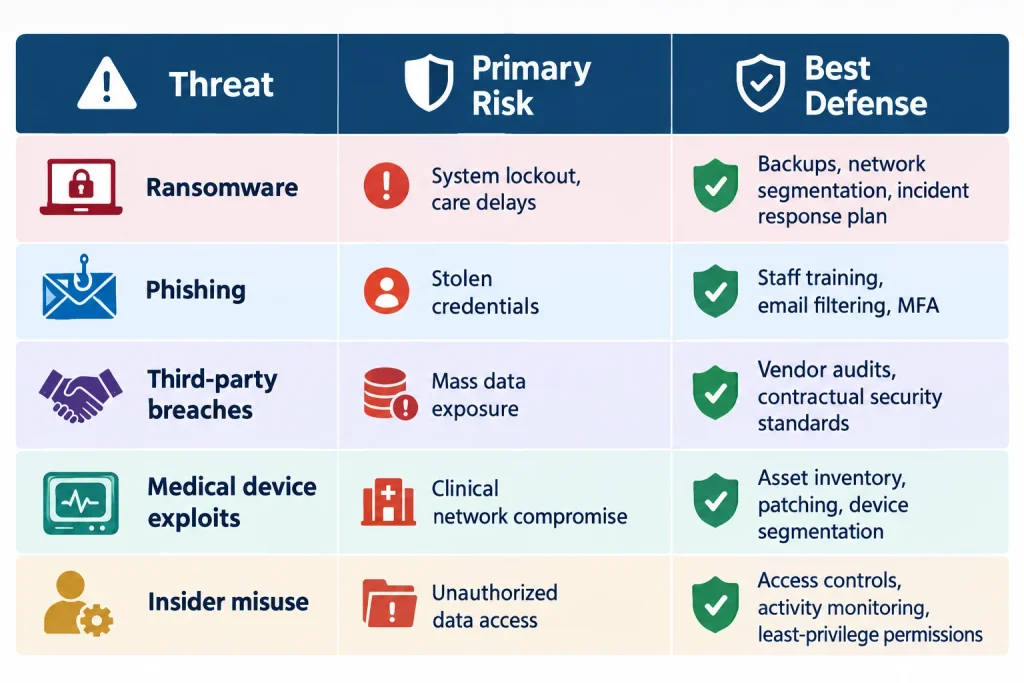
Ransomware: Encrypted computer systems, locked out of patient records. Healthcare-specific because of the high-pressure environment and high financial cost of being locked out of systems, making healthcare organizations attractive targets.
Phishing and Social Engineering: Attempts to trick staff members into disclosing their login credentials or clicking on a malicious link delivered through an email or phone call.
Medical Device Exploitation: Connected devices are a rich attack surface and a growing concern in healthcare IT security. Exploitation occurs when an attacker uses a vulnerability in a device to gain unauthorized access to the hospital or clinic network.
Third-Party Vendors: Healthcare data breaches have historically occurred due to security vulnerabilities found in third-party vendors. In most cases, a breach is the result of an attacker compromising an organization in order to gain access to a healthcare organization’s systems.
Spying: Some threat actors have begun targeting biotech and pharmaceutical organizations to steal the information needed to create new medications, and they may target hospitals and insurers in order to extract information regarding the treatment of specific diseases.
How to Improve Cybersecurity in Healthcare
Enhancing healthcare cybersecurity can be accomplished without huge budget overhauls. The best starting point is a risk assessment that can highlight the area(s) of highest risk to the organization.
Build a real asset inventory
Organizations need to have an accurate and up-to-date list of all devices and systems connected to the hospital network, including connected medical devices.
Build a real asset inventory
Passwords on their own are no longer deemed secure. Multi-Factor Authentication (MFA), which requires both a password and a second form of verification, is quickly becoming the norm and is the focus of several proposed changes to the HIPAA Security Rule.
Vet third-party vendors carefully
Since the majority of healthcare data breaches originate from third-party vendors and not an organization’s own network, it is essential to enforce the same level of security controls and monitoring on vendors.
Segment hospital networks
Segregating the network allows for limiting the spread of a threat within the network if it were to persist despite isolation methods.
Train staff continuously, not once a year
Phishing simulations are a great way to not only identify individuals who are susceptible to phishing but also raise overall awareness. Staff training does not have to occur annually but can be a refresher on certain topics such as phishing awareness as well as general network security.
Encrypt data at rest and in transit
Encryption adds an additional layer of security to data both on storage and in transit, ensuring that if information were to fall into the wrong hands, it would not be readable or usable.
Patch and update medical devices on a schedule
While device-specific and reliant on manufacturer support, patching medical devices on a regular interval or schedule is essential in minimizing risk and exposure. Devices that cannot be patched in a timely manner should be placed on a secured network segment and monitored regularly for any potential suspicious activity.
Prepare an incident response plan before you need one
Having a documented and well-rehearsed incident response plan can significantly reduce the financial and operational impact of a ransomware attack or data breach. The quicker an organization can respond, contain, and mitigate an incident, the quicker a business can recover and return to normal operations. Organizations that do not have a plan can lose critical hours debating who is responsible and who should do what.
You can learn how to implement cybersecurity strategy for businesses there!
Quick Reference: Threats and Defenses
What This Means for Patients
Patients can play an important role in hospital cybersecurity as the first line of defense. Using unique passwords for each patient portal account, ensuring Multi-Factor Authentication (if available), or avoiding providing personal information after receiving a suspicious email or text could prevent an incident. In addition, in the event a patient’s information is part of a breach, their response to the incident could be crucial. Most patients will be contacted by a healthcare provider in the event one of their records is exposed, and credit monitoring may be provided. Taking action, such as placing a credit freeze, will ensure patient information is not misused.
Frequently Asked Questions
Is telehealth less secure than in-person care?
Not inherently. Reputable telehealth platforms use encrypted video and data transmission that meets the same regulatory standards as other healthcare systems. The bigger risk usually comes from patients using unsecured public Wi-Fi during a telehealth visit rather than the platform itself.
Why do small clinics get targeted as often as large hospital systems?
Smaller practices often have fewer dedicated IT security staff and smaller cybersecurity budgets, making them easier targets even though the payout per attack is usually lower. Breaches affecting fewer than 5,000 records make up over half of all reported healthcare incidents.
Does upgrading to newer medical devices automatically fix security problems?
No. Newer devices can still be vulnerable if they are not configured correctly, connected to an unsegmented network, or left with default login credentials. Security depends more on how a device is deployed and monitored than on how new it is.
Can artificial intelligence tools used in diagnostics create new cybersecurity risks?
Yes. AI-powered diagnostic and clinical decision tools often pull data from multiple connected systems, which expands the number of potential entry points. They also introduce a newer risk category: manipulated or poisoned training data that could affect clinical recommendations if not properly secured.
What should a patient do if they receive a data breach notification letter from their provider?
Read it carefully to see exactly what information was exposed, whether it was financial, medical, or both. Enroll in any free credit monitoring offered, set up a fraud alert with credit bureaus if Social Security numbers were involved, and watch insurance statements for unfamiliar medical charges, which can indicate medical identity theft.
Final Thought
Health care cybersecurity is an ongoing process that requires continuous attention. Hospitals see new devices, vendors, and threats arise every year, and those that recover the fastest from an incident are those that have invested the most in preparation: specifically, understanding what assets they have in their network, forcing multifactor authentication, conducting regular staff training, and developing response playbooks.
Cybersecurity is not an alternative to high-quality medical care; it is a part of it. A hospital’s core mission is to improve patients’ health, and in 2026, the way to achieve it is by protecting electronic health records and information systems. The organizations that will be trusted to serve their communities are those that treat cybersecurity as a part of patient care, not an IT responsibility.