
Table of Contents
Every rule of thumb or prescriptive control you know in security, from requiring strong passwords to implementing firewalls and encrypting data, ultimately connects back to a single concept: the CIA triad.
Whether you’re prepping for a certification exam, diving into a career, or just curious about why your company’s IT team spends so much time securing databases, this guide will help you learn the fundamentals of what the CIA triad is and how it serves as the foundation for other key concepts like AAA, hashing, least privilege, and defense in depth.
What Is CIA in Cybersecurity?
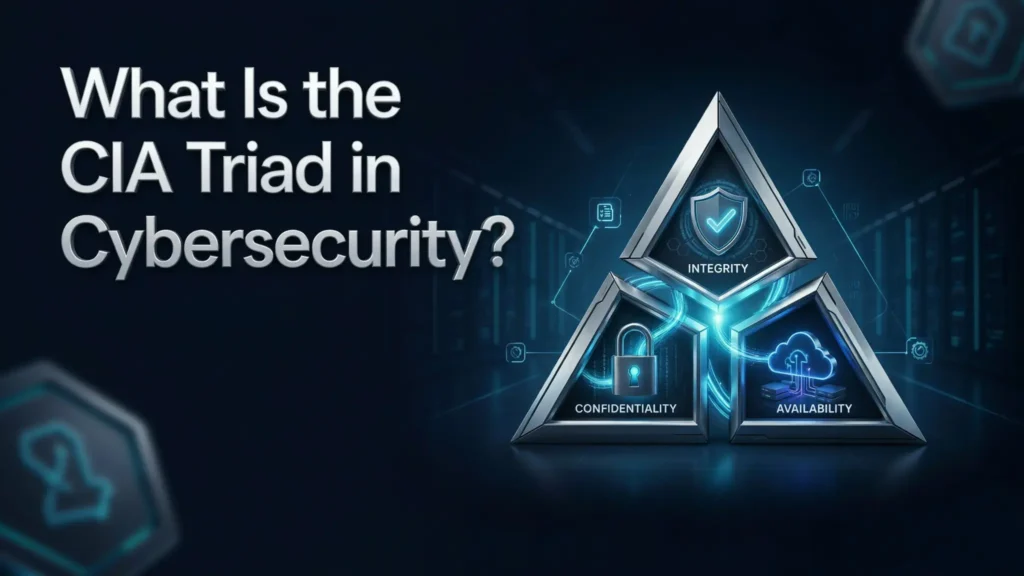
CIA stands for confidentiality, integrity, and availability. These three principles guide many aspects of cybersecurity but have no official standing themselves. They were developed as a conceptual model to help security practitioners understand what types of controls to implement and what a successful security program should accomplish. You’ll often see these principles abbreviated as the CIA triad, with the “triad” referring to the three pillars.
What Is the CIA Triad in Cybersecurity?
The CIA triad is a security model with three foundational principles:
- Confidentiality – restrict information and resources to only those who are authorized to access them
- Integrity – keep information and resources accurate and trustworthy
- Availability – ensure information and resources are accessible when needed
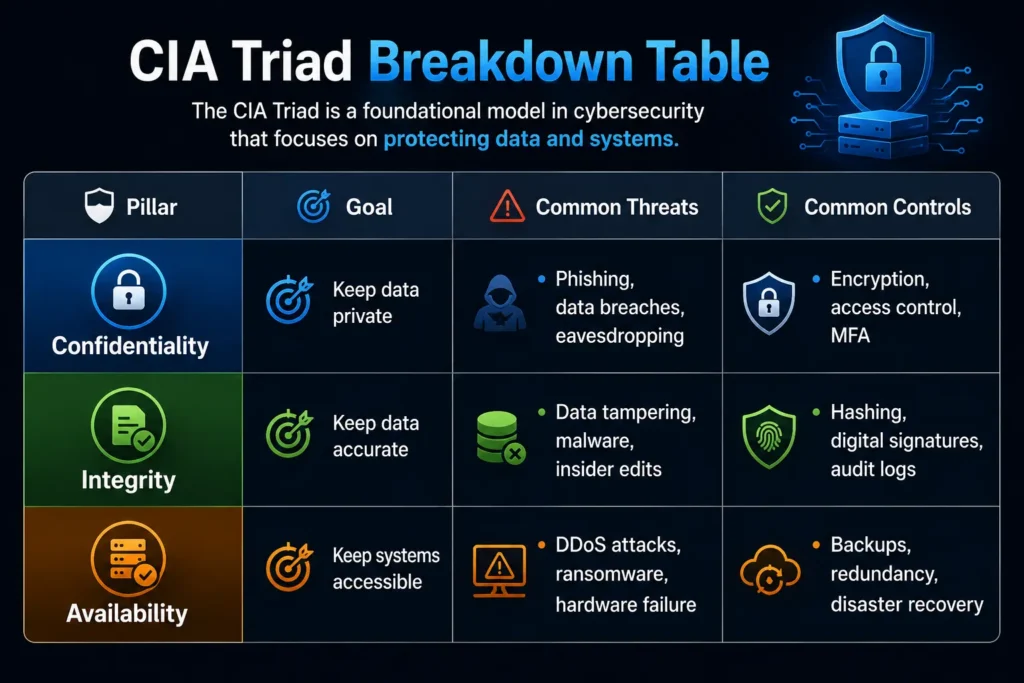
When designing a security policy, asking yourself how a particular control affects each of the pillars helps you determine what to prioritize. When a security incident occurs, you can also analyze what principles were compromised to understand what security controls failed. For example, a data breach impacts confidentiality, whereas ransomware encrypting your data affects its availability.
Why Are the Pillars of the CIA Triad Important?
Having a shared reference point helps security professionals avoid getting caught up in debates about what to prioritize first. By acknowledging the relative value of each principle, organizations can make realistic decisions during implementation and operations. For example, a hospital’s electronic health records must support confidentiality and integrity, whereas a trading platform requires a much higher degree of availability. And while a bank’s ledger needs strict integrity controls, few would argue that confidentiality is more important than availability for this system
Confidentiality – Keeping Secrets Secret
What Is Confidentiality in Cybersecurity?
In cybersecurity, confidentiality means ensuring that information is accessible only to authorized parties. In other words, confidentiality lets you define who can see a specific piece of information or work on a particular resource. The most common way to protect information is to encrypt it. Still, you can also prevent access by granting only specific individuals or groups permission to view a database or file.
Confidentiality is the basis for many other security controls, including access control policies, data classification, and various forms of identification. A breach of confidentiality generally results in private data being exposed or accessed by unauthorized individuals.
Examples of Confidentiality Failures
A confidentiality breach occurs when private information becomes accessible to unauthorized individuals. This scenario can involve both external and internal threats, including phishing attacks that compromise a workstation controlled by an employee. A confidentiality violation may also happen unintentionally, for example, if an employee accidentally sends a file with personal information to an unintended recipient.
Integrity – Keeping Things Accurate
What Is Integrity in Cybersecurity?
Integrity is about maintaining data’s accuracy and ensuring it is free from unauthorized modifications. Similarly, integrity in cybersecurity means ensuring resources and information remain accurate and trustworthy. Unlike confidentiality, which dictates who has access to information, integrity focuses on what can change, who can change it, and what safeguards need to be in place to prevent unauthorized or accidental modifications.
For example, a hacker may not be interested in stealing your data but rather in changing it. Imagine that a malicious insider modifies a single digit in a financial transaction, effectively stealing $50 to $000. An attack like this impacts the data’s integrity, and the consequences are potentially devastating.
Examples of Integrity Failures
- Integrity violations result from unauthorized modifications and can take many forms, ranging from human errors to malicious attacks. One example is a successful phishing attack that tricks an employee into modifying a financial transfer request.
- Data tampering can also occur during transfer, for instance, if an attacker intercepts information and alters it before transmitting it to the receiver.
- Unauthorized changes can also occur on purpose, for example, if an outsider tampers with a government or enterprise database.
Integrity is frequently linked to hashing, digital signatures, and various forms of file validation that help detect unauthorized changes.
Checksums, file hashes, and similar controls are critical in ensuring that transferred or stored data has not been altered and is trustworthy.
Availability – Keeping Things Accessible
What Is Availability in Cybersecurity?
Availability encompasses ensuring that information and resources are accessible when authorized users need them. Systems with inadequate availability controls can suffer outages, making their resources unavailable to legitimate users. This state can occur deliberately when attackers launch a distributed denial-of-service (DDoS) attack or when a natural disaster causes an extended power outage. Even ransomware disrupting regular business operations qualifies as an availability incident.
Although it is a broad term, availability security practitioners are typically concerned with designing and deploying systems that minimize downtime while ensuring continuous access to data and resources.
Examples of Availability Violations
- Various incidents can lead to a loss of availability, including natural disasters, equipment failures, and malicious attacks. DDoS flooding targets servers with traffic to overwhelm them and render them inaccessible to legitimate users.
- Ransomware attacks stop organizations from accessing their data, which is a form of resource disruption. Power outages can also contribute to the loss of availability, for example, if a disaster causes a prolonged region-wide power blackout.
- Most organizations employ some form of data replication and offsite data backups to protect against the loss of availability. These resources help systems resume regular operations following an outage, which is also known as disaster recovery.
CIA Triad, Violations, and Controls
How AAA Cybersecurity Principles Relate to the CIA Triad
What Is AAA in Cybersecurity?
AAA stands for authentication, authorization, and accounting, with these three components forming the basis for many computer security controls. While the CIA triad focuses on data and resources, security, and AAA principles concern themselves mainly with users. Authentication determines whether a user is who they claim to be, while authorization defines what actions they are permitted to take. Finally, accounting monitors and records their activity.
AAA security principles relate to confidentiality because authentication plays a crucial role in enforcing access control policies. Similarly, authorization is a key element of establishing integrity checks, and accounting often provides valuable data for auditing and other activities related to integrity. The principles of AAA do not explicitly mention availability, but they indirectly contribute to achieving it.
What Does Non-Repudiation Mean in Cybersecurity?
Non-repudiation in cybersecurity is a concept that prevents individuals from denying something, typically sending or receiving data or making changes to information. This principle is often linked to integrity since it prevents a user from repudiating actions they performed. Similarly, non-repudiation is closely related to accounting since audit logs are an essential tool for tracking users’ activities.
What Is Hashing in Cybersecurity?
Hashing uses an algorithm to transform data into a unique string of characters. The output, often referred to as a hash or digest, is substantially different from the input, although the hashing function always produces the same value given the same input data. The primary role of hashing in cybersecurity is to ensure data integrity by detecting unauthorized changes.
The most common applications of hashing concern verifying that files or data have not been modified, which is particularly useful when downloading content from the internet. Hashing also plays a vital role in digital signatures, which are used to demonstrate that specific data originates from a specific person or software.
What Is Least Privilege in Cybersecurity?
The principle of least privilege states that entities, including users and applications, should only be granted the permissions necessary to perform their tasks. If a particular employee needs access to a specific database, they should not have authorization to alter any data or access other parts of the system. The same principle applies to programs, meaning they should only have access to the resources they need to function correctly.
By restricting permissions and ensuring that users and applications only have access to the data they need, organizations reduce the risk of breaches and unauthorized data modifications. The principle of least privilege is particularly helpful in minimizing the impact of breaches and vulnerabilities, especially when attackers compromise accounts or applications with limited privileges.
What Is Defense in Depth in Cybersecurity?
Defense in depth is a concept that suggests organizations should implement multiple security measures to reduce the risk that a single security control failure will cause a breach. By distributing protective measures across different areas and focusing on several aspects of security, you can ensure that the failure of any individual component will not lead to a larger incident.
The concept of defense in depth typically involves several security measures at different levels, such as technical controls, administrative procedures, and physical security measures. An example of defense in depth is a strategy that combines firewalls and intrusion detection systems with strong access control policies and regular employee training.
Related Security Concepts Summary Table
| Concept | What It Protects | How It Relates to CIA |
| AAA (Authentication, Authorization, Accounting) | Identity and access | Supports confidentiality and integrity by controlling and tracking access |
| Non-repudiation | Proof of action | Reinforces integrity by preventing denial of actions |
| Hashing | Data accuracy | Directly supports integrity by detecting tampering |
| Least privilege | Access scope | Supports confidentiality and integrity by limiting exposure |
| Defense in depth | Overall system resilience | Supports all three CIA pillars through layered controls |
Example Scenario: Bringing the CIA Triad Together
Consider an online store that processes customer payments over the internet and hosts its database in a cloud environment. The store’s databases encrypt customer credit card information, ensuring confidentiality. The company uses hashing to guarantee that the order details stored in the database are not altered, protecting integrity.
Additionally, the site is hosted on multiple servers at different geographic locations, which ensures that the site remains accessible even if some servers become unavailable due to maintenance or a natural disaster, supporting availability.
When a customer accesses the site, multifactor authentication confirms their identity, supporting confidentiality by ensuring only authorized users can view the online store.
Authorization allows them to access only the site’s publicly available area, enforcing the principle of least privilege. Every action they perform within the online store is tracked, supporting auditing, accountability, and non-repudiation. Meanwhile, firewalls, intrusion detection systems, and employee security awareness training provide defense in depth.
The above example demonstrates how the principles of the CIA triad and related concepts come together to form the basis of the online store’s information security program.
People Also Ask
Is availability the overlooked component of the CIA triad?
More often than not, teams focus resources on ensuring confidentiality and integrity, only to find themselves spending a fortune trying to recover from an outage. One reason behind this problem is that many organizations do not invest in high availability infrastructure and design their systems with the assumption that downtime is rare.
Can a system or asset have a strong level of confidentiality while having weak integrity?
It is entirely possible for a system or asset to have strong confidentiality controls while failing to protect its integrity. For instance, a database with end-to-end encryption can store sensitive information securely, but weak hashing mechanisms can allow unauthorized modifications to that information.
What Is the CIA triad vs. the Parkland Hexad?
The Parkland Hexad is a security model that shares some similarities with the CIA triad but focuses on six areas of information security rather than three. The hexad is an evolution of the triad, incorporating possession/control, confidentiality, integrity, availability, authenticity, and utility. The main difference between the two concepts is that the hexad recognizes the importance of ownership and authenticity, which the triad does not explicitly address.
Does every aspect of information security serve all aspects of the CIA triad?
Every security control typically serves one area of the triad, and few, if any, contribute to all three. As such, when a security team chooses which controls to implement, it has to assess which aspects of the triad they want to address. For example, antivirus software primarily serves to protect the integrity of information, while data encryption mainly serves confidentiality. Most security programs, however, are designed around addressing all three areas, even if individual controls serve only one or two.
Why do certifications and courses emphasize the CIA triad so intensely?
Certifications and courses make the CIA triad a focal point because most security topics relate to it somehow. For example, questions about networking and data transmission are primarily concerned with maintaining data integrity. Decisions about what cryptographic controls to employ are based on the level of confidentiality a system needs. And many certification tests ask candidates to evaluate which pillar of the triad is being addressed by a proposed control.
Can there be a conflict between the need for confidentiality and the need for availability?
Confidentiality and availability can conflict with each other under specific circumstances, such as when an unauthorized individual deliberately denies access to information. This conflict can occur even within an organization if an employee attempts to prevent others from accessing resources. The simplest example of a conflict between the two is when a government official needs to restrict access to specific information for national security reasons, which may reduce the information’s overall availability.
Final Thoughts!
Ultimately we have learned that what is the CIA triad in cybersecurity. The CIA triad offers a simple yet powerful framework for addressing security issues without getting bogged down in countless technical details. By understanding the triad, you can evaluate how different security controls contribute to your organization’s security objectives. And while the triad may seem like a set of abstract terms that have little to do with everyday IT operations, it serves as the theoretical basis for many of the procedures and operations conducted by security teams.
By focusing on confidentiality, integrity, and availability, security teams can ensure that an organization’s information assets are properly protected, not compromised, and available to authorized users whenever they are needed.