
If you’ve ever asked a security vendor “so what should we actually do first,” you’ve probably heard the word framework tossed out at you. It’s not that a framework is simply a set of paperwork, but rather it defines a certain building code for your digital world, establishing what your IT team, auditors, and board members should consider “secure enough.”
This article covers what a cybersecurity framework is, the purpose of the NIST Cybersecurity Framework, how CIS controls relate to it, what’s GRC, and what’s new with cybersecurity mesh architecture in 2026!
What Is a Cybersecurity Framework?
A cybersecurity framework is a set of guidelines, standards, and controls that allow an organization to identify risks, implement proper safeguards, and demonstrate the effectiveness of its cybersecurity measures. In other words, it’s a cheat sheet that tells you what to protect, how to protect, and how to show that you’ve done both.
Frameworks are necessary because telling your C-suite that you want to “be secure” is too vague. Without a framework, it’s hard to tell the regulator, your customers, or even your own security team if you’re “secure enough” or not. A framework provides a common language and reference point, which becomes critically important if you operate in a heavily regulated industry or work with other companies that use frameworks.
Here is what are cybersecurity frameworks share some common features:
- Four foundational categories of risk (typically, this includes data, identities, networks, and third-party vendors)
- List of controls, safeguards, or security measures needed to address each category of risk
- Different maturity levels or tiers to show your progress
- List of procedures and reporting standards that allow you to demonstrate your progress
Frameworks are usually voluntary, and are often used as a reference when developing standards, regulations, and contractual obligations. However, because many regulators now explicitly ask to see evidence of framework compliance, a lot of companies find themselves having to adopt frameworks anyway.
Why Are Cybersecurity Frameworks Important in 2026?
There are several reasons why frameworks are suddenly such a big deal; First, there is a regulatory tailwind – insurance, government contracts, and data privacy laws are pushing companies to demonstrate framework compliance.
Moreover, there are more threats than ever, including complex attacks that involve nation-states and third-party supply chains. Modern frameworks address these challenges by encouraging organizations to go beyond securing their own data and networks and pay more attention to their third-party exposure.
Furthermore, artificial intelligence and machine learning are enabling attackers and defenders to innovate at an unprecedented pace, making it more important than ever to move from periodic protection assessments to continuous monitoring and governance.
NIST Cybersecurity Framework: Purpose and Structure
The cybersecurity framework published by NIST was originally developed in response to Executive Order 13636, which was issued in 2013 and called for “the development of a voluntary cybersecurity framework.” The framework was formally published in 2014, and updated for the first time in 2024.
NIST’s framework aims to provide a common language that can be used by any organization – public or private, large or small, domestic or international – to understand their cybersecurity posture, set appropriate goals, identify gaps, determine what needs to be done to meet goals, and demonstrate progress to internal and external stakeholders. In other words, NIST CSF gives you a reference point to understand and explain your existing security measures as well as the path to achieve a certain level of cybersecurity maturity.
What Changed With NIST CSF 2.0
The framework’s original version (CSF 1.1) consisted of only 5 functions, but CSF 2.0 that was released in late 2024 added a 6 th function called Govern. It also amended several definitions and provided more detailed guidance for each category. Most importantly, NIST CSF 2.0 was designed to be applicable to all types of organizations, not just critical infrastructure.
While the 2.0 version provides more guidance, it’s critical to note that references to “the 5 NIST CSF categories” refer to the original version (1.1). This is an important distinction to make since, as of 2026, version 2.0 is already in effect and has replaced version 1.1.
CSF 2.0 thus consists of 6 functions, 22 categories, and 106 subcategories. The core functions performed by the framework are as follows:
| Function | What It Covers | Example Activity |
| Govern (GV) | Strategy, policy, and oversight for the whole program | Defining risk tolerance and assigning accountability |
| Identify (ID) | Understanding assets, data, and risk exposure | Building an inventory of systems and vendors |
| Protect (PR) | Safeguards that limit or contain an incident | Access control, encryption, staff training |
| Detect (DE) | Finding security events as they happen | Log monitoring, anomaly detection |
| Respond (RS) | Acting on a confirmed incident | Containment, communication, forensics |
| Recover (RC) | Restoring normal operations | Backup restoration, post-incident review |
The Govern function was not present in CSF 1.0; it was added in CSF 2.0 to provide a high-level organizational structure that allows for proactive rather than just reactive cybersecurity outcomes. In other words, leadership oversight, reporting to the board, and supply chain risk management are now central pillars of the framework.
How to Use the NIST Cybersecurity Framework
The NIST CSF does not have a beginning or an end – it is applied iteratively. This is how the process of using CSF for an organization that has never used it looks like in terms of a practical schedule:
- Determine the current profile: understand which of the six functions the business is currently performing based on its cybersecurity activities.
- Determine the target profile: define the desired CSF outcomes for each function based on the organization’s risk tolerance, sector, and regulatory requirements.
- Perform a gap analysis: compare the current and target profiles and prioritize the CSF gaps using business impact rather than solution ease.
- Determine the implementation tier: place the organization on an ordinal scale of four cybersecurity risk management levels (Partial, Low, Medium, Adaptive) according to the rigor of its Govern function and risk management in other functions.
- Create an action plan with responsible owners and implementation dates for each of the identified subcategory gaps.
- Review this plan at least once a year to check progress and response to time-sensitive factors affecting the CSF implementation.
The most common mistake is to consider the CSF implementation as a one-time assessment. As stated explicitly in the CSF Reference Document, the CSF is applied iteratively throughout the continuous cycle of improvement. In particular, the frequency of the reviews should depend on the rate at
which the business environment changes for the reviewed entity: quarterly for cloud operations and annually for tier reviews.
How to use the NIST Cybersecurity Framework in practice
There are three main ways to apply the CSF once it has been implemented:
- Ask vendors about the CSF functions and tiers they apply when choosing third-party providers.
- Report to the C-suite: the high-level overview of CSF implementation is critical for the boards to understand the maturity of their cybersecurity posture.
- After responding to an incident: detecting what controls allowed the breach to occur (in terms of CSF Detect function) or what response actions failed (Respond) is essential for improving the organization’s resilience in the future.
What Is CIS in Cybersecurity
CIS, which stands for the Center for Internet Security, is a nonprofit organization that provides the CIS Critical Security Controls, which are prioritized, activity-focused, and based on real-world attack data. The controls are developed from the MITRE ATT&CK and Verizon Data Breach Investigations reports, making them among the most practical and evidence-based cybersecurity frameworks available.
The latest version of the CIS Controls, v8.1, was released in 2024. It follows the activity-centric approach, which prioritizes securing activities rather than devices as in the previous version. CIS Controls v8.1 contains 18 controls and 153 total safeguards. They are organized into three Implementation Groups (IGs) based on an organization’s risk management strategy and implementation capabilities.
Implementation Groups are probably the most interesting part of the report for most people because they tell you where to start. The three groups represent different levels of cybersecurity maturity, which means that each organization should choose the one that best reflects its needs and capabilities.
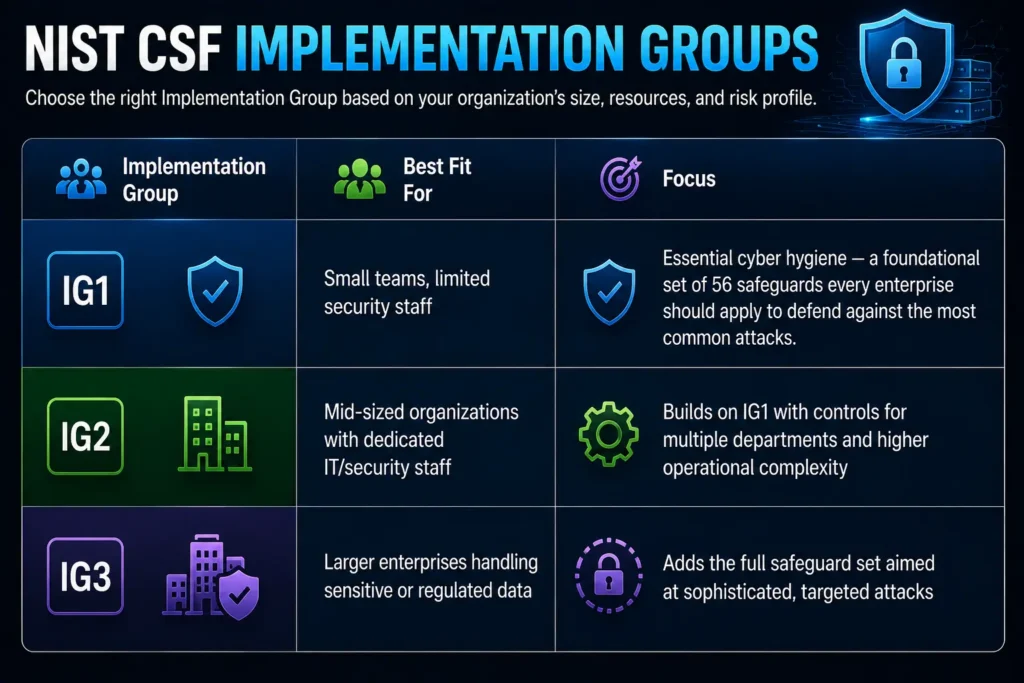
CIS Controls and NIST CSF Are CIS Controls and NIST CSF mutually exclusive, or can they be used together? CIS Controls v8.1 is fully aligned with NIST CSF 2.0, HIPAA, PCI DSS, SOC 2, CMMC, and ISO 27001 standards. This means that a company can use NIST CSF as a control framework while using CIS Controls to implement the actual controls.
Moreover, CIS Controls are a set of best practices for securing an enterprise, while CIS Benchmarks are configuration guidelines for hardening operating systems, middleware, applications, and network infrastructure.
What Is GRC in Cybersecurity?
GRC stands for Governance, Risk, and Compliance. It refers to the discipline that aligns governance, risk management, and compliance efforts to make sure that an enterprise’s cybersecurity strategy supports its business strategy, risk appetite, and regulatory needs.
GRC consists of three distinct pillars:
- Governance – defines who is responsible for authorizing, designing, monitoring, and reporting on the cybersecurity framework.
- Risk – the continuous process of identifying, assessing, prioritizing, and responding to cybersecurity threats.
- Compliance – how the enterprise demonstrates its adherence to laws, regulations, standards, and contracts through policies, procedures, and records.
A GRC framework is typically a software tool that allows an enterprise to manage and demonstrate compliance with various regulations and frameworks (e.g., PCI DSS, NIST CSF, ISO 27001). When implemented correctly, a GRC program consolidates evidence from disparate sources (e.g., vulnerability scanners) and helps map controls to relevant regulations and compliance frameworks. In other words, organizations can use the same evidence to demonstrate compliance with several standards instead of tracking them separately.
For example, without a GRC framework, an enterprise would have to prepare three separate compliance reports: a PCI DSS audit in March, an ISO 27001 audit in June, and a security questionnaire response to a customer in September. However, as mentioned above, many regulations have overlapping requirements. Therefore, a GRC framework can help an organization streamline these repetitive tasks and respond to audits more efficiently.
What Is Cybersecurity Mesh?
Cybersecurity mesh architecture (CSMA) is an emerging paradigm that proposes a distributed security model, designed to help organizations secure workloads and identities in a cloudy, distributed environment. CSMA complements and enhances the NIST zero trust framework and is particularly useful in modern architectures where the enterprise network perimeter is blurred or completely absent.
CSMA replaces the traditional enterprise network perimeter with an identity perimeter. In other words, the security controls are applied not only to the network but also to identities inside and outside the organization. CSMA is implemented via 4 pillars:
- Security analytics and intelligence – a centralized security analytics function that ingests data from disparate sources.
- Distributed identity fabric – a decentralized infrastructure that handles distributed authorization decisions.
- Consolidated policy management – a unified policy model that standardizes security policies across various domains.
- Consolidated dashboard – a single pane of glass for cybersecurity.
At the enterprise level, CSMA helps standardize and consolidate cybersecurity operations and improves the efficiency of existing security tools. With a mesh architecture, an organization can enforce one security policy consistently across on-premises, cloud, and hybrid infrastructure without having to reconcile the idiosyncrasies between them. At the same time, CSMA reduces the operational burden of a cybersecurity team that would otherwise have to monitor dozens of different tools and platforms. While CSMA is not a substitute for regulations and standards (such as NIST CSF or CIS Controls), it is sometimes a necessary infrastructure design choice that enables an enterprise to comply with certain regulations.
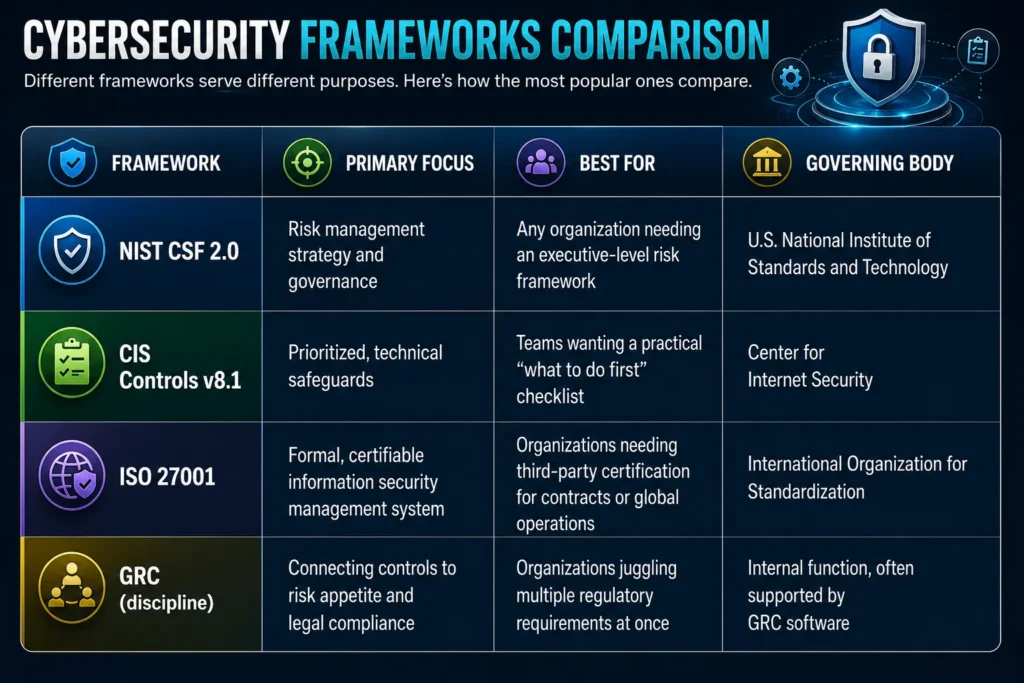
NIST CSF vs. CIS Controls vs. ISO 27001: Quick Comparison
A fast way to see how the major frameworks differ in scope and audience:
Common Mistakes Organizations Make With Cybersecurity Frameworks
The Most Common Mistakes Organizations Make are illustrated below:
- Choosing a framework based on the vendor’s recommendation – the framework should be selected based on an organization’s own regulatory requirements.
- Thinking of implementation as a one-time project – Each of the frameworks highlighted in the article is intended to be iterative and cyclical in nature.
- Not considering governance when selecting controls – Most of the frameworks emphasize the need for organizations to establish a formal governance process for managing cyber-risk, which was the reason why NIST proposed the Govern function.
- Trying to implement all controls right away – The frameworks provide maturity levels; therefore, the implementation should be progressive and not rushed.
Frequently Asked Questions
Is a cybersecurity framework legally required?
Most frameworks, including NIST CSF and CIS Controls, are voluntary on their own. However, specific laws, industry regulations, insurance policies, or client contracts increasingly require proof of alignment with a recognized framework, which is why adoption has become close to mandatory in regulated industries like healthcare, finance, and defense contracting.
Can a small business realistically implement NIST CSF or CIS Controls?
Yes. CIS Controls were built with this in mind — Implementation Group 1 is specifically the “essential cyber hygiene” tier aimed at organizations with limited security staff. NIST CSF’s tier system similarly lets a small business start at a lower maturity tier and build up rather than attempting full-scale enterprise implementation on day one.
Do I have to choose only one framework?
No, and most mature organizations don’t. It’s common to use NIST CSF for governance and board communication, CIS Controls as the technical implementation checklist, and ISO 27001 when formal certification is required for a contract or international operation.
How often should a cybersecurity framework be reassessed?
There’s no universal rule, but a practical pattern is a full gap analysis annually, with faster-moving areas like identity management, cloud configuration, and third-party risk reviewed quarterly. Any material change, such as a new cloud platform, an acquisition, or a significant incident, should trigger an off-cycle review.
What’s the difference between a framework and a certification?
A framework is a set of guidelines you can adopt at your own pace with no formal sign-off required. A certification, like ISO 27001 or SOC 2, requires an independent auditor to verify you meet a defined standard, usually resulting in a formal certificate you can share with customers or regulators.
Final Thoughts
Cybersecurity frameworks tend to sound like an incomprehensible jargon to anyone unfamiliar with the field. If you’ve ever attempted to understand the NIST CSF, CIS Controls, or GRC, you might have realized that they mostly answer the same questions but from different perspectives. NIST CSF, for example, primarily focuses on defining outcomes and establishing the management lexicon. CIS Controls provide implementation recommendations organized according to criticality and interdependencies, depending on the personnel scope. In its turn, GRC emphasizes aligning security outcomes with the business’s needs, making the C-suite accountable for achieving them. Lastly, the cybersecurity mesh concept refers to the modern infrastructure design that enables implementing all recommendations, controls, and outcomes mentioned above, considering the distributed nature of modern IT ecosystems. It is especially useful in the context of cloud platforms, remote employees, and third-party vendors since they are no longer isolated by the corporate perimeter.
It is also noteworthy that none of these frameworks require you to implement each recommendation to the letter right away. You can choose which controls to prioritize depending on your business needs and threat landscape. The most effective organizations do not strive to reach higher maturity levels right away. Instead, they pick a framework, understand their unique requirements, and design a continuous improvement cycle that works for them. It is not the sophistication of a cybersecurity program that makes a difference but its ability to withstand the test of time. Therefore, it is essential to review your security maturity periodically instead of blindly following the established standards.