

Table of Contents
Cybersecurity has a long list of technical terms, and many of them are closely connected. A vulnerability can lead to an exploit. An exploit can deliver a payload. A malicious program can then spread through a network, steal information, or create another way into the system.
For someone learning cybersecurity, it is easy to mix these concepts together.
One term that often causes confusion is a computer worm. Unlike malware that depends heavily on user interaction, a worm can replicate and spread from one system to another on its own. That ability makes worms particularly dangerous in connected environments.
But worms are only one part of the bigger picture. Terms such as payload, exploit, zero day, APT, TTP, honeypot, enumeration, and reverse engineering describe different aspects of cybersecurity.
Understanding the differences gives you a much clearer picture of how attacks happen and how security professionals investigate them.
What Is a Worm in Cybersecurity?
A worm in cybersecurity is a type of malicious software that can replicate itself and spread to other systems without requiring a user to manually copy or install it. Worms commonly take advantage of weaknesses in software, network services, or connected systems to move from one host to another.
The ability to spread independently is what separates a worm from many other types of malware.
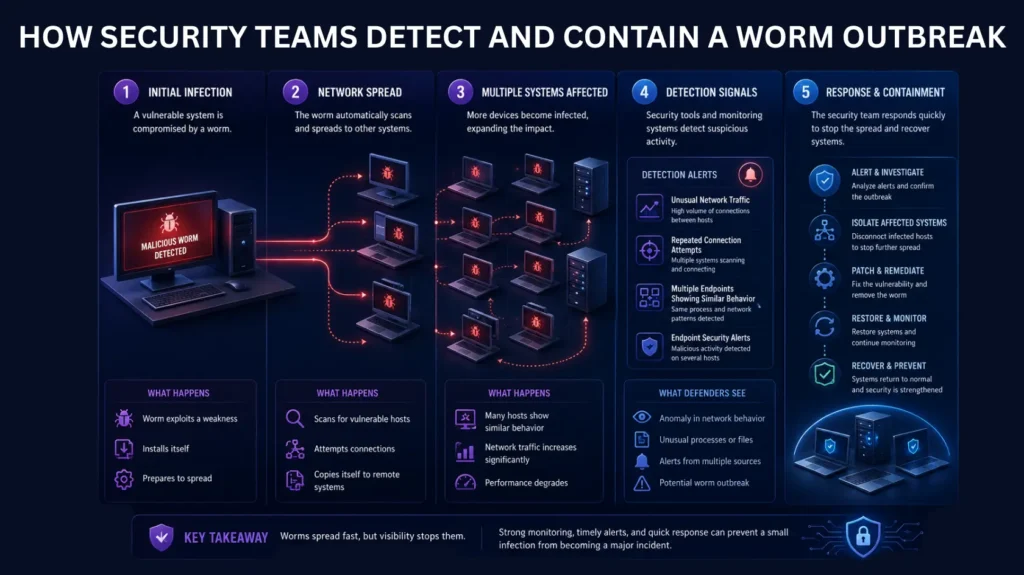
Imagine an organization with dozens of computers connected to the same network. If one computer becomes infected with a worm, the malware may look for other vulnerable systems. If it finds them, it can attempt to spread further. This process can continue across the network.
That can make a worm outbreak difficult to contain, particularly when vulnerable systems are connected closely together.
A worm may cause different types of damage depending on its design. Some consume system or network resources. Others may install additional malicious software, disrupt services, damage files, or create opportunities for further compromise.
Worm vs Virus
Worms and viruses are often mentioned together, but they are not exactly the same.
A virus generally attaches itself to another file or program and usually requires some form of user or program interaction to execute and spread.
A worm is designed to operate more independently. It can replicate and propagate between systems without needing to attach itself to a host file in the same way.
This distinction matters because autonomous propagation can allow a worm to move rapidly through vulnerable environments.
Keeping systems patched, limiting unnecessary network exposure, segmenting networks, and monitoring unusual traffic can all help reduce the risk associated with worm outbreaks.
What Is a Payload in Cybersecurity?
A payload in cybersecurity is the part of an attack that performs the intended action after it reaches or executes on a target system.
The word can be easier to understand with a simple comparison.
Suppose an attacker finds a weakness in an application. The method used to take advantage of that weakness is the exploit. What happens after access is gained can involve the payload.
A payload could be designed to perform many different actions. It might attempt to steal information, install additional malware, modify files, execute commands, or establish persistence.
This is why the term what are payloads in cybersecurity does not have one answer tied to a particular type of malware. A payload describes functionality rather than one specific threat.
Security researchers also use the term when analyzing malicious software. Identifying what a payload does can help determine the purpose and severity of an incident.
For defenders, understanding the payload is important because stopping the initial intrusion does not always tell the whole story. Analysts may also need to determine what executed afterward, what information was affected, and whether the compromised system was used to reach other systems.
What Is an Exploit in Cybersecurity?
An exploit in cybersecurity is a technique, code, or method used to take advantage of a vulnerability in software, hardware, or another technology.
The difference between a vulnerability and an exploit is simple:
A vulnerability is the weakness. An exploit is the way that weakness is abused.
For example, imagine an application contains a security flaw that allows unexpected input to be processed in an unsafe way. The vulnerability is the underlying flaw. An exploit is the technique used to take advantage of it.
An exploit does not automatically mean that malware is involved. Security researchers and penetration testers can use exploits in authorized environments to verify whether a vulnerability is genuinely dangerous.
That distinction is important in cybersecurity because vulnerability management is not simply about finding flaws. Security teams also need to understand how those flaws could affect their systems and what controls can reduce the associated risk.
What Is APT in Cybersecurity?
APT in cybersecurity stands for Advanced Persistent Threat. The term describes a prolonged and targeted cyber threat in which an attacker or threat group attempts to gain access to a particular environment and maintain that access over time.
An APT is generally more than a single attempt to compromise a system.
A sophisticated operation can involve several stages. An attacker may first gather information about a target, find a way to gain initial access, establish persistence, explore the environment, move between systems, and attempt to access valuable information.
The exact techniques can vary considerably between campaigns.
That is why security professionals look beyond individual malware samples. An attacker may change tools or infrastructure while continuing to use similar methods and behaviors.
APT activity is particularly concerning for organizations that manage sensitive information or critical systems. Long term access can give attackers more opportunities to understand an environment and achieve their objectives.
For defenders, continuous monitoring is therefore important. A suspicious event that appears minor on its own may become more significant when viewed alongside other activity occurring across the environment.
What Is a Zero Day in Cybersecurity?
A zero day in cybersecurity refers to a previously unknown or unaddressed vulnerability that can be exploited before defenders have an effective fix or sufficient time to respond.
The term is commonly associated with vulnerabilities that have not yet received an effective patch or were not previously known to the affected vendor or security community.
This creates a difficult situation for defenders.
If a vulnerability has been publicly known for months, organizations have had an opportunity to assess their exposure, apply available updates, or introduce compensating controls. A previously unknown vulnerability does not provide the same preparation time.
However, a zero day does not automatically mean that an organization will be compromised.
Security is based on multiple layers. Network segmentation, endpoint monitoring, access controls, application isolation, logging, and behavior based detection can all help reduce the impact of an attack, even when the underlying vulnerability has not yet been patched.
It is also worth distinguishing a zero day vulnerability from a zero day exploit. The vulnerability is the weakness. The exploit is the method used to take advantage of that weakness.
What Is a Honeypot in Cybersecurity?
A honeypot in cybersecurity is a deliberately deployed system or resource designed to attract suspicious activity and help security teams observe potential attackers.
Instead of protecting a real production asset, a honeypot acts as a controlled decoy.
The idea is straightforward. A security team creates something that appears interesting enough to attract unauthorized activity. Since legitimate users should have little reason to interact with it, activity around the honeypot can be a useful warning signal.
Honeypots can help security teams learn more about:
- Suspicious connection attempts
- Attacker behavior
- Malware activity
- Unauthorized access
- Reconnaissance
- New attack patterns
They can also provide useful information for threat intelligence and security research.
A honeypot should not be treated as a replacement for normal security controls. It works best as an additional layer that gives defenders another source of visibility.
One of its biggest advantages is the relatively high value of the alerts it generates. If a properly configured decoy is accessed unexpectedly, that activity deserves attention.
What Is TTP in Cybersecurity?
TTP in cybersecurity stands for Tactics, Techniques, and Procedures.
The term describes the way an attacker operates. Security teams can therefore look for behavior rather than relying only on a specific file name or malware signature. The MITRE ATT&CK framework provides a useful way to understand and categorize these adversary behaviors.
A tactic represents the broader objective behind an action. A technique describes the method used to achieve that objective. A procedure describes how that technique is carried out in a particular situation.
This distinction is useful because attackers can change their tools without completely changing their behavior.
For example, a threat actor might use different software during different campaigns but continue using similar approaches for gaining access, discovering systems, moving through a network, or collecting information.
Security teams can therefore look for behavior rather than relying only on a specific file name or malware signature.
TTP analysis is especially useful in threat intelligence because it helps defenders understand what an attacker is trying to accomplish and how different activities may be connected.
What Is Enumeration in Cybersecurity?
Enumeration in cybersecurity is the process of gathering detailed information about systems, users, services, resources, or other components within an environment.
It goes beyond simply identifying that a system exists.
During an authorized security assessment, enumeration can help security professionals understand what services are running, which resources are available, what accounts exist, and how different parts of an environment are organized.
That information can reveal potential weaknesses that need attention.
Enumeration can also be part of malicious activity. An attacker who has gained access to a network may attempt to learn more about the environment before deciding what to target next.
This is why discovery and monitoring are important parts of defensive security.
For legitimate penetration testing, enumeration should always be performed with clear authorization and within the agreed scope. The same activity can have a very different legal and ethical meaning when performed without permission.
What Is Cain and Abel in Cybersecurity?
Cain and Abel is a Windows security auditing and password recovery tool that became known for demonstrating weaknesses in password security and authentication.
It was particularly well known among security enthusiasts and researchers for capabilities related to password recovery, network analysis, and password auditing.
Today, Cain and Abel is more useful as a historical example than as a modern recommendation for cybersecurity professionals. The security landscape has changed significantly, and organizations now rely on a much broader collection of security tools and controls.
The underlying lesson behind password auditing remains relevant, though.
Weak or reused passwords can make it easier for unauthorized users to gain access to accounts. Strong passwords, password managers, multi factor authentication, secure authentication mechanisms, and appropriate account monitoring can significantly improve account security.
So, when discussing Cain and Abel cybersecurity, it is useful to understand both its place in the history of security tools and the broader password security principles it helped demonstrate.
What Is Reverse Engineering in Cybersecurity?
Reverse engineering in cybersecurity is the process of examining software, binaries, firmware, or other technical components to understand how they work.
Security professionals often use reverse engineering when the original source code or documentation is unavailable or when a suspicious program needs closer examination.
Malware analysis is one of its most important applications.
Suppose an analyst discovers an unfamiliar executable on a company computer. Removing it may solve the immediate problem, but the security team still needs to understand what the program did.
Reverse engineering can help reveal its behavior, files it interacts with, communications it attempts to establish, and other characteristics that may help investigators understand the incident.
It is also used in vulnerability research and software security testing. As cybersecurity tools continue to evolve, AI is also becoming part of security research, analysis, and testing workflows.
Reverse engineering is not inherently malicious. Security researchers use it to investigate threats, understand software behavior, identify weaknesses, and develop better defensive measures.
What Is a Canary in Cybersecurity?
A canary in cybersecurity is a deliberately placed digital resource or piece of information designed to alert defenders when it is accessed or used unexpectedly.
The idea is similar to an alarm.
For example, an organization could place a monitored file or decoy credential somewhere that legitimate users have no reason to access. If someone interacts with it, the resulting alert can indicate that something unusual is happening.
Canaries can provide useful signals for detecting:
- Unauthorized access
- Suspicious internal activity
- Credential misuse
- Data discovery
- Potential lateral movement
Their value comes from the expected behavior. If nobody legitimate should be interacting with a particular resource, an unexpected interaction becomes much more meaningful.
Like honeypots, canaries work best as part of a wider security monitoring strategy rather than as a standalone defense.
How These Cybersecurity Terms Connect
At first, these terms may appear unrelated. Once you look at how a real attack can develop, the connections become easier to understand.
An attacker may begin by gathering information about a target. Enumeration can be part of that process. If a weakness is discovered, an exploit may be used to take advantage of it.
Once access is achieved, a payload may perform the attacker’s intended action.
If malicious software is capable of independently replicating and spreading between vulnerable systems, it may behave as a worm.
A longer and more targeted campaign may involve an APT. Throughout that activity, the attacker may use recognizable TTPs.
Defenders can use honeypots and canaries to create additional detection opportunities. If suspicious software is discovered, reverse engineering can help analysts understand what it does.
A zero day can make the situation more difficult when the underlying vulnerability was not previously known or did not have an available fix.
This is why cybersecurity is rarely about one tool or one threat. Modern security depends on understanding how different behaviors, technologies, and defensive controls interact.
Why Should You Learn These Cybersecurity Terms?
Knowing these terms gives you a stronger foundation for almost every area of cybersecurity. If you prefer a structured learning environment instead of studying everything independently, a cybersecurity bootcamp may also be worth considering.
If you are studying penetration testing, concepts such as vulnerabilities, exploits, and enumeration will appear frequently. If you are interested in security operations, TTPs, honeypots, canaries, and threat detection become more important.
If you are building your cybersecurity knowledge from the ground up, choosing the right certifications can also help you structure your learning path.
Those interested in malware analysis will encounter worms, payloads, reverse engineering, and related concepts. Threat intelligence professionals also need to understand how attackers operate over time and how their behavior can be identified.
You do not need to memorize every definition immediately.
A better approach is to understand the relationship between them. Once you know what a vulnerability is, an exploit becomes easier to understand. Once you understand exploitation, the purpose of a payload becomes clearer. When you understand how malicious software spreads, the behavior of a worm makes more sense.
That connected understanding is much more useful than simply memorizing cybersecurity vocabulary.
| Cybersecurity concept | What it can look like in a real environment | What defenders can pay attention to |
| Worm activity | The same suspicious behavior appears across multiple connected systems | Unusual network scanning, rapid host-to-host connections, and sudden traffic increases |
| Exploit activity | A vulnerable application receives unexpected or abnormal requests | Repeated requests targeting the same service, unusual application behavior, and security alerts |
| Payload execution | An unexpected program or process performs a new action after an intrusion | Unusual processes, unexpected file changes, and suspicious command execution |
| APT activity | Small suspicious events continue across an environment over an extended period | Persistent access, unusual account activity, internal discovery, and repeated attempts to access sensitive resources |
| Zero day exploitation | A system behaves abnormally despite having no known matching vulnerability signature | Unusual application behavior, endpoint anomalies, and unexpected network communication |
| Enumeration | Someone appears to be systematically learning about systems and available resources | Unusual discovery activity, unexpected account queries, and repeated requests for system information |
| Honeypot interaction | An otherwise unused decoy resource receives unexpected activity | Immediate alerts and investigation of the source and surrounding activity |
| Canary trigger | A monitored decoy file, credential, or resource is accessed unexpectedly | The account, device, time, source, and activity surrounding the alert |
| Reverse engineering findings | Suspicious software reveals unexpected functions or communication patterns | File behavior, network indicators, persistence mechanisms, and other forensic evidence |
| TTP patterns | Similar attacker behaviors appear across multiple events | Repeated techniques, unusual sequences of activity, and connections between separate security events |
FAQs
Can a worm infect a computer without the user clicking anything?
Yes. A worm can be designed to spread automatically by exploiting weaknesses or using available network mechanisms. This ability to replicate without requiring the same level of user interaction is one of its defining characteristics.
How can organizations reduce the risk of worm infections?
Regular security updates are an important starting point. Organizations should also use network segmentation, access controls, endpoint security, secure configurations, monitoring, and a clear incident response process. Limiting unnecessary network exposure can also reduce opportunities for rapid propagation.
Is a payload always malicious?
Not necessarily. The word payload refers to the functional content delivered or executed during an operation. In cybersecurity discussions, it is often used when describing malicious activity, but the term itself does not automatically define something as malicious.
What is the difference between an exploit and a payload?
An exploit takes advantage of a vulnerability. A payload is the code or action that performs the intended function after or during an attack. They can work together, but they describe different parts of the process.
Can zero day attacks be detected?
They can sometimes be detected even before the underlying vulnerability is fully understood. Behavioral monitoring, endpoint detection, network analysis, access controls, and other security layers can reveal suspicious activity. Detection is not guaranteed, but layered defenses can improve an organization’s chances of identifying abnormal behavior.
Are honeypots suitable for every organization?
Not necessarily. Honeypots can provide valuable detection and research benefits, but they require proper planning, monitoring, and isolation. An organization should consider its security goals, available resources, and ability to manage the additional environment before deploying one.
Why is reverse engineering important for malware analysis?
Reverse engineering can reveal what suspicious software is designed to do. Analysts can use that information to understand an incident, identify useful indicators, improve detection, and determine what systems or data may have been affected.
Is enumeration always considered hacking?
No. Enumeration is a technique rather than an automatically illegal activity. Security professionals routinely use it during authorized assessments. The important factor is whether the activity is permitted and performed within the agreed scope.
Why do attackers change their tools?
Changing tools can make detection more difficult. This is one reason security teams pay attention to behavior and TTPs instead of relying entirely on the identification of a particular malware family or application.
Are Cain and Abel and modern password security tools the same?
No. Cain and Abel is an older security auditing and password recovery tool. Modern organizations use a broader combination of authentication controls, identity security, password management, multi factor authentication, monitoring, and other defensive technologies.
Final Thoughts
Cybersecurity terminology becomes much less confusing once the individual concepts are connected.
A worm is known for its ability to replicate and spread. An exploit takes advantage of a weakness, while a payload carries out an intended action. A zero day involves a vulnerability that defenders may not yet have an effective fix for, while an APT describes a sustained and targeted threat.
On the defensive side, TTPs help security teams understand attacker behavior. Enumeration provides information about an environment, while honeypots and canaries can create useful detection opportunities. Reverse engineering helps researchers investigate software and understand suspicious programs.
These concepts form part of the foundation of cybersecurity knowledge. Learning how they relate to one another will make security reports, threat research, penetration testing material, and malware analysis much easier to understand.