Table of Contents
A hospital in Ohio lost access to its own patient records in 2023 not because of a zero-day exploit. But because someone in IT support believed a caller who already knew the CEO’s name, the help desk’s script, and just enough internal jargon to sound legitimate. No malware was needed for the first thirty minutes. Just a phone, a voice, and patience.
That’s social engineering in a sentence. It skips the code and goes straight for the person holding the keys.
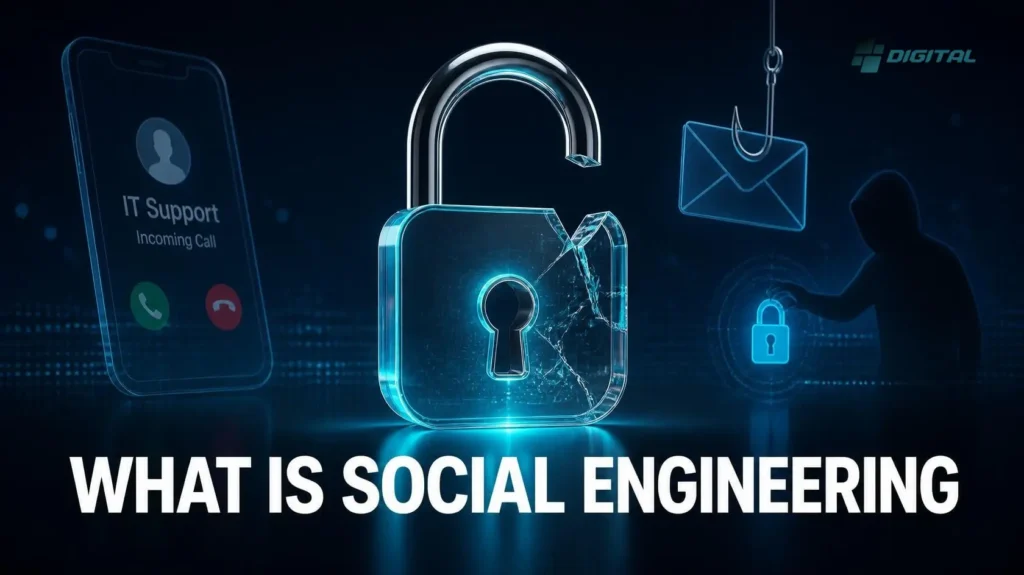
What Is Social Engineering in Cybersecurity?
Social engineering is a form of manipulation designed to obtain data, access, or privileges by coaxing an employee into disclosing personal information. Unlike traditional penetration testing, social engineering does not involve technical exploitation of software vulnerabilities. Social engineering is also known as “hacking the human,” and the name is well-deserved because human error is the most common vulnerability in any security system. Cybersecurity analysts sometimes use social engineering to bypass technological defenses by manipulating people into giving up their secrets, such as passwords, or allowing attackers to access data, premises, or systems.
In short, social engineering is deception for infiltration purposes. The target’s technological defenses are irrelevant since the victim’s trust is the real weakness.
What Common Cybersecurity Threat Involves Human Interaction Skills?
Unlike ransomware, which requires a payload to encrypt data, or SQL injection, which requires malformed queries to exploit a database, social engineering requires no special software or network tools to penetrate a system. While other forms of cyberattack are mechanical, social engineering is human nature.
You will recognize social engineering as a distinct category of cyberattack in any standard list of cybersecurity threats and vulnerabilities. Phishing emails, for example, contain no malicious attachment or script that takes advantage of software vulnerabilities. Instead, phishing attempts rely on human psychology to convince victims to provide personally identifiable information.
Social engineering attacks may take many forms, but all of them rely on deceptive communication with the target. The deception could take the form of a phone call, email, text message, or even face-to-face conversation. In any case, social engineering is distinguished by the fact that it relies on interpersonal skills rather than technical expertise.
What Is the Primary Goal of Social Engineering in Cybersecurity?
Unauthorized access is the primary objective of social engineering attacks, although what attackers want to access defines the type of attack. For example, perpetrators may seek to get hold of login credentials to gain unauthorized access to a network or computer system. Attackers may also want to entice victims into installing malware on their computers through social engineering. Some cybercriminals use social engineering tactics to extract sensitive data such as financial or personal information from their targets. Finally, social engineers may want to gain physical access to a facility, server room, or other secure location by tricking legitimate employees into letting them in.
A few of the more specific objectives attackers chase:
- Login credentials for email accounts, VPNs, or hosting control panels
- A foothold for malware, delivered through a file the victim opens willingly
- Internal documents, customer databases, or financial records
- Physical entry to a building, data center, or restricted room
- Direct financial fraud, usually through impersonated payment requests
None of these require breaking anything. They require someone saying yes.
How Do These Attacks Usually Take Place?
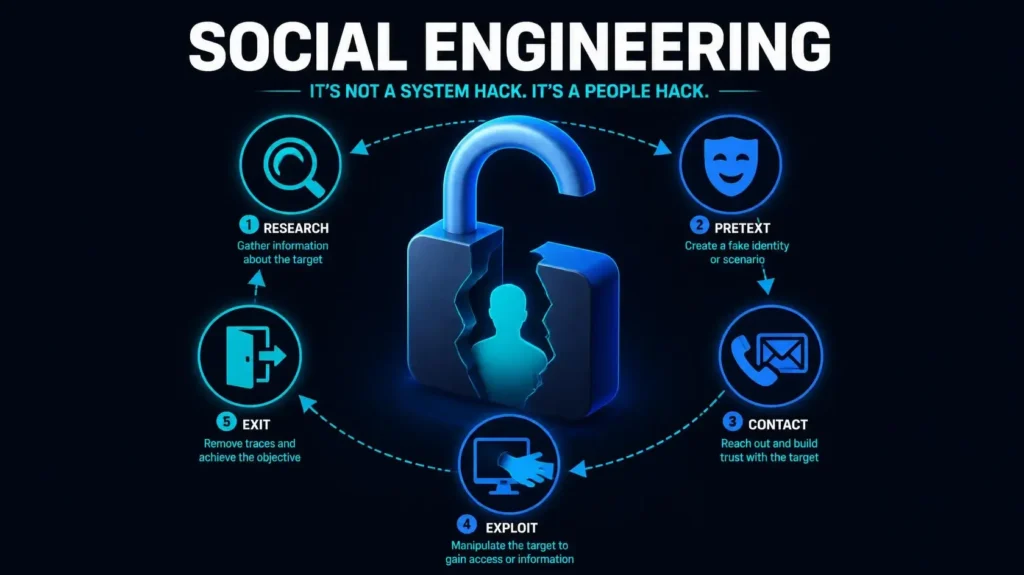
Social engineering attacks have several phases, although the details of each phase vary depending on the attack method and vector.
- First, attackers do background research on a target to identify weaknesses that can be exploited. This might involve researching potential victims on social media to determine their interests, employment status, and even friends and family. In some cases, reconnaissance involves contacting company employees via LinkedIn to establish a relationship. Attackers increasingly use AI to draft flawless pretext emails and clone voices for vishing calls, see how generative AI is being used in cybersecurity for the fuller picture.”
- Second, social engineers devise a pretext or scenario that enables them to convince their targets to provide information or access the attackers want. The pretext makes the scam harder to detect because it usually involves some level of truth. For example, attackers might pose as IT support professionals contacting victims to “help” them with technical problems.
- Third, attackers contact their victims via phone, email, text, or even in person to deliver the message. At this point, attackers use social engineering tactics to influence prospects to take action, such as giving away personal information, opening attachments, or clicking on links.
The Main Types of Social Engineering Attacks
| Attack Type | What Happens | Who Usually Gets Targeted |
| Phishing | Bulk emails posing as banks, vendors, or services to steal login details | Broad, non-specific audiences |
| Spear Phishing | A tailored email built around one person’s job, habits, or relationships | Executives, finance teams, admins |
| Vishing | A phone call impersonating support staff, a bank, or an authority figure | Employees, older adults |
| Smishing | Malicious links sent through text message | Mobile-first users |
| Pretexting | A fabricated identity or scenario used to extract details over time | HR, help desks, customer service |
| Baiting | Infected USB drives or “free” downloads left where someone will find them | Curious employees |
| Tailgating | Physically following an authorized person through a secure entrance | Offices, data centers |
| Quid Pro Quo | A fake favor or service offered in exchange for access | IT support lines, survey respondents |
None of these are mutually exclusive. A single campaign might open with a phishing email, escalate to a follow-up phone call once the target seems receptive, and end with pretexting to squeeze out one more piece of information before the attacker disappears.
Why Hosting Admins and Website Owners Get Targeted Specifically
Anyone managing server access or a hosting panel is worth more to an attacker than the average inbox. One compromised admin login can expose dozens of client sites, databases, and email accounts in a single move, which is a much better return on effort than phishing individual users one at a time.
The pattern usually starts with a message claiming to be from a hosting provider. A billing discrepancy, a flagged security issue, something that needs “immediate verification” before an account gets suspended. Urgency does the rest of the work.
This is where access controls inside a platform like CyberPanel actually earn their keep. Two-factor authentication on the admin login means a stolen password alone isn’t enough to get in. Role-based permissions limit what a compromised account can actually touch. Restricting panel and SSH access to known IP ranges closes off remote login attempts entirely, even from someone holding valid credentials. None of these stop the social engineering attempt itself, but they shrink what it can accomplish if it succeeds.
Red Flags Worth Recognizing in the Moment
| Warning Sign | What It Usually Means |
| Urgent, time-pressured language | Designed to short-circuit careful thinking |
| A request for credentials over email or phone | Legitimate providers rarely ask this way |
| A sender address that’s almost right | One swapped letter is enough to fool a quick glance |
| An unexpected attachment or link | The most common malware delivery method |
| An offer that seems unusually generous | Built to lower suspicion before the real ask |
| Pressure to skip a normal verification step | Attackers avoid any process with a built-in check |
| A caller who claims internal authority you can’t verify | Classic pretexting, especially over the phone |
Spotting these in real time is harder than it sounds on paper. Most people don’t fail because they’re careless; they fail because the message arrived at a busy moment and looked close enough to normal.
What Are Effective Measures to Reduce Social Engineering Attacks?
Various steps can be taken to reduce the risk of falling victim to social engineering:
Measure Description
Confirm the request using a different communication channel If the request is urgent, call or email the sender using a known contact channel to verify the request
Treat Urgent Requests with Caution
Organizations that deal with sensitive information always ask for clarification before acting on any request
Minimize the amount of sensitive information shared online Most social engineering attacks start with information obtained from the victim’s social media, such as personal interests and friends
Implement Multifactor Authentication (MFA)
MFA makes it harder for attackers to compromise an account, even if they have obtained the password
Carry Out Regular Awareness Training
Organizations must conduct regular phishing simulations to help employees recognize social engineering attempts. If you’re building this into a formal security role rather than just internal training, it’s worth knowing which cybersecurity certifications are worth pursuing first.
Restrict Access To the Hosting Server
These are additional security measures that can be taken to protect against social engineering:
When it comes to social engineering, organizations must implement technical safeguards and awareness training. These two security controls are essential because social engineering cannot be stopped by firewalls or intrusion detection systems. Awareness training complements technical safeguards by educating staff and reducing human error.
Why Are Cyber Security Experts Concerned With Social Engineering?
Social engineering is a serious problem for several reasons:
- Social engineering attacks are difficult to detect since most of them are disguised as legitimate requests from trusted organizations.
- Many social engineering attacks start with phishing emails that are designed to look like they came from a legitimate source. Phishing attempts can be hard to distinguish from genuine messages, which means that attackers can succeed with their schemes.
- Unlike traditional hacking attempts, which usually rely on software vulnerabilities, social engineering takes advantage of human error, which can be hard to predict or prevent. Therefore, cybersecurity experts are concerned with social engineering because it creates a unique set of challenges that cannot be addressed by conventional security measures. That’s part of a bigger debate on whether AI can actually replace human judgment in cybersecurity, and social engineering is exactly the kind of threat that tests that idea.
- Various studies have shown that most successful cyber-attacks originate from human error. In other words, most successful attacks are facilitated by human mistakes, inadvertent disclosures of sensitive information, or employees failing to follow established security practices. Human error can affect anyone, regardless of their technical expertise.
Conclusion
The most effective way to prevent social engineering is to strengthen awareness and make sure that the necessary technical safeguards are in place. Hosting users can protect their accounts from social engineering by implementing the following safeguards:
1. Enabling two-factor authentication to add an extra layer of security to the admin panel
2. Making sure that only trusted IP addresses have access to the server
3. Limiting user privileges to reduce the damage caused by a compromised account.
Website owners and administrators should always make suspicious requests with caution and confirm them using a separate communication channel. Finally, users should conduct regular security audits to ensure that their websites or applications are protected against various forms of cyber-attack.
Frequently Asked Questions
Does a strong password stop a social engineering attack?
Not on its own. A social engineer isn’t trying to guess your password, they’re trying to get you to hand it over voluntarily. A strong password protects against brute-force attempts, but it does nothing if you type it into a fake login page yourself.
Why do attackers bother with social engineering instead of just hacking the system directly?
Because it’s usually faster and requires less technical skill. Finding and exploiting a software vulnerability can take weeks of work and a lot of expertise. Convincing one distracted employee to click a link can take five minutes.
Can a security awareness policy alone prevent social engineering?
No, and treating it that way is a common mistake. Policy sets expectations, but attackers count on the moments people forget or bend the policy under pressure. Real protection comes from combining awareness with technical safeguards like MFA and access restrictions that limit damage even when a policy gets ignored.
How do attackers choose who to target inside an organization?
Usually by looking for people with either high access (IT admins, finance staff, executives) or high responsiveness (customer service, HR, anyone whose job is to help quickly). Both groups make attractive targets for different reasons, one has the keys, the other is trained to say yes.
Is social engineering illegal?
In most jurisdictions, yes. Depending on what’s obtained and how, it can fall under fraud, unauthorized computer access, or identity theft laws, even if no malware or hacking tool was ever used in the attack itself.