If you googled “what certs do I need for cybersecurity” and landed here, you probably want a brief and straight answer before you continue. If you are new to this space, you will need only one certification to get started on your cybersecurity career path. The majority of cybersecurity job postings require a foundational certification, such as Security+, before the candidate can schedule a phone interview. Your best bet is to prioritize the certifications based on your job objective.
However, even if you can answer the most frequently asked questions about certifications, you may not be confident that your experience will differentiate you from other candidates with similar credentials. In this article, you will find answers to questions regarding the value of certifications for getting a cybersecurity job, what to do if you have zero experience in the field, and the importance of degrees versus certificates for your job prospects.
Do You Need Certifications for Cybersecurity Jobs?
What certs do I need for cybersecurity? This is one of the most common questions asked by aspiring cybersecurity professionals.
In most cases, certifications are required to get a cybersecurity job, at least at the entry level. Certifications help employers to narrow the field of resume applicants because the process of eliminating unqualified candidates who do not hold any relevant credentials is much faster than scanning hundreds of resumes. For example, if an organization puts out a job posting for an entry-level cybersecurity analyst, they may receive over 200 responses. However, certifications allow recruiters to quickly identify qualified candidates. Apart from the obvious benefits for recruiters, certifications offer potential employees with little or no experience in the domain an advantage over candidates with degrees.
Despite the prevalence of certifications in the cybersecurity hiring landscape, it is important to note that there are alternative paths to landing a cybersecurity job:
- Getting hired in the related field and demonstrating skills or knowledge acquired on the job
- Earning a degree in computer science or a cyber-related specialization
- Demonstrating skills and practical knowledge through personal projects or experience
- Getting transferred internally within the organization into the cybersecurity department
When choosing the right path for your career, remember that certifications without any practical knowledge or experience will rarely get you hired.
Why Certs Carry Weight in This Field
If you’re still wondering what certs do I need for cybersecurity, the answer depends on your experience level and career goals. The issue with hiring decisions in the cybersecurity field is that the risk factor is particularly high due to the nature of the work. Cybersecurity is one of those areas where you cannot trial an employee. At the same time, the field evolves at an extremely rapid pace, and an employee needs to constantly update their skills. Certifications such as Security+ or the recently introduced Certified in Cybersecurity (CC) from ISC2 aim to tackle this issue by certifying that a candidate possesses baseline competencies.
Which Cybersecurity Certification Is Most Requested by Employers?
Not every certification carries the same value in the job market. While employer requirements vary depending on the role and organization, entry-level cybersecurity positions consistently favor certifications that validate core security knowledge and practical skills.
| Career Goal | Commonly Requested Certification |
|---|---|
| Entry-Level Cybersecurity | CompTIA Security+ |
| Security Operations Center (SOC) | CompTIA Security+, CySA+ |
| Penetration Testing | CompTIA PenTest+, eJPT, OSCP |
| Cloud Security | AWS Certified Security – Specialty, Microsoft SC-200 |
| Security Management | CISSP, CISM |
Important: A certification should support your career goal, not define it. Employers typically evaluate certifications alongside practical experience, hands-on labs, projects, technical interviews, and problem-solving ability.
What Certs Do I Need for Cybersecurity? A Level-by-Level Breakdown
The following roadmap answers the question what certs do I need for cybersecurity at every stage of your career.
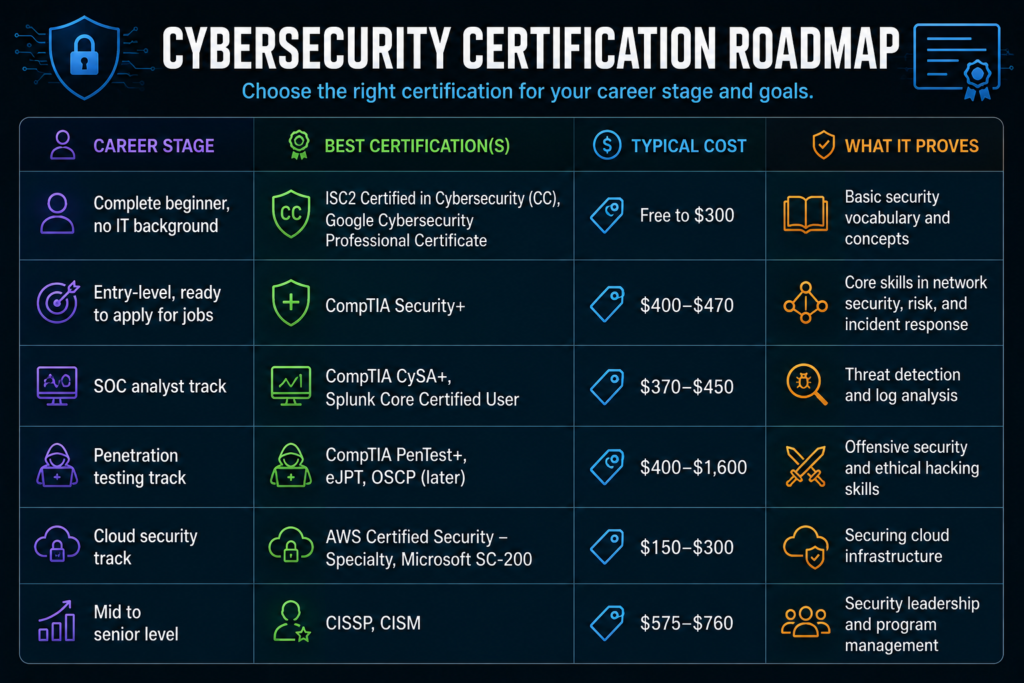
A common mistake beginners make is to try to pursue multiple certifications at the entry level. Instead, it is better to aim for one high-quality entry-level certification and supplement it with some practical experience or a related project that can be showcased on your resume. This will give you an advantage over other entry-level job candidates with multiple certificates but no practical experience.
Which Cybersecurity Certification Should You Get First?
If you’re wondering what certs you need for cybersecurity, the answer depends on your experience and career goals. However, most beginners do not need multiple certifications.
- No IT experience: Start with ISC2 Certified in Cybersecurity (CC) or the Google Cybersecurity Professional Certificate.
- Ready for entry-level cybersecurity jobs: Choose CompTIA Security+.
- Want to become a SOC analyst: Earn Security+ first, then CompTIA CySA+.
- Interested in penetration testing: Start with Security+, then move to CompTIA PenTest+, eJPT, or OSCP as you gain experience.
- Planning a cloud security career: Begin with Security+, followed by AWS Certified Security – Specialty or Microsoft SC-200.
Recommendation: Focus on earning one certification, building hands-on projects, and applying for jobs instead of collecting multiple beginner certifications.
Can I Get a Cybersecurity Job With a Certificate?
It is possible to get almost any entry-level cybersecurity job with just a certificate. In fact, this is the main reason why certifications are so prevalent in this particular industry. Most entry-level cybersecurity jobs require some sort of certificate or training. At the same time, it is important to note that certificates do not guarantee a job. They only serve to get your application in front of recruiters and demonstrate that you possess baseline knowledge in cybersecurity.
Some of the most effective ways of landing a cybersecurity job with a certificate include:
- Pairing an entry-level certificate with a home lab or project
- Leveraging personal connections and professional networks
- Improving resume optimization and interview skills
- Using transferable skills from previous jobs
If an individual is choosing between getting a $400 Security+ exam and a $40,000 master’s degree and getting a certificate as the very first step in their career, then the certificate is the obvious choice.
Common Mistakes to Avoid While Choosing Cybersecurity Certifications
Many readers ask what certs do I need for cybersecurity before applying for their first security role. However, selecting the appropriate certificates is as important as getting certified itself. Many people start studying for certification when they should be gaining experience and learning the ropes. This article will list and discuss mistakes to avoid while choosing certifications
To begin with, people make mistakes such as:
- getting multiple beginner certificates instead of getting some work experience
- ignoring practice, like home labs, CTFs, or other virtual labs
- starting to prepare for more difficult certifications, such as CISSP, before they are ready
- not looking for job descriptions and studying what potential employers want
- believing that certifications are enough to land a job when they are not, so they do not invest enough time in their portfolio, interviewing skills, and networking
- trying to follow the latest trends without understanding their own goals and spending their time on the irrelevant certifications
The last tip that I would like to share concerns preparing for the certification exams. Specifically, before registering for tests, I advise to look through at least 20 different job offers and see what requirements they set. This is helpful because it gives a clear vision of what certificates are relevant and needed for a specific field.
Can I Get a Cybersecurity Job With No Experience
Yes, you can get cybersecurity job with no experience. The following tips will help you know how to get a cybersecurity job with no experience:
- Choose one foundational certification and go for it:
Beginners thinks that what certs do I need for cybersecurity. You should start with one foundational certification such as Security+ or CompTIA CC. Do not attempt to pursue three different certificates one after the other right away. Aim for quality over quantity when choosing the certification. - Supplement it with a project:
Having a certificate is great, but employers are looking for someone who not only knows the theory but can also demonstrate practical skills. Building a home lab or a project is one way to gain experience and demonstrate your knowledge of networking, computer security, and other relevant topics. Even writing a blog post about a particular topic or a series of CTF challenges you have completed is better than nothing at all. - Target the right job titles:
It is crucial to choose the right job titles when applying for jobs. Avoid aiming for highly competitive entry-level job titles, such as penetration tester, SOC analyst, and security engineer, at least at first. Target lower-level analyst positions and look for any junior-level cybersecurity jobs. Another good option is to look for IT-related jobs with some security exposure. Entry-level jobs in the GRC (governance, risk, and compliance) domain are also a good option for people with no experience. - Use your background to your advantage:
It is not uncommon for individuals who have worked in the past in unrelated fields to underestimate their transferable skills. Working in retail, restaurant, or even customer service can provide you with valuable soft skills that are crucial for any cybersecurity job. - Submit applications extensively and stay persistent:
One of the most important pieces of advice for people with no experience is to apply extensively and not get discouraged by rejections. At the entry level, competition is tough, and even the best candidates may receive only a few job offers after dozens of applications. In other words, rejections are a completely normal part of the process.
A Cybersecurity Masters Degree and IT Certifications: Do You Need Both?
In most cases, both can be avoided at the beginning of one’s career. Certifications and degrees serve two dramatically different purposes.
- Certifications demonstrate that an individual has the practical skills and knowledge to perform a particular job.
- Whereas degrees allow students to gain theoretical knowledge in-depth in the chosen subject area. Certifications tend to be cheaper and quicker to complete and usually last for several months. Degrees, on the other hand, can take up to 2 years to complete and can be very expensive, costing students an average of $20,000 to $60,000.
Most employers ask for specific certifications when hiring for entry and mid-level positions. However, at the manager and executive levels, degrees begin to gain traction. Symmetrically, certifications tend to be more relevant for individuals with a technical track record. For instance, a degree will rarely help someone with the technical skills to become a CISSP-certified professional and move into the network security field.
| Factor | Certifications | Master’s Degree |
| Time to complete | Weeks to a few months | 1 to 2 years |
| Typical cost | $100–$800 per cert | $20,000–$60,000+ |
| Best for | Entry to mid-level technical roles | Leadership, research, policy, academia |
| How employers view it | Proof of current, specific skill | Proof of depth and long-term commitment |
| Renewal required | Often, every 3 years | No, but skills still need updating |
If you’re early in your career, certifications almost always deliver a better return per dollar and per month spent.
Is a Masters in Cybersecurity Worth It?
Whether a degree is worth the investment depends solely on the professional goals of the individual and has nothing to do with one’s interest in the field. For some people, a Masters in Cybersecurity can be a fantastic choice. For others, it can be a waste of time and money.
A Masters in Cybersecurity is worth it if:
- You want to advance to technical leadership positions within your organization
- Your educational expenses are covered or subsidized by an employer
- You are targeting highly competitive industries, such as government and defense
- You already have some experience and seek to transition into a cybersecurity field
A Masters in Cybersecurity is not worth it if:
- You have no relevant experience and expect the degree to get you hired
- You do not have a clearly defined career objective
- You are considering incurring substantial student loan debt to earn the degree
- Your career goals can be achieved without a degree
A typical progression of one’s career in cybersecurity typically follows this pattern: a foundational certificate, 1 to 3 years of experience, and a graduate degree. There is no point in going for a Master’s degree if there is no particular reason to do so, such as transitioning into the leadership or government cybersecurity roles. This approach allows you to avoid paying expensive tuition fees for a degree before you have gained sufficient industry experience.
Is A Cybersecurity Degree Worth It? 7 Essentials Things To Know!
Frequently Asked Questions
Do cybersecurity certifications expire?
Most of them do. For instance, CompTIA certifications require you to renew them every 3 years by earning continuing education credits or taking a renewal exam. Similarly, CISSP requires 120 hours of continuing education every 3 years. A few certifications, however, do not require renewal, including the OSCP certification.
Which certification should I get first if I am making a career change from a non-IT field?
If you’re asking what certs do I need for cybersecurity, start with one foundational certification rather than several beginner certifications. The best place to start is the ISC2 Certified in Cybersecurity or the Google Cybersecurity Professional Certificate. These are the only certifications that are designed specifically for people with no IT experience. These certifications will provide you with foundational knowledge in the field without requiring any prior experience.
Is it better to self-study for certifications or to attend a paid bootcamp?
Self-study is much more cost-efficient than a bootcamp, and for some people, it is the only viable option. However, if you are someone who finds it challenging to stay disciplined and complete the course material on your own, a bootcamp can be a better choice. Additionally, cybersecurity bootcamps allow you to build connections with other students and often have a better success rate when it comes to finding a job after completing the program.
Do I need a college degree if I have strong certifications?
Most entry-level and mid-level cybersecurity positions do not require a college degree. Having said that, government and defense-related jobs will almost always require a degree. This is why it is important to research the requirements for cybersecurity jobs in your target industry.
How long does it take to become proficient enough in cybersecurity to get a job?
The answer depends on how much time you can dedicate to studying. However, as a rule of thumb, it takes anywhere between 6 to 12 months of part-time studying to become proficient enough in cybersecurity to get an entry-level job. If you can dedicate more time to studying, you can expect to get a job in half the time.
Conclusion
If you’re wondering what certs do I need for cybersecurity, don’t fall into the trap of collecting every certification you can find. Most cybersecurity professionals pick one foundational certification to start with while enhancing your practical knowledge through home lab experimentation plus applying your skills. Certifications can carry you through the early levels of a cybersecurity career, but being able to demonstrate practical skills will set you ahead of the pack.
Are You Ready to Begin Your Cybersecurity Career?
Select the certification you want to pursue based on your career objectives, create a practical plan, and gain extensive experience while learning practical skills. Completing projects and acquiring relevant skills will prepare you for your first cybersecurity job.
Start your cybersecurity career with the appropriate certifications and practical skills!