
If you’re thinking about a career in cybersecurity, two questions come up more than any others: does cybersecurity require coding, and is cybersecurity easy to break into? The short answer is no, you don’t need to code to get started, and yes, breaking into the information security space is entirely achievable even if you’re coming in with zero technical background. But the full picture depends a lot on which corner of cybersecurity you’re aiming for.
The truth is that you do not need to know how to code to be successful in cybersecurity. However, some coding knowledge can take you a long way and open the doors to higher-paying security specialties than a non-coder would otherwise have access to.
Let’s take a look at what else you need to know to determine how hard cybersecurity is, and how you can prepare yourself for your chosen field.
Table of Contents
Why Doesn’t Cybersecurity Require Coding?
For most starter roles in the industry, you will typically not need to have extensive coding knowledge. You may only need to know enough coding to help you troubleshoot issues, or even just understand the tools you are using better.
That said, coding is still an extremely important skill to have if you are considering more advanced cybersecurity fields. Coding is therefore not an absolute necessity, but it definitely helps depending on what specific career path you are considering.
Do Cybersecurity Analysts Code?
Not for daily work. Most analysts spend their day reviewing alerts, checking logs, and following incident response steps, none of that requires writing code. Understanding what daily SOC analyst responsibilities look like explains why this question comes up so often, most of the work centers around monitoring and triaging rather than development.
While it is true that cybersecurity analysts do not generally need to know how to write code for their day-to-day activities, having some coding knowledge can help you automate and speed up repetitive tasks such as scanning and log analysis.
Does Cybersecurity Involve Coding?
While the overarching field of cybersecurity touches many different technical areas, coding is only necessary within specific specializations. There are some jobs where coding is an important skill, and jobs where it is not. Some fields where you are likely to need to know how to code:
- Penetration testing
- Security engineering
- Malware analysis
- Security automation
- Application security
Fields where coding knowledge is less necessary:
- Security awareness training
- Governance, Risk, and Compliance (GRC) frameworks
- Security operations center analyst
- IT audit
The reality is that cybersecurity involves coding, but it is by no means a necessary skill across the board. So if somebody asks that does cybersecurity require coding? It totally depends upon the job they are looking for.
Is Cybersecurity Coding?
No, cybersecurity is not coding. Coding is one small aspect of a much broader discipline.
Most cybersecurity professionals will actually spend a lot less time coding than you might think. Cybersecurity is about analysing and protecting computer systems and networks from being compromised. Coding is only a small part of that, although it is a good skill to have.
Do You Need Python For Cybersecurity?
Python is in many ways the default language in the cybersecurity space due to how readable and easy it is to use. You will not strictly need to know Python to get a job in cybersecurity, but it is definitely a good idea to be at least somewhat proficient in the language, particularly if you want to be considered for more technical roles.
It is one of the most common languages used in cybersecurity, and therefore even a basic familiarity with it will give you an advantage depending on what field you are considering. You can even get away with only superficial knowledge if you want to take this route.
Other languages that are useful for cybersecurity include:
- Bash
- PowerShell
- SQL
- JavaScript
- C/C++
Do You Need Math For Cybersecurity?
You do not need advanced math to be a cybersecurity analyst. Most mathematical concepts that are necessary for cybersecurity tend to be fairly basic.
You will likely want to have at least some basic math skills so that you can understand basic networking and security concepts, but that is about it. It is also worth noting that many of the more math-intensive disciplines fall under cryptography, which is actually the smallest area of all cybersecurity specialties.
If you thought math was your weakest subject, you should be glad to know that it is not one of the most important things to learn for cybersecurity.
How Hard Is Cybersecurity?
Is cybersecurity hard? Yes, but not in a way that should scare you off. There’s a lot of ground to cover, and staring at the full list of topics at once feels overwhelming. Most people who quit early do it for that reason, not because the material itself is too tough. Broken into pieces and tackled one at a time, it’s genuinely manageable.
How Hard Is Cybersecurity To Learn?
No, you won’t learn it overnight, and jumping in with zero prep will feel rough. But “hard to learn” and “impossible to learn” are two different things, most people who stall out simply started in the wrong order, not because they lacked the ability.
The trick to learning cybersecurity is to do it the right way. The right way here refers to a proper step-by-step guide in learning the fundamentals, and then moving on to more specific areas. As long as you follow such a guide, there is nothing that can stop you from learning cybersecurity.
If you are self-studying, picking up top-rated security foundational books covering core networking and system concepts is the best place to start.
Can I learn Cybersecurity without coding?
If you’re interested in a cybersecurity career but you don’t know how to code, you might feel intimidated. Fortunately, you can still begin to learn about cybersecurity without knowing anything about programming! Many fundamental topics of cybersecurity – including operating systems, networking, and fundamental security principles – don’t rely on programming knowledge. When you have a basic understanding of security, if coding skills are needed for a role that aligns with your career goals, they will be easier to learn.
What Part of Cybersecurity Actually Requires Coding?
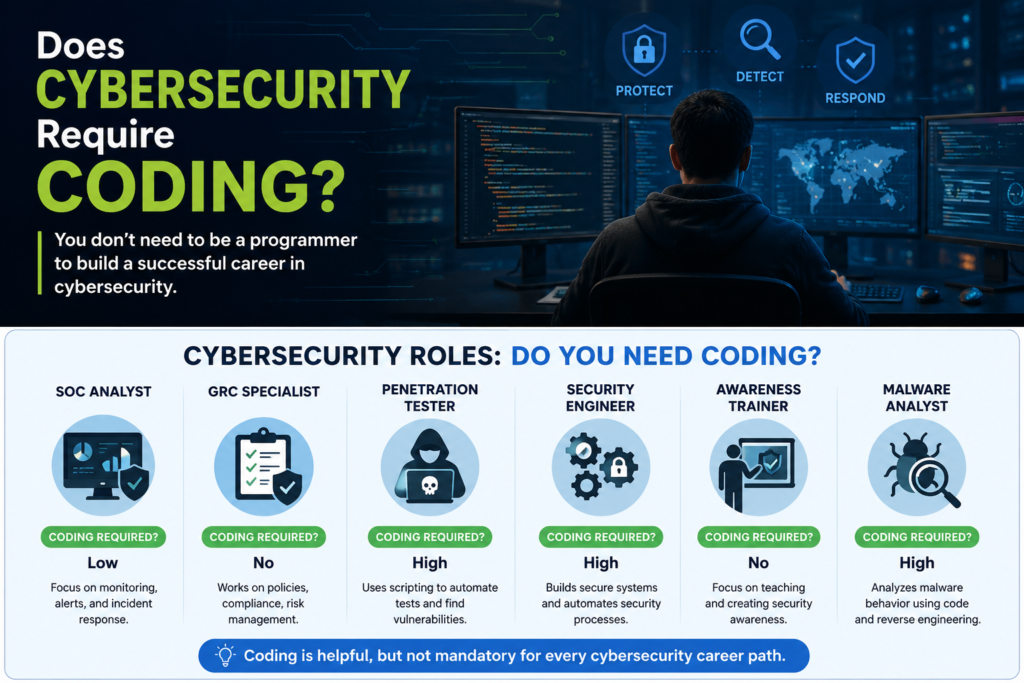
Coding generally starts to become relevant for the more technical career paths in Cybersecurity. The following jobs, to name just a few, use coding on a daily basis:
- Penetration Tester
- Malware Analyst
- Application Security Engineer
- Security Engineer
While you will find opportunities to excel at cybersecurity without being able to write an advanced piece of code to solve a complex problem, the ability to work with scripting languages like Python or Bash could put you on the fast track to highly technical jobs.
Which Cybersecurity Jobs Do Not Involve Coding?
Many non-coding roles focus heavily on documentation, requiring strong skills in drafting clear security incident reports and compliance audits. If you are not a fan of coding, don’t be discouraged, there are plenty of good cybersecurity jobs for you:
- Security Operations Center (SOC) Analyst
- Governance, Risk, and Compliance (GRC) Specialist
- IT Auditor
- Security Awareness Trainer
These are several of the cybersecurity jobs that do not require coding. As you can see, coding is not an absolute necessity for almost all cybersecurity fields.
Which Cybersecurity Jobs Are In Higher Demand?
| Role | Coding Required? | Common Languages |
|---|---|---|
| SOC Analyst | Rarely | None / basic scripting |
| GRC Specialist | No | None |
| IT Auditor | No | None |
| Security Awareness Trainer | No | None |
| Penetration Tester | Yes | Python, Bash |
| Malware Analyst | Yes | Python, C/C++ |
| Security Engineer | Yes | Python, PowerShell |
| Application Security Engineer | Yes | JavaScript, Python |
People Also Ask!
Can I get a cybersecurity job without learning programming first?
Yes. Many entry-level cybersecurity roles focus on monitoring, risk assessment, compliance, and incident response rather than software development. You can start your career without programming experience and gradually learn coding as you move into more technical cybersecurity positions.
Which programming language should I learn first for cybersecurity?
Python is the best first language for most beginners because it is easy to read and widely used for automation, scripting, and security testing. After Python, learning Bash, PowerShell, and SQL can further strengthen your cybersecurity skills.
Is cybersecurity a good career if I don’t enjoy coding?
Yes. Cybersecurity offers many career paths where coding is not a primary responsibility. Roles in governance, risk and compliance (GRC), security awareness, auditing, and security operations allow professionals to build successful careers with little or no coding.
How much coding is required for ethical hacking?
Ethical hackers usually benefit from coding knowledge, but they do not need to be expert software developers. Understanding Python, JavaScript, Bash, and basic scripting helps automate testing and identify vulnerabilities more efficiently.
Do cybersecurity certifications require coding knowledge?
Most beginner certifications, such as CompTIA Security+, ISC2 CC, and Google Cybersecurity Professional Certificate, do not require programming knowledge. Advanced certifications and penetration testing exams may expect basic scripting skills.
Whether you choose self-study or attend one of the top academic cybersecurity programs, initial coursework emphasizes core infrastructure over heavy software development.”
Can AI replace coding skills in cybersecurity?
AI can automate repetitive tasks and help write scripts, but cybersecurity professionals still need to understand security concepts, analyze threats, and verify AI-generated code. Human expertise remains essential for protecting systems and responding to attacks.
Final Thoughts
Does cybersecurity require coding? What you actually need is now clear, and it seems that coding is actually not that difficult to pick up. It might not actually even be as hard as you are making it out to be.
Although you will benefit immensely from having coding knowledge in certain cybersecurity fields, many entry-level cybersecurity jobs do not require extensive coding knowledge, which means you can start with minimal coding knowledge and build up from there.
Whatever the case may be, keep in mind that cybersecurity is an extremely broad discipline, and there are dozens of possible career options open to you, even if you are just starting. Now go forth, build your knowledge and skills, and enjoy your journey into the world of cybersecurity!