
Want to learn cybersecurity but don’t know where to start? The right book, or IT security book, can take you from zero knowledge to job-ready skills, at your own pace, on your own schedule.
This guide covers the 10 best cybersecurity and IT security books for 2026, organized by skill level. Whether you’re a complete beginner, preparing for a certification like CEH or Security+, or an advanced professional, there’s a book, textbook, or ebook on this list for you.
Table of Contents
Why Learn Cybersecurity from Books in 2026?
Online courses come and go, but cybersecurity books and IT security books offer something different: structured, reliable, and deep learning you can revisit anytime — in print, textbook, or ebook format.
Here’s why books still work:
- Structured learning: Books build knowledge step by step, from basics to advanced topics.
- Certification prep: Many top books align directly with CEH, CISSP, and CompTIA Security+ exam objectives.
- Self-paced study: Read at your speed, re-read tricky sections, and take notes without time pressure.
- Career value: Books teach real-world skills, not just exam answers.
Whether you want to break into cybersecurity or level up your current role, books give you the depth that short tutorials often miss. If you are trying to decide whether self-study through books is enough or if formal academia is required, evaluating is a cybersecurity degree worth it can help you choose the right path. For those using these resources to switch careers entirely, take a look at our complete guide on how much does cybersecurity specialist make to see what your new skills are worth in today’s market.
How to Choose the Best Cybersecurity or IT Security Book
Not every book suits every learner. Here’s a quick framework to pick the right one:
Match the Book to Your Level
| Book Level | Key Focus |
|---|---|
| Beginner | Plain-language explanations, no assumed tech knowledge |
| Intermediate | Hands-on labs, real attack examples, tool walkthroughs |
| Advanced | Deep dives into frameworks, reverse engineering, or SOC operations |
Ask These Four Questions
- What’s my focus area? Hacking? Defense? Certification prep? Cloud security?
- Do I learn better by doing or reading? Choose books with labs if you’re hands-on.
- Is the edition up to date? Look for books covering 2025–2026 threats, cloud security, and AI-driven attacks.
- Is the author credible? Check forums like Reddit r/netsec, cybersecurity communities, and university reading lists for trusted recommendations.
Top 10 Best Cybersecurity and IT Security Books for 2026
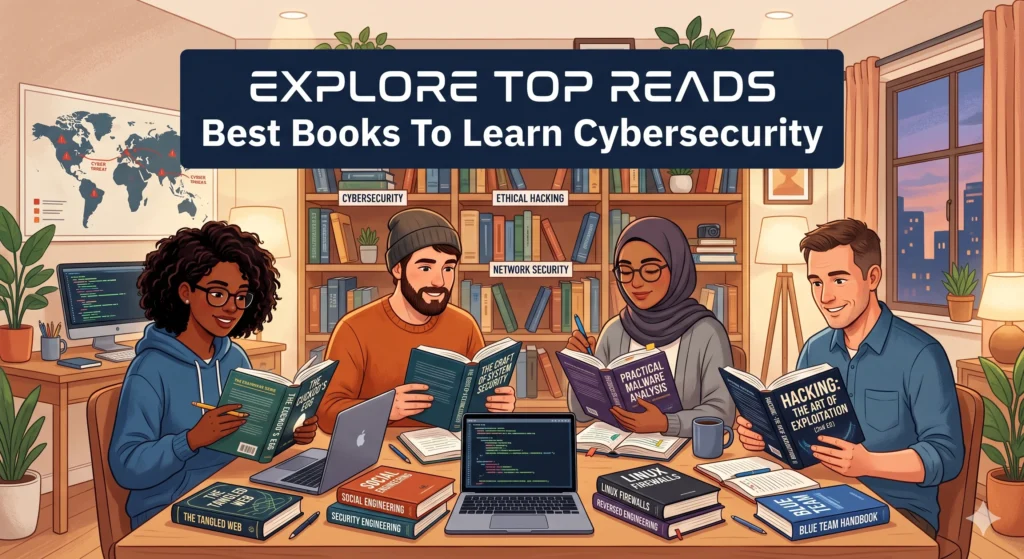
We’ve curated this list of best cybersecurity books and IT security books for 2026 based on expert recommendations, university reading lists, and training resources. The selections range from beginner-friendly manuals to hands-on ethical hacking guides and advanced resources.
We organized these books into three tiers: beginner, ethical hacking/pen testing, and advanced professional.
Best Cybersecurity Books for Beginners (2026)
These beginner cybersecurity books and IT security books assume no prior knowledge. They’re perfect if you’re just starting out or switching careers into IT security.
1. Cybersecurity for Beginners – Raef Meeuwisse
Best for: Total beginners who want a plain-English foundation.
This book covers the core ideas of cybersecurity, threats, defenses, and how attacks happen, without drowning you in technical jargon. It’s one of the most recommended starting points in beginner study guides and online communities.
What you’ll learn:
- Basic threat types and how they work
- How organizations defend against attacks
- Key cybersecurity terms and concepts
2. Cybersecurity for Dummies – Joseph Steinberg
Best for: Students and non-technical readers entering IT security.
Don’t let the “Dummies” title fool you. This book gives a solid overview of network security, data protection, and common cyber threats. It’s written in simple, accessible language that makes complex ideas easy to grasp.
What you’ll learn:
- How hackers target individuals and businesses
- Practical steps to protect devices and accounts
- Basics of network security
3. The Art of Invisibility – Kevin Mitnick
Best for: Anyone concerned about personal privacy and online tracking.
Kevin Mitnick was once one of the world’s most wanted hackers. Now he teaches you how to protect yourself online. This book is less technical than others on this list, but it’s eye-opening and highly engaging.
What you’ll learn:
- How companies and governments track you online
- Practical privacy tips you can use today
- How hackers think and operate
Top Ethical Hacking & Penetration Testing Books
These books go deeper into the offensive side of security. They’re ideal for anyone targeting a CEH certification or a career in penetration testing.
1. The Web Application Hacker’s Handbook – Dafydd Stuttard & Marcus Pinto
Best for: Developers and testers who want to find and fix web vulnerabilities.
This is a classic in the penetration testing world. It walks you through how attackers find weaknesses in websites and web apps — and how defenders can stop them. The content is technical but well-explained.
What you’ll learn:
- How to find SQL injection, XSS, and authentication flaws
- Step-by-step web vulnerability testing
- How to think like an attacker when building apps
2. Hacking: The Art of Exploitation – Jon Erickson
Best for: Learners who want to understand hacking at a deep technical level.
This book goes beyond surface-level tutorials. It covers programming, networking, and exploitation techniques from the ground up. If you’re concerned about learning C or assembly before starting, check does cybersecurity require coding to see which career paths actually demand software development
If you want to truly understand how hacking works, not just use tools, this is the book.
What you’ll learn:
- C programming basics for exploitation
- Buffer overflows and shellcode
- Network-level attack techniques
3. Metasploit: The Penetration Tester’s Guide – David Kennedy & Team
Best for: CEH exam candidates and aspiring pen testers.
Metasploit is one of the most widely used penetration testing frameworks in the world. This guide teaches you how to use it effectively, from scanning targets to exploiting vulnerabilities to writing reports.
What you’ll learn:
- Setting up and using Metasploit
- Running real-world penetration tests
- Reporting vulnerabilities professionally
4. The Hacker Playbook 3 – Peter Kim
Best for: Readers who want a hands-on, real-world red team approach.
This is one of the most practical books on the list. It reads like a field manual for penetration testers, full of attack scenarios, tool recommendations, and step-by-step exercises.
What you’ll learn:
- Red team tactics used in real engagements
- How to chain multiple vulnerabilities together
- Post-exploitation and lateral movement techniques
Advanced Cyber Security Books for Professionals
These advanced IT security books and textbooks are for experienced security professionals who want to go deeper into defense, malware, and system design.
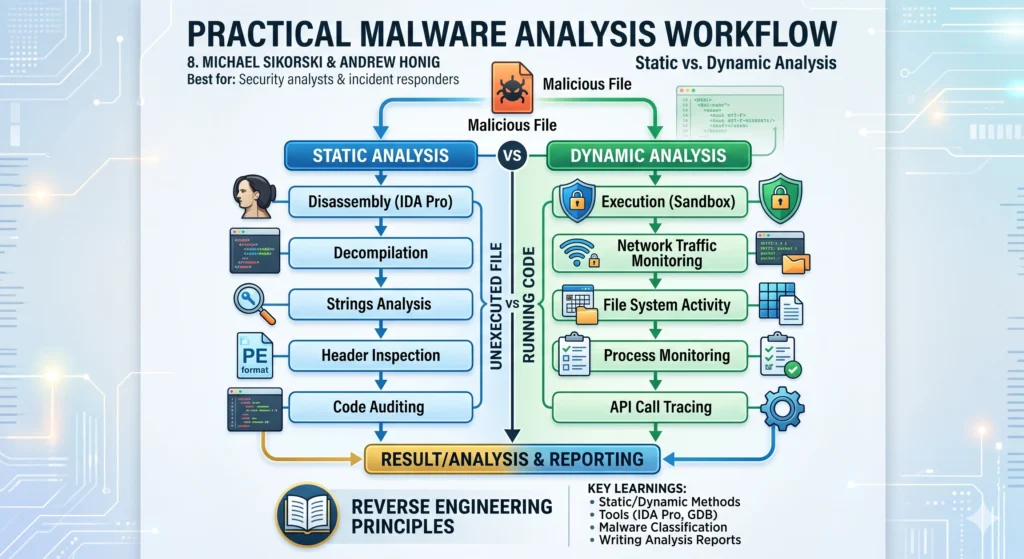
1. Practical Malware Analysis – Michael Sikorski & Andrew Honig
Best for: Security analysts and incident responders.
This is the go-to book for anyone who wants to understand how malware works from the inside. You’ll learn how to reverse-engineer malicious software, analyze its behavior, and respond to infections.
What you’ll learn:
- Static and dynamic malware analysis
- Reverse engineering with IDA Pro and other tools
- How to write malware analysis reports
2. Blue Team Field Manual (BTFM)
Best for: SOC analysts, incident responders, and blue team defenders.
This compact, reference-style manual is designed for quick lookups during real incidents. It covers commands, tools, and procedures for defending systems and responding to attacks.
What you’ll learn:
- Key commands for Windows and Linux defense
- Incident response checklists
- Network monitoring and log analysis essentials
3. Security Engineering – Ross Anderson
Best for: Senior professionals, architects, and CISSP candidates.
This is a dense, comprehensive textbook covering the full scope of information security — from cryptography and access control to psychology and policy. Ross Anderson is one of the most respected names in the field.
What you’ll learn:
- Security frameworks and risk management principles
- How secure systems are designed
- Real-world case studies of security failures
Bonus Recommended Reads
These didn’t make the top 10 but are worth your time:
| Book Title | Author | Best For |
|---|---|---|
| Cybersecurity and Cyberwar | P.W. Singer & Allan Friedman | Policy, ethics, global threats |
| Black Hat Python | Justin Seitz | Hackers who code in Python |
| Ghost in the Wires | Kevin Mitnick | Social engineering stories and lessons |
The best cybersecurity books range from beginner guides to advanced titles, including Cybersecurity for Beginners, Cybersecurity for Dummies, The Web Application Hacker’s Handbook, The Hacker Playbook 3, Practical Malware Analysis, and Security Engineering. These resources help students and professionals build skills in network security, penetration testing, and certification prep.
Cybersecurity Textbooks vs E-books, Which Format Should You Choose?
Whether you prefer a physical cybersecurity textbook or a cyber security ebook, most of the titles above are available in both formats. Here’s how to decide:
| Format | Best For | Trade-off |
|---|---|---|
| Print Textbook | Academic study, annotating, reference books like Security Engineering | Bulkier, harder to search, more expensive |
| Ebook | Searchable text, portability, studying on multiple devices | Harder to flip between sections quickly during labs |
| Audiobook | Conceptual books like The Art of Invisibility, commuting/passive learning | Not ideal for technical, code-heavy titles |
For hands-on, code-heavy titles like Hacking: The Art of Exploitation or Black Hat Python, a searchable ebook format usually works best so you can copy commands directly. For dense reference textbooks like Security Engineering, many readers prefer print or a tablet-based ebook they can annotate.
How These Books Help You To Pass Cybersecurity Certifications
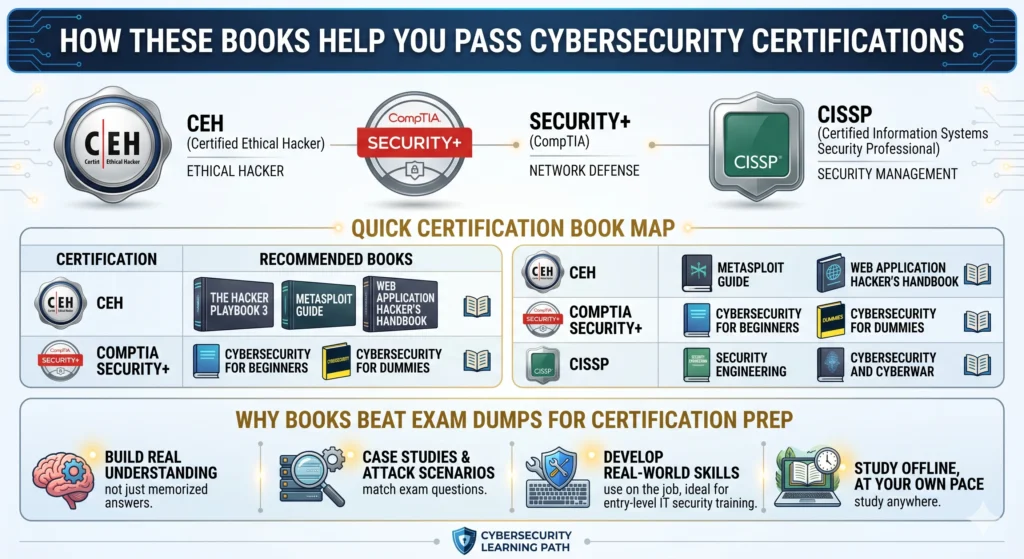
The best cybersecurity books and IT security books are more than just study material, they are powerful tools to help you pass certifications like CEH, CISSP, and CompTIA Security+ while also building real-world job skills.
Not sure which book supports which cert? Here’s a quick map:
| Certification | Recommended Books |
|---|---|
| CEH (Certified Ethical Hacker) | The Hacker Playbook 3, Metasploit Guide, Web Application Hacker’s Handbook |
| CompTIA Security+ | Cybersecurity for Beginners, Cybersecurity for Dummies |
| CISSP | Security Engineering, Cybersecurity and Cyberwar |
Passing these certifications is a primary milestone. For a broader, strategic look at how these certs fit into a complete career roadmap, see our ultimate guide on how to get into cybersecurity.
Why books beat exam dumps for certification prep:
- You build real understanding, not just memorized answers.
- You get case studies and attack scenarios that match exam questions.
- You develop skills you’ll actually use on the job, making them ideal for entry-level IT security training.
- You can study offline, anywhere, at your own pace.
Benefits of Using Books for Certification Prep
- Structured Learning: Books give a step-by-step path from basics to advanced cyber defense strategies.
- Real-World Scenarios: Many books include case studies, threat intelligence resources, and incident response guides.
- Study at your own pace with books and prepare for a cybersecurity certification flexibly.
- Deeper Understanding: Unlike just memorizing answers, books ensure you gain practical cybersecurity skills needed for IT jobs.
Books support cybersecurity certifications by providing structured learning, hands-on labs, and exam-focused content, thereby enhancing the learning experience. For CEH, choose books on ethical hacking and penetration testing. For Security+, start with the cybersecurity fundamentals guides. For CISSP, use advanced information security textbooks.
How to Get the Most Out of Cybersecurity Books
Here are some beginner-friendly tips to help you learn cybersecurity step by step using books:
1. Start with Fundamentals
Begin with beginner-level cybersecurity manuals, such as “Cybersecurity for Dummies” or “Cybersecurity for Beginners.” These books explain cybersecurity basics, threat prevention, and network security in simple terms.
2. Follow a Learning Path
Move from fundamentals → ethical hacking books → penetration testing guides → advanced resources.
Example: Start with Cybersecurity Essentials, then try The Hacker Playbook 3.
3. Practice While Reading
Many books include exercises. Use free tools alongside your reading:
- Kali Linux — for penetration testing practice
- Wireshark — for network traffic analysis
- Metasploit — for exploitation labs
4. Match Books to Your Certification Goal
If you plan to earn a CompTIA Security+, CEH, or CISSP certification, choose books that align with cybersecurity certification preparation. Example: Metasploit Guide for CEH, Security Engineering for CISSP.
5. Use Latest Editions Only
Pick the latest editions to keep up with cybersecurity trends in 2026, like cloud security, IoT security, and AI-driven attacks.
6. Join Cyber Security Communities
Combine book learning with forums, blogs, and study groups to enhance your learning experience. This helps you understand real-world cybersecurity case studies and defense strategies.
Start learning cybersecurity through books in 2026 by covering fundamentals, practicing with free security tools, following a clear learning path from basics to ethical hacking, and using updated editions that support certification preparation.
Quick Comparison: All 10 Books at a Glance
| # | Book | Level | Best For |
|---|---|---|---|
| 1 | Cybersecurity for Beginners | Beginner | Fundamentals |
| 2 | Cybersecurity for Dummies | Beginner | Non-technical readers |
| 3 | The Art of Invisibility | Beginner | Privacy & awareness |
| 4 | Web Application Hacker’s Handbook | Intermediate | Web pen testing |
| 5 | Hacking: The Art of Exploitation | Intermediate | Deep technical hacking |
| 6 | Metasploit Guide | Intermediate | CEH prep, pen testing |
| 7 | The Hacker Playbook 3 | Intermediate | Red team tactics |
| 8 | Practical Malware Analysis | Advanced | Malware & incident response |
| 9 | Blue Team Field Manual | Advanced | SOC & blue team defense |
| 10 | Security Engineering | Advanced | CISSP, system design |
FAQs
What are the best cybersecurity books for beginners in 2026?
For “best books to learn cybersecurity for beginners,” try Cybersecurity for Beginners by Raef Meeuwisse or Cybersecurity for Dummies by Joseph Steinberg. They cover cybersecurity fundamentals and provide beginner-friendly guides with clear explanations.
Which books help prepare for cybersecurity certifications, such as CEH?
Books like The Hacker Playbook 3 by Peter Kim and Metasploit: The Penetration Tester’s Guide are top cybersecurity books for CEH preparation, focusing on ethical hacking and penetration testing guides.
Are there cybersecurity books with practical exercises for hands-on learning?
Yes, “Practical Malware Analysis” by Michael Sikorski & Andrew Honig, and “Black Hat Python” by Justin Seitz, are cybersecurity books that include exercises for hands-on security practice and interactive cybersecurity learning.
How can I learn ethical hacking from books in 2026?
Start with “books to learn ethical hacking,” like Hacking: The Art of Exploitation by Jon Erickson, for advanced hacking techniques and cybersecurity certification prep.
What are the top cybersecurity books for advanced professionals?
Advanced cybersecurity books include “Security Engineering” by Ross Anderson, which covers cybersecurity frameworks, and “The Tao of Network Security Monitoring” by Richard Bejtlich, a valuable resource for expert-level cybersecurity knowledge.
Can cybersecurity books help with a career in cybersecurity for developers?
Absolutely, the Web Application Hacker’s Handbook supports cybersecurity for developers with secure coding books and vulnerability assessments, as well as cybersecurity career guidebooks for tech skill development.
What’s the difference between an IT security book and a cybersecurity book?
They’re largely used interchangeably. “IT security” often leans toward protecting business systems, networks, and infrastructure, while “cybersecurity” is the broader umbrella term covering personal, corporate, and national security. Most books on this list, including Cybersecurity for Beginners and the Web Application Hacker’s Handbook, work equally well whether you search for “IT security books” or “cybersecurity books.”
Are there good cybersecurity textbooks for university courses?
Yes. Security Engineering by Ross Anderson is widely used as a university-level cybersecurity textbook, alongside Cybersecurity and Cyberwar for policy-focused courses. Both are comprehensive enough to serve as core course material rather than just supplementary reading.
Can I get these cybersecurity books as ebooks?
Most titles on this list, including Cybersecurity for Dummies, Hacking: The Art of Exploitation, and Practical Malware Analysis, are available as ebooks in addition to print. Ebooks are especially useful for code-heavy books since you can copy commands directly instead of retyping them.
Final Thoughts
The best cybersecurity books and IT security books in 2026 aren’t just reading material — they’re career tools. Pick one that matches your current level, in whichever format (print, textbook, or ebook) suits how you learn, practice alongside it, and move up the ladder systematically.
Start with a beginner guide if you’re new. If you’re chasing a cert, match the book to your exam. If you’re already in the field, go deep with malware analysis or security engineering.
Pick one book today and start.