
Table of Contents
Cybersecurity software refers to programs designed to detect, prevent, and respond to digital threats that can affect computers, networks, applications, and data. These tools help protect against malware, phishing, unauthorized access, data breaches, and network attacks.
There are many types of cybersecurity software, and each one protects a different part of a digital environment. Antivirus software can detect malware, firewalls filter network traffic, while EDR, SIEM, XDR, IAM, encryption tools, and vulnerability scanners provide additional layers of protection.
Choosing the right cybersecurity software depends on what needs to be protected, the type of threats an organization faces, and how well the software works with its existing security setup. This guide explains the main types of cybersecurity software, their key features, and how to evaluate them before making a decision.
The article will provide a comprehensive list and description of cybersecurity software tools with the help of the essential information that the owner should know about each component. In addition, the article will highlight the critical features to look for and how to evaluate the cybersecurity tools to ensure that buyers do not waste money on ineffective software.
What Are Cybersecurity Softwares & What Does They Do?
Cybersecurity software helps detect, prevent, and respond to threats that target digital systems. Depending on the type of software, it may protect a device, network, application, user account, or sensitive data.
For example, antivirus and anti-malware software focus on malicious programs, while firewalls control network traffic. EDR monitors endpoints for suspicious behavior, SIEM analyzes security events from multiple sources, and IAM controls user access. Encryption protects data from unauthorized access, while vulnerability scanners help identify security weaknesses before attackers can exploit them.
These tools serve different purposes, so organizations often use multiple types together as part of a defense-in-depth security strategy.
| Cybersecurity Software Type | Main Purpose | Example Use Case |
|---|---|---|
| Antivirus / Anti-malware | Detects and removes malicious software | Blocking a ransomware-infected file |
| Firewall | Filters incoming and outgoing network traffic | Blocking suspicious connections to a server |
| Endpoint Detection and Response (EDR) | Monitors endpoints for suspicious activity and responds to threats | Detecting a process attempting to disable security controls |
| Security Information and Event Management (SIEM) | Collects and analyzes security logs and events from multiple sources | Detecting unusual login activity across an organization |
| Extended Detection and Response (XDR) | Correlates security data across endpoints, networks, cloud, email, and other sources | Investigating an attack that moves from email to an endpoint |
| Identity and Access Management (IAM) | Controls user identities, authentication, and access permissions | Requiring MFA for administrator accounts |
| Encryption Software | Protects data by converting it into an unreadable format without the required key | Protecting sensitive files stored on a laptop |
| Vulnerability Scanners | Identifies security weaknesses, outdated software, and misconfigurations | Finding an outdated server component that could be exploited |
No single cybersecurity software can protect every part of a digital environment. A firewall, for example, can filter network traffic but cannot protect against every malicious file or compromised account. Organizations therefore combine different security tools to create multiple layers of protection, a strategy commonly known as defense in depth.
Must-Have Features of Cybersecurity Tools
The right features depend on the type of cybersecurity software and what an organization needs to protect. However, security tools used for threat detection, monitoring, and response should provide several important capabilities that improve visibility, detection, and response.
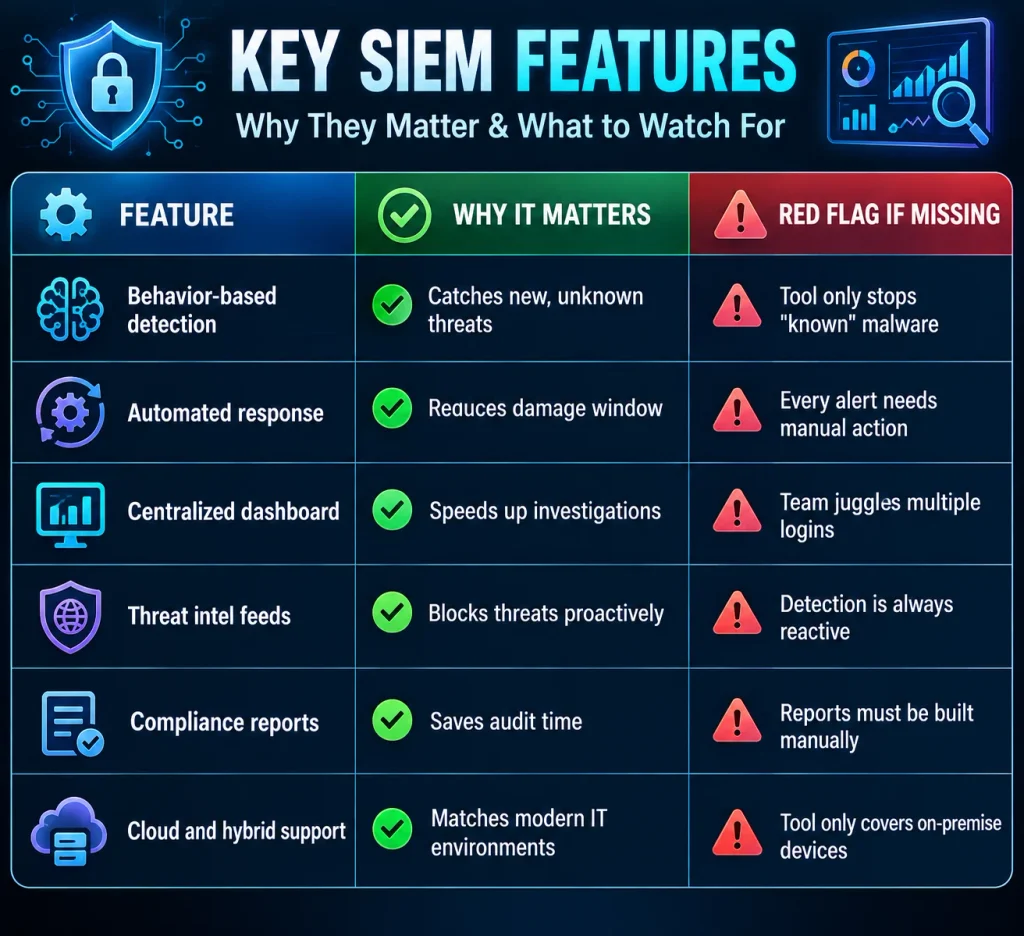
1. Real-time detections and alerts
The tool is not effective if it is not able to send out timely notifications. In practice, daily scanning is not sufficient, whereas continuous monitoring and alerting help protect the organization.
2. Behavior-based detections
Most traditional antivirus software uses known malware signatures to detect malicious code; however, newer malware does not have these markers, so the software cannot identify it.
3. Automated response
Detection is only possible if the tool can respond to the threat immediately.
4. Centralized visibility
Unified dashboards provide the analysts with consolidated information about the incident instead of forcing them to split their attention across several consoles.
5. Threat intelligence feeds
Having feeds helps the software recognize malicious patterns before they enter the network.
6. Log storage scalability
The tool must have the required scalability to allow users to sift through months of data.
7. Compliance reporting
It is vital to have the automated reporting feature if the company operates in a highly regulated industry.
How to Evaluate the Effectiveness of Cybersecurity Tools?
The buyer must know how to assess the efficiency of cybersecurity tools. First, check the test results to see if the tool is good enough. It is recommended to learn more about independent testing, such as AV-Comparatives testing and MITRE ATT&CK evaluations, and understand what they mean for the product. Second, use mean time to detect (MTTD) and mean time to respond (MTTR) to determine if the tool is appropriate for the organization. Ideally, these indicators should be as low as possible, but in either case, the software should improve the MTTD and MTTR after deployment.
Request a demonstration, a tabletop exercise, or a simulated attack, if possible. Most companies offer these services to showcase the tool’s unique characteristics. It is also vital to pay attention to the number of false positives because they waste the analysts’ time and attention. Furthermore, inquire if the tool is easy to set up and use with existing software. If the vendor has to customize the tool to work with the current cybersecurity ecosystem, it may be a costly affair.
Ask the vendor about the frequency of the software’s updates. A competent hacker can use new exploits to circumvent older tools, so the cybersecurity software must update constantly to stay ahead of the game. Before choosing specific security products, organizations should also consider how those tools fit into their broader cybersecurity framework and risk management approach.
How Antivirus Software Enhances Cybersecurity
How antivirus software enhances cybersecurity depends on its ability to detect, block, and remove malicious software before it can cause significant damage. Modern antivirus solutions use signature detection, heuristic analysis, and behavioral techniques to identify threats such as malware, ransomware, and malicious files. They can also scan files and, depending on the product, email attachments and other content for potential threats.
Besides, they use heuristic scanning to recognize the behavior of malicious code and protect the system. Another advantage is that antivirus software is relatively affordable and straightforward to deploy. Antivirus tools are the first line of defense and thus reduce the workload of other security tools, such as EDR and SIEM, by filtering out low-level threats.
The main disadvantage of traditional antivirus scanners is that they cannot detect targeted malware or insider threats, which is why the companies supplement them with EDR/XDR and IAM. Overall, modern antivirus software is effective, and organizations can use it to enhance their cybersecurity.
How Can Encryption Help to Improve Cybersecurity?
Data encryption is an essential element of any cybersecurity strategy. Even though it may seem that it does not offer much protection, it is an excellent way to minimize damage in case of an attack. For example, if an unauthorized person gains access to the system, they will not be able to read the encrypted data. Data encryption has three main types:
Data at rest encryption: Protects all data on storage devices, servers, and backups.
Data in transit encryption: Helps safeguard data on networks and is especially useful when data is transmitted via the internet.
End-to-end encryption: Ensures that no third party can access the data during transmission.
Key management: It is vital to store encryption keys securely and ensure that they are not vulnerable, since otherwise unauthorized users will gain access to critical data. Ideally, the keys must be kept separately from the data. Besides, cybersecurity analysts should remember that encryption is the best way to comply with data privacy regulations if an attacker gains access to the system.
What Are SIEM Tools in Cybersecurity?
Firstly, SIEM is an umbrella term for security information and event management solutions. Explaining in simple words, SIEM is a security operations ecosystem that ingests logs and events from various sources, be it firewalls, servers, applications, cloud platforms, and other IT infrastructure, and correlates this information to identify potential threats that a single source would not trigger on its own.
For instance, if one’s account was attempted to be hacked, one would not know about it without a SIEM, whereas a SIEM system would correlate failed logon events and detect anomalous activity such as unauthorized data exfiltration, simultaneous logons from different locations, and other suspicious patterns.
SIEM tools in 2026 tend to have a wide variety of additional functionalities; the most common include:
- UEBA (User and Entity Behavior Analytics) that establishes normal behavioral patterns and detects deviations.
- AI-powered first-line threat response and triage tools.
- XDR (Extended Detection and Response) correlation to ingest data about potential threats from external sources.
- Compliance management features to help auditors.
Finally, note that SIEM is not a set-and-forget solution; rather, it requires extensive tuning to establish relevant alerting thresholds. A poorly tuned SIEM might either trigger too many false positives, frustrating security analysts, or, on the contrary, fail to react to real incidents, exposing the organization to attacks.
What Are the Benefits of Cisco XDR in Cybersecurity?
Cisco XDR is a cybersecurity solution that helps enterprises streamline and strengthen their security operations. Unlike traditional tools, Cisco XDR unifies endpoint, network, email, cloud, and data security in one platform to help analysts respond to incidents faster. It is a beneficial addition to the cybersecurity software ecosystem for several reasons.
First, Cisco XDR enables faster and more accurate detection since the software uses extended detection and response across multiple areas to locate the source and scope of threats. Traditional systems require human analysts to manually investigate and correlate the events in search of the cause. Cisco XDR also reduces the mean time to detect and contain incidents, which allows organizations to limit the damage.
Second, the tool is helpful because it reduces the workload on the analysts. Cisco XDR automates the majority of incident investigation and response, leaving the mundane tasks for humans. It also makes it easier to troubleshoot since the software provides an in-depth understanding of what is happening in the system, as opposed to point solutions that are limited to one area. Finally, Cisco XDR can work with the existing security infrastructure and is not intended to replace other security solutions, such as SIEM or EDR.
Cisco XDR is the right choice for midsize and large businesses that want to prevent the attacks that traditional tools could not handle. The software uses artificial intelligence to detect threats efficiently and respond accordingly. Organizations can benefit dramatically from deploying Cisco XDR because it improves visibility, accelerates threat detection, and minimizes workload.
Creating an Effective Cybersecurity Software Stack
It is evident that one tool is not enough to ensure that the company is safe from cyber threats.
Enterprises must build the cybersecurity stack by combining several products, such as antivirus and EDR, to detect and neutralize threats. Organizations should also consider adding encryption to comply with data privacy regulations and prevent data breaches. SIEM is another useful product that allows the firm to monitor and oversee its cybersecurity around the clock. Lastly, Cisco XDR should be included in the cybersecurity stack if the company wants to ensure that no threats will bypass other tools.
Frequently Asked Questions
Does a small business really need a SIEM, or is that only for large enterprises?
Cloud-based SIEM options now offer usage-based pricing, which makes them affordable for smaller teams too. A small business with cloud apps, remote employees, or customer payment data still generates enough log activity to benefit from centralized correlation, even at a smaller scale than an enterprise deployment.
Can encryption slow down my systems or applications?
Modern encryption standards like AES-256 add minimal, often unnoticeable, processing overhead on current hardware. The bigger performance risk usually comes from poor implementation, such as encrypting and decrypting the same data repeatedly in a badly designed workflow, not from encryption itself.
What’s the actual difference between EDR and XDR if they sound similar?
EDR only watches endpoints, like laptops and servers. XDR expands that same detection logic across endpoints, network traffic, cloud environments, identity systems, and email, so it can catch attacks that move between these areas instead of staying isolated to one device.
How often should a cybersecurity tool’s detection rules be updated?
Threat intelligence feeds should update in near real time for critical indicators, while broader detection logic and behavioral models are typically refined by vendors on a weekly or monthly basis. If a vendor can’t tell you their update cadence clearly, treat that as a warning sign.
Is antivirus software still necessary if a company already has EDR?
Yes, in most setups they work as complementary layers rather than replacements. Antivirus filters out common, low-effort malware cheaply and quickly, which frees EDR’s more resource-intensive behavioral monitoring to focus on subtler, targeted threats that basic scanning would miss.
Final Thoughts
The cybersecurity software development process is not static, as new methods emerge to address the same problems of threat detection, damage control, and data privacy. The antivirus, SIEM, encryption, XDR, and other tools address diverse elements of the issue, but each has its niche. Multiple products are necessary to achieve an adequate level of security.
The most protected companies are not necessarily the ones that invested the most in the field. Instead, they optimized their expenditures by selecting the tools that address their specific issues and remaining aware of each product’s limitations. One should establish their security priorities and tackle the most pressing problems first, rather than trying to cover every vulnerability at once.