Table of Contents
Small businesses do not need a huge security team to improve cybersecurity. They need a clear plan for protecting their accounts, devices, data, and employees.
Learning how to implement a cybersecurity strategy for small businesses starts with knowing what needs protection and where the biggest risks are. From there, a business can put basic controls in place, assign responsibility, train its employees, and prepare for an incident before one happens.
The goal is not to buy every security product available. It is to build a practical security strategy that fits the business and can improve as the company grows.
The cybersecurity strategy for a small business is a detailed operating procedure that covers people, processes, and technology and is designed to evolve with the company’s needs. This article discusses how to develop a strategy, how much it costs in 2026, and what mistakes to avoid.
Why Do Small Businesses Need a Cybersecurity Strategy?
The myth that small businesses are not priorities for cybercriminals has existed for years, but statistics show that nearly 50% of all small businesses suffer an attack each year, and a successful breach occurs every few seconds in the economy. Criminals use automated tools that target vulnerabilities without discrimination, meaning the same script that exploits a Five Guys POS can easily breach a Fortune 500’s database.
The cost of a successful breach for small businesses is high, averaging between $120,000 and over $1 million after forensic investigations, legal fees, customer notifications, and lost revenue. Sixty percent (60%) of organizations that suffer an attack close within six months of the breach due to direct and indirect costs.
However, small businesses are statistically less likely to be targeted with sophisticated custom-built malware and more likely to be victims of opportunistic attacks that exploit known weaknesses. Those weaknesses are often easy to remedy by implementing multifactor authentication, regularly patching software, training employees, and storing data in secure backups.
How to Implement A Cybersecurity Strategy For Small Businesses?
Here are steps small businesses can take to develop a robust cybersecurity strategy:
Step 1: Map the Business’s Cyber Ecosystem
Before purchasing cybersecurity products, take a day to understand the business’s cybersecurity footprint by answering the following questions:
- Where is the business’s payment and customer data stored? Is it in a POS system, CRM, or other programs?
- What devices are on the company network?
- Who has administrative access to what data? Do past employees still have access?
- Who are the business partners and what access do they have?
Completing this exercise, sometimes called asset inventorying, is necessary for cybersecurity success because it ensures that nothing slips through the cracks. Business owners are surprised by how many vulnerable accounts or shared passwords turn up during this discovery phase.
Step 2: Pick the Right Cybersecurity Tools Stack
After identifying the business’s cybersecurity needs, it’s time to discuss how to protect data and minimize risk. Cybersecurity is rarely about a single product, and the right approach is to design a zero-trust framework, one that requires continuous verification before granting access to data or systems. A layered defense makes it harder for attackers to succeed.
A formal cybersecurity framework can also help a small business organize these controls and decide what to prioritize first. Before buying security tools, a business should identify its most important assets, likely threats, and the damage each risk could cause.
Multifactor Authentication (MFA)
MFA is the most critical security control, and it is often free. Microsoft and Google offer MFA options for their products, and most cybersecurity insurers consider it a must-have. MFA requires users to enter a security key besides the regular username-password combination during login. Cybercriminals cannot benefit from stolen credentials with MFA because they lack the second authentication factor.
How Password Managers Improve Small Business Cybersecurity
A password manager can improve small business cybersecurity by giving employees a secure place to store unique passwords without having to remember every credential. They eliminate the need to remember complex passwords, provide auditing capabilities for weak or reused secrets, and notify users when a credential leaks online. Premium password managers have monitoring features that detect breaches on the dark web, and those with business plans offer single sign-on capabilities for enterprise software. A business password manager gives employees a safer way to create and store unique credentials, while administrators can remove access when someone leaves the company.
Endpoint Detection and Response (EDR)
Traditional antivirus software is no longer sufficient for cybersecurity protection. Modern EDR tools use advanced analytics to detect abnormal activity on devices, such as unauthorized access attempts or ransomware trying to encrypt data. Most cybersecurity insurers mandate EDR software as a condition for policy coverage.
Backups That Actually Work
Backups are only useful when they work, and the best way to ensure that is to test them at least twice a year. Small businesses should also store backups separately, preferably offline, from company devices to prevent ransomware encryption. Offline backups may seem like a pain, but they are essential for organizations that cannot afford extended downtime.
Email and Web Filtering
Most cyberattacks originate from deceptive email messages, so standard cybersecurity tools include email filtering and web filtering solutions. The former scans incoming messages for malicious links or attachments, while the latter checks visited sites in real-time.
Step 3: See Who Is Responsible for Cybersecurity at a Company?
A common mistake in cybersecurity is to think that it is everyone’s responsibility, which is true in theory but not in practice, as experience shows that decentralized cybersecurity rarely prevents breaches. Cybersecurity should have a primary owner, a person accountable for the organization’s cyber posture. The owner will delegate duties to others but should possess the technical knowledge and authority to make decisions, such as who gets access to what data.
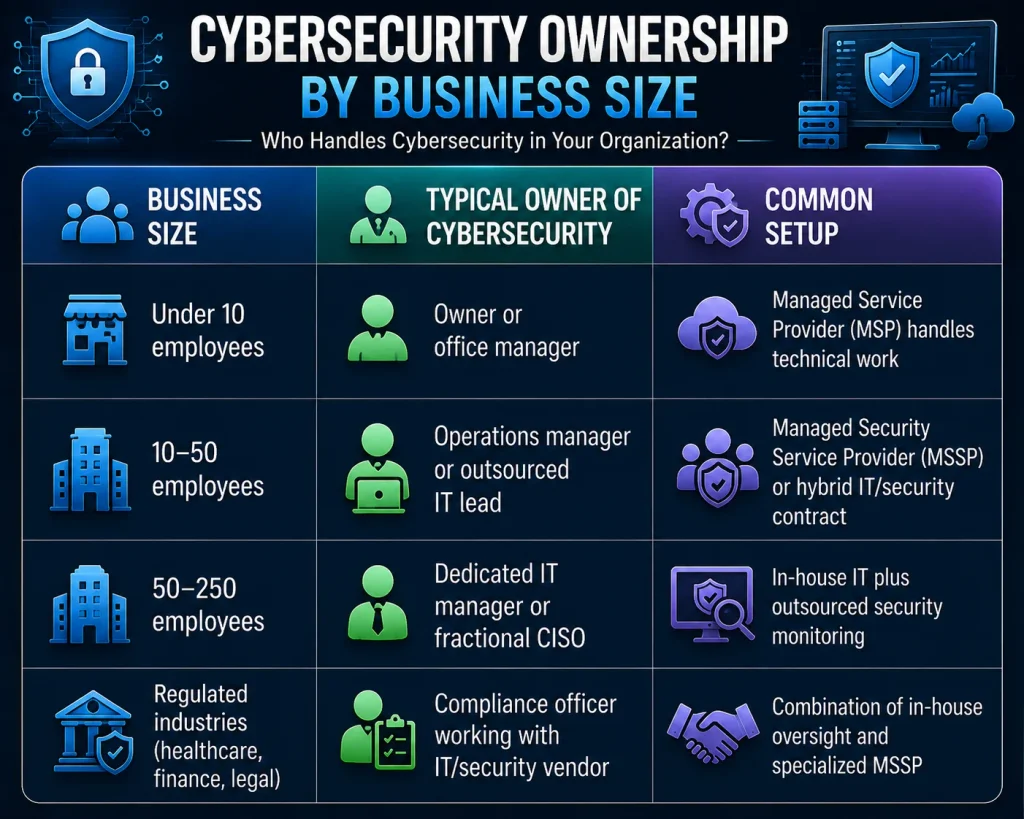
Fewer than a third of small businesses have an in-house cybersecurity team. At this level, it is normal for organizations to outsource some responsibilities while keeping others in-house, such as the IT manager having primary ownership over cybersecurity. The most critical consideration is that someone can respond to a security incident immediately without having to seek approvals from others.
Step 4: Train Employees
Employees are often the first line of defense against phishing and social engineering attacks. Understanding how social engineering works can help employees recognize suspicious requests before they become security incidents. Attackers know that getting a person to make one mistake can be easier than breaking through a well-configured security system. In most cases, employees are the cybersecurity perimeter, and attackers target the path of least resistance, which is human error.
Short monthly training sessions are more valuable than annual seminars that everyone forgets. Fifteen minutes of phishing awareness can help employees spot fake invoices or scams that mimic a manager’s email. Phishing simulations are also helpful because they highlight the weaknesses in human judgment, and they are eye-opening exercises that reduce future attack success.
Step 5: Know What Should Organizations Do Before a Cybersecurity Incident Happens?
A response plan cannot stop an attack, but it can reduce confusion when one happens.
The plan should be comprehensive, contain all the responsible parties and their activities, as well as the contact information. The plan should address such issues as:
- Who should call whom in case of an attack, including the contact information of the cyber insurance provider and a forensic IT specialist.
- Storing the response plan in an accessible location, in case the company’s email is shut down due to the cyberattack.
- Keeping all data and programs’ copies offline and secured.
- Developing a crisis communication plan to inform customers and regulators about the breach. Some states require organizations to report a cyberattack, so the plan should also consider the insurance company requirements, as they may dictate how the claim should be processed.
It is essential to review and update the plan at least once a year or more often if possible. Most small companies may take more than a day to respond adequately to an incident, while the response plan will help them save plenty of time.
Cybersecurity Cost Guide For Small Businesses
Most business owners have one practical question before building a security plan: how much do companies spend on cybersecurity? There is no single figure that fits every small business. The budget depends on the number of employees, the type of data handled, the systems in use, and how much security work is managed internally.
So, how much does cybersecurity cost for a small business? Basic protection can start with low-cost controls such as MFA, secure passwords, software updates, and tested backups. More complete protection costs more when you add endpoint monitoring, security management, employee training, and outside expertise.
| Cost Category | Typical Small Business Range | Notes |
| Annual prevention (tools, monitoring, training) | $5,000–$15,000 per year | Scales with employee count and data sensitivity |
| Managed security service (MSSP/MSP contract) | A few hundred dollars per user, per year | Often the most cost-effective route for teams without in-house IT |
| Incident recovery (if attacked without preparation) | $15,000–$50,000 for professional response | Can exceed $100,000 with ransomware or regulated data involved |
| Cyber insurance premium ($1M coverage) | $900–$3,500 per year | Businesses with MFA, EDR, and trained staff qualify for lower rates |
| Percentage of revenue spent on cybersecurity | Roughly 3–7% of the IT budget, rising each year | Small firms often spend a higher share of revenue than large enterprises because baseline tools cost the same regardless of size |
Prevention costs make up between 10 and 20% of post-breach costs on average. Most small businesses have little to nothing spent on cybersecurity, which explains why they appear frequently on the lists of victimized organizations. It is always cheaper to prevent than to deal with the consequences of an attack, even if cybersecurity seems like a smaller investment.
How Much Does Cybersecurity Insurance Cost for a Small Business?
If you are wondering how much does cybersecurity insurance cost, a small business may pay around $900 to $3,500 a year for a standalone policy with $1 million in coverage. The actual premium depends on the business, its revenue, industry, security controls, and the insurer’s requirements.
However, the price will vary depending on the industry, revenue, and the controls the business already has in place. Organizations in more security-intensive industries, such as healthcare or financial services, pay more for cyber insurance because of the sensitivity of the data they process. Additionally, businesses that lack standard security measures, such as MFA or EDR, either pay much more for their policies, or they do not get coverage.
Cyber insurance is an important component of a small business’s cybersecurity because it provides coverage for some of the most significant expenses associated with an attack. However, most of the controls cyber insurers recommend, such as MFA, EDR, verified backups, and employee training, are also essential for mitigating the damage and downtime caused by an attack. In other words, purchasing cyber insurance and implementing recommended cybersecurity controls are complementary activities that should occur together.
How to Choose a Reliable Cybersecurity Provider for Small Business
The small business cybersecurity landscape is littered with managed security providers that promise to protect businesses from attacks for a relatively low price. However, not all providers are equal, and it is important to conduct some research before choosing a cybersecurity partner. Here are some pointers for selecting a reputable provider:
- Ask about industry-specific considerations. Cybersecurity providers that work with healthcare organizations have a baseline understanding of HIPAA requirements, while providers with experience in retail know PCI-DSS standards.
- Ask about their response time in case of an attack. Reputable providers will give you an approximate idea of their response time in case of an attack, such as the guaranteed response time windows at 3 am on a weekend.
- Ensure there is a detailed breakdown of services. Avoid providers that promise to do everything and everything for a flat fee. Ask for specifics, such as what they do for patch management, EDR monitoring, and backup verification, because different providers have varying comfort levels with those tasks.
- Ask about insurance-related considerations. A competent provider will help the business get the most coverage for its premiums without leaving any security gaps.
- Ask for an explanation of services in simple language. There is nothing wrong with technical jargon, but providers that cannot explain what they do in simple terms demonstrate a lack of competence.
- Request at least three vendor proposals, and compare them using the same criteria.
- Remember that the cheapest provider is rarely the best option because they might not offer comprehensive services, leaving the business exposed to attacks. Always compare vendors based on their ability to handle specific tasks rather than going for the lowest overall price.
How External Cybersecurity Protects Brands
Many small business owners overlook the indirect effects of a cyberattack, such as the loss of consumer confidence. Cybersecurity breaches erode the trust of customers and partners, which can be especially damaging for small businesses that rely on word-of-mouth marketing and long-term clientele. Cyber insurance helps mitigate some of those indirect costs, but an external cybersecurity provider can help in another important way by providing credibility.
Small businesses can leverage their cybersecurity provider’s reputation by mentioning certifications on marketing materials or informing clients that the business has a robust security posture. This transparency is an important differentiator, as customers and partners have growing concerns about data privacy and security. Mentioning a cybersecurity provider’s name builds trust with consumers, and it also serves as an assurance to business partners that the small business takes data protection seriously.
Moreover, a strong external security presence enables a more transparent and professional response to a security incident, which is critical in maintaining consumer confidence. In other words, a small business is much less likely to lose customers after an attack if it has a trustworthy cybersecurity provider.
How to Strengthen Your Cybersecurity Posture Against Emerging Threats
Cybersecurity is a proactive endeavor, and businesses must update their defenses regularly to stay ahead of attackers. Cybersecurity vendors report that small businesses should review their cybersecurity strategy at least once a year to ensure it addresses current threats. Some of the most pressing threats small businesses are likely to encounter in 2026 are as follows:
AI is also changing the way attackers and defenders operate. Businesses that use AI tools should understand both the security benefits and the new risks they introduce. Small businesses need to be wary of AI-generated scams, such as fake invoices or phishing emails that appear to come from a business executive.
Supply chain attacks allow attackers to compromise a business by targeting its suppliers and vendors, making them a particularly relevant risk for small businesses that rely on outside organizations. Small businesses are also encouraged to bolster their defenses against business email compromise (BEC), a type of scam where cybercriminals impersonate company executives to trick employees into sending money or confidential information.
Cloud misconfigurations are another concern, especially for organizations that rely on cloud computing.
Small businesses can stay ahead of those threats by conducting regular cybersecurity assessments, ensuring that their IT infrastructure is up-to-date, and educating their employees about the latest security practices. However, it is important to note that those activities should be complemented by an annual review of the cybersecurity strategy to ensure that existing controls are sufficient to address emerging threats.
Building The Foundation For A Cybersecurity Strategy
For those who are new to building an organization-wide cybersecurity strategy, the following is a possible implementation roadmap:
- Inventory data, devices, and accounts.
- Turn on MFA for all accounts.
- Purchase a business password manager subscription.
- Set up EDR and verify that backups are working.
- Assign an owner for cybersecurity responsibilities.
- Research and request proposals from at least two cybersecurity providers.
- Apply for cyber insurance with recommended controls in place.
- Draft a response plan for potential cyber incidents.
- Schedule regular employee cybersecurity training.
- Review the cybersecurity strategy annually or whenever major changes occur.
This cybersecurity strategy implementation guide follows the security operations lifecycle, where preparation activities (such as conducting an inventory) reduce the impact of incidents, making it easier to respond to them and resume business operations. Moreover, some steps are more important than others, such as choosing a competent provider to handle day-to-day security operations. Small businesses that do not have the resources to handle those responsibilities in-house should make sure to select a provider that offers managed security services. At the same time, other preparatory steps, such as setting up password managers and MFA, benefit employees and make their cybersecurity duties easier.
Frequently Asked Questions
Do small businesses really need a formal cybersecurity strategy, or is basic antivirus enough?
Antivirus alone misses most modern attack methods, including phishing, credential theft, and business email compromise, none of which involve malware an antivirus program would catch. A strategy covering access controls, backups, training, and a response plan closes gaps that a single tool never could.
How often should a small business update its cybersecurity strategy?
Review the full plan at least once a year, and immediately after any major change, like hiring remote staff, adopting new software, or expanding into a new market. Threats and business operations both shift faster than an annual review alone can catch, so quarterly check-ins on backups and access lists are worth the extra time.
Can a small business get cyber insurance without an internal IT department?
Yes. Insurers generally care about controls, not staffing structure. A managed security provider maintaining MFA, EDR, and backups on your behalf typically satisfies underwriting requirements just as well as an in-house team would.
What’s the difference between a Managed Service Provider (MSP) and a Managed Security Service Provider (MSSP)?
An MSP typically handles general IT support, like device setup and troubleshooting. An MSSP specializes specifically in security monitoring, threat detection, and incident response. Some vendors offer both, but it’s worth asking directly which category a provider actually falls into before signing a contract.
Is it worth paying for a password manager if employees already use browser-saved passwords?
Yes. Browser-saved passwords don’t offer centralized visibility, don’t alert you to compromised credentials, and become a liability the moment an employee leaves without their access being revoked everywhere. A dedicated business password manager solves all three problems at once.
FINAL THOUGHTS
A cybersecurity strategy for small business would not necessarily focus on buying all available products. Instead, it would rely on a combination of a few power tools such as multifactor authentication, a password manager, an endpoint detection and response platform, regular testing of backups, and well-trained personnel. It would also require a documented strategy and a specific person who would be responsible for the ongoing process. Finally, purchasing cyber insurance would mitigate some of the financial losses if an attack still happens, and the whole strategy would be reviewed and updated annually.
The companies that suffered the most damage were the ones that did not have any particular strategy. Using the checklist provided above, one can address the most pressing issues first and then move on to resolving less critical problems.