Table of Contents
Most companies discover the importance of compliance when it is too late. When a client asks for a SOC 2 report, an auditor finds a concerning absence in access logs, or a regulator files a complaint about a data breach. By the time organizations realize the value of compliance, the damage is already done. Investing in preemptive controls is significantly more useful than trying to mend the aftermath of a security incident. Let’s learn why cybersecurity compliance important!
Let’s go!
The Basics of Cybersecurity Compliance
Cybersecurity compliance refers to a set of requirements that should be met by an organization to prove that it is maintaining the necessary level of security. These requirements can be defined by a specific regulation (for instance, there are strict rules for protecting health data, HIPAA), a standard developed for a particular industry (PCI DSS), or a contract specification (SOC 2 or ISO 27001 compliance).
In other words, cybersecurity compliance is about being able to demonstrate that an organization has implemented controls to ensure the confidentiality, integrity, and availability of data. It is always about evidence, and such evidence can have various forms, depending on the standard that has to be followed. For example, companies are often required to submit a report describing the results of a penetration test or a third-party audit. This may also include evidence of incident response preparedness or a list of security procedures in place.
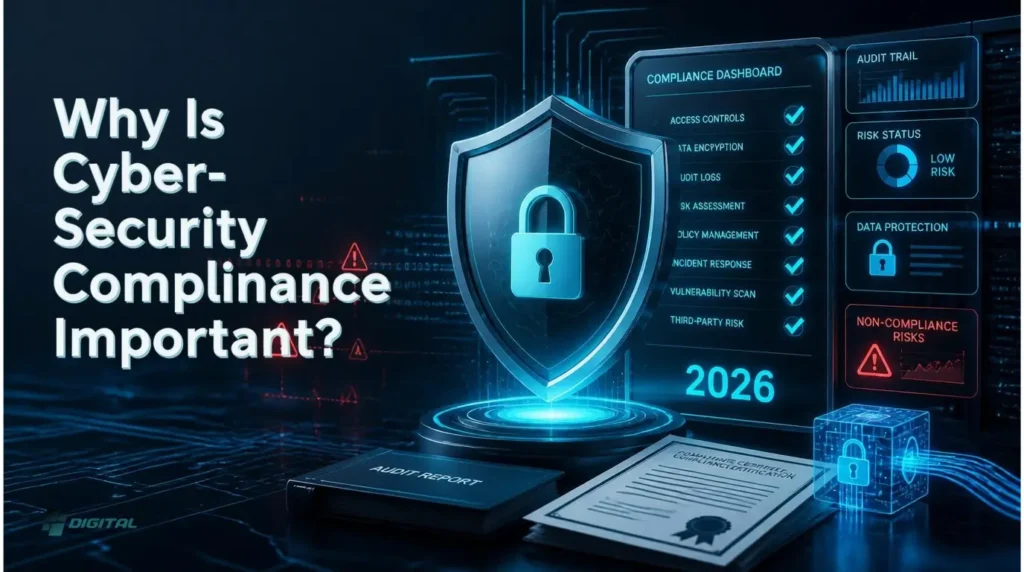
Why Is Cybersecurity Compliance Important?
Many companies do not understand that cybersecurity compliance is not a goal or a one-time achievement. Rather, it is a continuous process involving people, procedures, and technologies. Moreover, compliance is not just about preventing data breaches and ensuring security. It is about being able to formally demonstrate and prove this to an external party. Here are several reasons why most organizations should take compliance more seriously than they do.
Prevent Financial Losses
Regulatory fines are a significant risk for any company, especially if they experience a data breach or fail to implement required data protection measures. For example, HIPAA violations can lead to organizations being fined several hundred thousand dollars per incident. Fines imposed by the GDPR can be as high as 4% of the organization’s revenue if the breach involves the personal data of European Union residents.
By being compliant, companies reduce the chances of being penalized for regulatory failures. Another reason for being compliant is that many organizations will not want to work with you if you do not meet the relevant cybersecurity standards. Large corporations are now more likely to request compliance reports from external software providers and vendors. In many cases, such reports serve as the basis for contract approval, so refusing to provide one means losing business.
Finally, there is a direct link between compliance and company revenues. According to IBM’s research, the cost of a data breach in an organization with a comprehensive compliance and incident response framework is almost 3 times lower than in firms that do not have such measures in place.
Avoid Insurance Premium Increases
Insurance coverage is another critical factor that has to be considered when talking about compliance. Most insurance companies now require companies to demonstrate compliance in several key areas, including the implementation of multi-factor authentication, regular penetration tests, and employee training. In many cases, insurance policies are canceled for firms that do not meet these requirements, or their premiums are increased to unreasonably high levels.
What is Cybersecurity Governance: Cybersecurity Compliance vs. Cybersecurity Governance
Often, people tend to confuse these two terms, since they are closely related but answer different questions. Firstly, cybersecurity governance is a set of processes established by the governing body to clarify responsibility for appropriate cybersecurity management practices within the organization. This concept answers the questions of who should be responsible for designing security policies, buying the tools necessary for their implementation, and ensuring the accountability of these policies and tools. Secondly, cybersecurity compliance is a status that reflects whether an organization’s practices are aligned with established requirements or not. In other words, this term answers the question of who can verify that the organization did what it was supposed to do.
| Aspect | Cybersecurity Governance | Cybersecurity Compliance |
| Main question | Who decides, and how? | Can we prove it? |
| Focus | Policy, structure, accountability | Evidence, audits, documentation |
| Owned by | Board, CISO, risk committee | Compliance officer, security team |
| Output | Security strategy and policies | Audit reports, certifications |
| Timeframe | Ongoing, strategic | Periodic, tied to renewal cycles |
| Example | Deciding all remote staff need MFA | Proving MFA logs exist for every login |
Good governance makes compliance easier. Without clear ownership and policy, there’s nothing consistent to audit against.
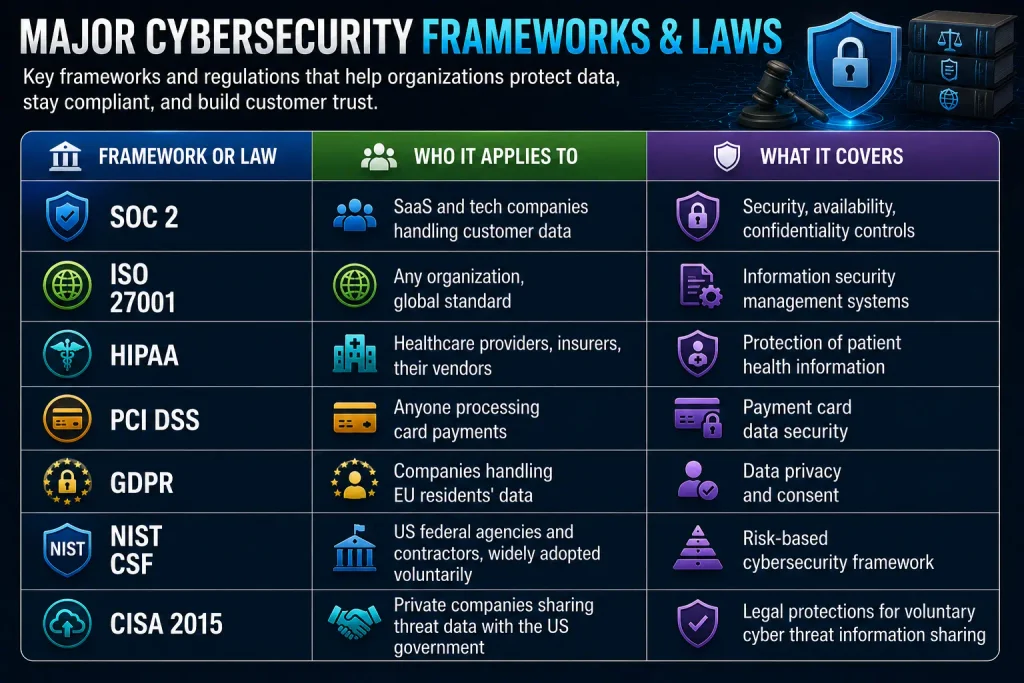
Major Cybersecurity Compliance Frameworks and Laws to Know
Different industries answer to different rules. Here’s a quick reference for the frameworks that come up most often.
What Is Cybersecurity Information Sharing Act (CISA 2015)?
The Cybersecurity Information Sharing Act of 2015 (CISA 2015) is a United States federal law that allows private entities to share information about cyber threats with each other and with the government while granting liability and antitrust law protections.
The law’s proponents contended that the ability to share threat intelligence quickly and confidently would enhance the cybersecurity posture of participating entities.
Did The Cybersecurity Information Sharing Act of 2015 Expire?
Yes, CISA 2015 expired on multiple occasions.
Most recently, it was due to expire on September 30, 2025, when Congress failed to extend it before the government shutdown in 2025.
During the period when the law was not in force, organizations could not take advantage of the legal protections it provided for sharing information about cybersecurity threats with the government and other private entities.
CISA 2015 was reauthorized on November 12, 2025, as part of the measure to end the government shutdown, with the new expiration date set to January 30, 2026.
It expired once again around that date before being reauthorized for the second time, with the new expiration date set to September 30, 2026.
The law is currently in force, although its intermittent expirations and renewals mean that organizations should be on the lookout for its status’s changes at all times.
Organizations that want to take advantage of the law’s threat intelligence-sharing provisions should consider having contingency plans regarding the possible legal and operational consequences that the expiration of the law might entail.
What Is a STIG in Cybersecurity?
A STIG (Security Technical Implementation Guide) is a document that contains detailed configuration instructions for a particular IT system created by the Defense Information Systems Agency (DISA).
It generally specifies the required measures to secure a given system, such as a database or operating system, to achieve a desired degree of cybersecurity.
For instance, a STIG for a Windows Server will specify the minimum length of a password, the ports that must be blocked, and the accounts that must be disabled by default.
There are a variety of STIGs, which apply to different IT systems and cybersecurity software.
Although they were developed for the Department of Defense, they are often used and relied upon by private organizations since they are comprehensive and publicly available on the official DISA website.
Most notably, following the STIGs guidelines is essential for any organization that wants to work with the Department of Defense since it is mandatory for all government contractors.
What Is RADIUS in Cybersecurity?
RADIUS (Remote Authentication Dial-In User Service) is a remote authentication protocol used to ensure that users are only granted access to a network if they have been authenticated.
It helps organizations meet compliance requirements by providing centralized access control and auditing capabilities.
When a user attempts to log in to a network, the request is sent to a central RADIUS server, which then authenticates the user’s request using the information provided in the directory.
The directory contains data about every user in the system, such as Active Directory, which then communicates the information about the user to the server.
RADIUS is important because it supports a variety of remote access types, including Wi-Fi, virtual private networks (VPNs), and dial-up connections.
It also aids in fulfilling compliance requirements, particularly those related to information security management.
Many industry-specific standards require organizations to implement a centralized access control system and demonstrate that their access control measures are working correctly.
What Are the Ways to Validate Compliance in Cybersecurity Practices?
Compliance validation involves determining whether specific controls or processes are implemented correctly and can provide the necessary level of cybersecurity.
Below are the steps that can be taken to conduct compliance validation:
- Mapping controls to the standard.
- This term refers to establishing what a particular standard requires and ensuring that the controls listed in the policies are appropriate for the tasks that the organization performs.
- It is crucial to make sure that all the necessary controls are included in the policies since any deficiencies found during the compliance validation process will need to be addressed.
- Continuous evidence collection.
- This step involves collecting evidence that shows that a particular control is operating correctly.
- It is essential for organizations to collect information about their cybersecurity practices regularly instead of waiting until the compliance validation day to present evidence.
- Evidence can take various forms, including screenshots indicating that certain policies have been followed, reports demonstrating compliance with specific regulations, and training records.
How Cybersecurity Startups Can Navigate Compliance and Security Certifications
Cybersecurity startups need to grapple with the tension between the time and resources spent on compliance and the value it provides to enterprise customers. How do these companies balance the need to demonstrate security without wasting too much time and money on certifications?
Most cybersecurity startups begin with SOC 2 Type I compliance, which focuses on design and controls at a moment in time, rather than over a multi-month period like Type II.
Founders are often drawn to compliance automation tools that can integrate with AWS, GitHub, Google Workspace, and other software to gather evidence of compliance, reducing a six-month full-time project into a part-time task.
In addition, many early-stage cybersecurity startups outsource their SOC 2 audit to a boutique CPA firm that specializes in SOC 2 for startups, since these firms have a better appreciation for the lighter-weight controls appropriate for a young company.
Cybersecurity startups that target healthcare, finance, or government verticals tend to pursue an additional standard such as HIPAA, PCI-DSS, or FedRAMP, but only for specific deals, rather than across the board.
Finally, most cybersecurity startups designate a chief compliance officer (even if they have other duties) to ensure that compliance processes are followed, rather than leaving it to engineers and lawyers.
Tools That Help With HR Cybersecurity Compliance
The HR function touches on many different compliance areas, since they are often responsible for onboarding and offboarding employees, managing training records, and overseeing access controls. The tools that help with HR cybersecurity compliance include:
- Identity and access management systems such as Okta or Microsoft Entra ID that can automatically disable access when an employee leaves the company
- Security awareness training platforms such as KnowBe4 or Curricula that track which employees have completed training
- HRIS systems such as Rippling or Gusto that can store policy acknowledgments and background check information
- Compliance automation tools such as Vanta or Drata that connect to other systems and extract information about employees, such as whether they have completed required training
- Document management and e-signature tools such as DocuSign that can collect policy acknowledgments and other documents
The main theme is automation – manually tracking training and policy acknowledgments is error-prone and time-consuming, especially at scale, and creates headaches for auditors who need to review this information
How to Choose a Cybersecurity Training Tool for Compliance Needs
Not every training platform fits every framework. Before choosing one, check for these things.
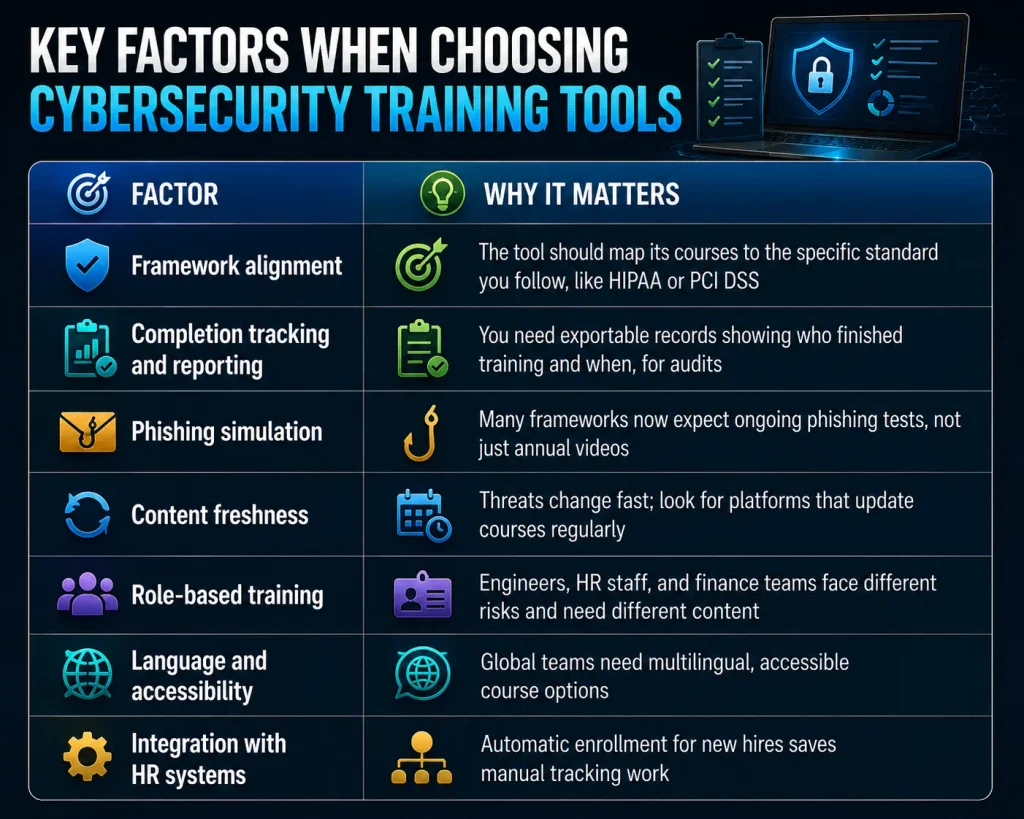
A small-scale test with a limited audience is an ideal way to assess the engagement of employees with a platform’s content since the completion rate is usually lower than for the entire workforce, making it less compliant.
Can Incident Response Training Help Reduce Cybersecurity Risk?
In most cases, the answer is affirmative, and multiple industry studies confirm that organizations that provide incident response training and conduct tabletop exercises are better prepared to respond to incidents promptly and limit damage.
Incident response training will help in multiple ways, including reducing the time employees spend deliberating on the correct course of action, minimizing human error, and preventing communication mishaps. This is achieved by providing a detailed walk-through of potential scenarios, each of which comes with specific instructions and key takeaways. As a result, an employee is less likely to make mistakes when responding to incidents, for example, by powering down a compromised server before isolating it, thus damaging the forensic analysis abilities of the response team.
Finally, incident response training is often required by law or, at minimum, by certain regulatory frameworks. For example, SOC 2, ISO 27001, and HIPAA compliance standards require organizations to demonstrate that they have an incident response plan and that it undergoes regular simulation testing.
Frequently Asked Questions
Is cybersecurity compliance the same as being fully secure?
No. Compliance proves you meet a defined baseline of controls, but a compliant company can still be breached if it faces a threat the framework didn’t anticipate. Compliance and strong security work best together, not as substitutes for each other.
How often does a company need to renew its compliance certifications?
Most certifications, including SOC 2 Type II and ISO 27001, require annual renewal audits. PCI DSS compliance is typically reassessed yearly as well, though the exact requirement depends on transaction volume.
Can a small business skip compliance frameworks entirely?
It depends on the industry and customer base. A small business that never handles regulated data or sells to enterprise clients may face fewer requirements, but even basic protections like data breach notification laws apply almost everywhere.
Who is legally responsible when a vendor causes a compliance failure?
Liability usually depends on the contract, but most frameworks now require companies to vet third-party vendors and hold them to similar standards through vendor risk assessments and signed agreements.
Does remote work change compliance requirements?
Yes. Remote and hybrid teams typically need stronger identity verification, device management policies, and secure remote access tools like VPNs or RADIUS-based authentication to meet the same standards that used to rely on office network security.
Final Thought
Cybersecurity compliance is a living and breathing entity. There is no end date for it – new laws emerge, such as the thrice-postponed CISA 2015, frameworks evolve, new tools appear that can make the auditing process more efficient, etc. Therefore, organizations that want to stay on the right side of the law need to think about compliance as an ongoing process. Even if they just want to get it out of the way before an important contract signing, they need to take it seriously and document all measures taken. This is simply the only way to provide satisfactory evidence of due diligence and meet regulatory requirements during an audit, an inspection, or when a nervous client asks for them.
The companies that fail at compliance usually see it as a chore to be completed – and the CISA 2015 debacle has shown us that such a philosophy will lead to failure. Organizations that do right, however, are able to embed a culture of compliance within their day-to-day, so that when the difficult time comes, they are prepared and have all documentation in order.