
Table of Contents
No. AI is not going to replace cybersecurity, but it is already replacing parts of what junior cybersecurity workers used to do all day. That distinction matters, and most articles answering “will cybersecurity be replaced by AI” skip right past it.
If you’re asking this question because you’re worried about your job. Or a client asked you about it, or simply, you’re deciding whether to even enter the field. You need the honest version, not the reassuring one and not the doom-and-gloom one either.
In short, AI is changing how cybersecurity professionals work. It is not replacing them. It can automate repetitive tasks like alert triage, malware detection, and report writing. However, it still falls short when it comes to human judgement, strategic decision-making, and defending against evolving threats. Here is what that means for the future of cybersecurity careers.
Why This Question Keeps Coming Up
Every few months, a new AI security tool launches with a demo showing it catching a breach, writing an incident report, or triaging alerts faster than a human analyst. Vendors post the demo. Someone on LinkedIn says “cybersecurity jobs are done.” A security manager somewhere quietly cuts their tier-1 SOC headcount by two people. And the search volume for “is cybersecurity AI proof” spikes again.
There’s a real thing happening underneath the hype. Security operations centers process a genuinely absurd number of alerts. A mid-sized company can generate thousands per day, and most of them are false positives. That’s tedious, repetitive, pattern-matching work, which is exactly the kind of task AI is good at. So yes, AI is already doing some of the work cybersecurity teams used to pay entry-level analysts to do manually.
That’s not the same as AI replacing cybersecurity as a field.
The growing interest in AI-powered security isn’t just hype. According to the 2024 IBM Cost of a Data Breach Report, organizations that extensively use AI and automation in cybersecurity identify and contain breaches 100 days faster on average than those that don’t. That kind of efficiency explains why companies are investing heavily in AI—not to eliminate cybersecurity teams, but to help them respond faster and reduce the burden of repetitive work.
What AI Is Actually Good At Right Now
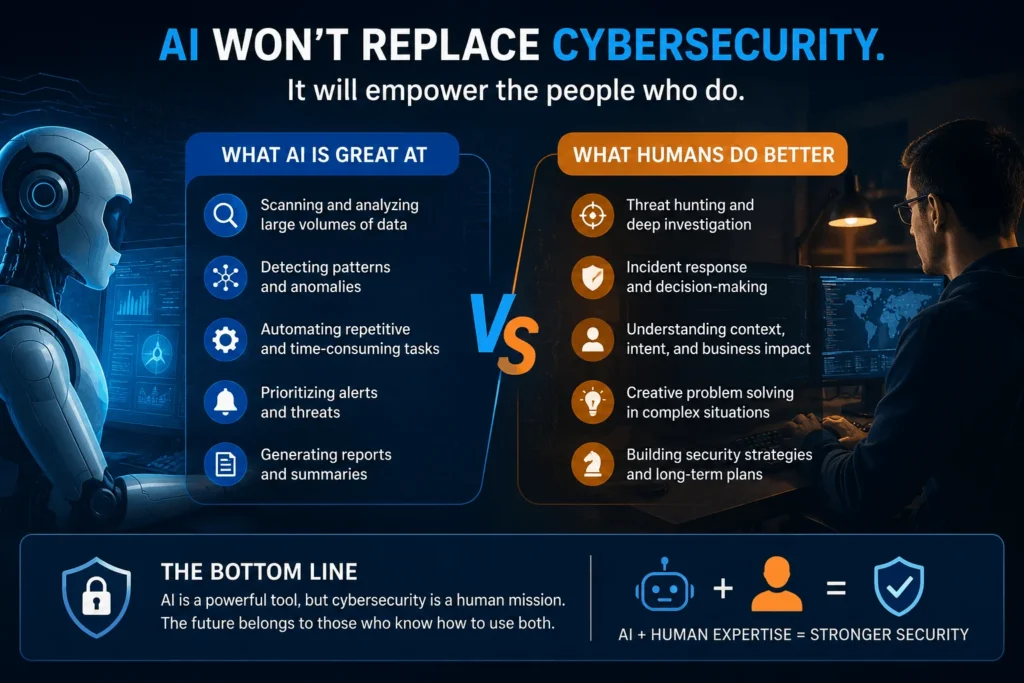
Alert triage is the most obvious one. You can use machine learning to sort through your SIEM output and identify the few genuine alerts that require human investigation. And then suppress the rest. A human still reviews the flagged items, but they’re reviewing 200 instead of 4,000.
Phishing detection is another one. Natural language processing is pretty good at identifying the linguistic patterns in a phishing email. Even if it’s not a known phishing campaign, or doesn’t have any known malicious links or attachments. Endpoint detection tools can use behavior-based models to spot malware that doesn’t have a signature, which traditional antivirus couldn’t catch.
You could also use it for generating reports. First drafts of incident reports, or vulnerability reports, or even penetration testing reports. Anything that requires a certain amount of rote human thought is probably a candidate, since it’s busywork that security professionals would rather not do.
It’s Already Happening, Just Not the Way Headlines Say
This isn’t hypothetical anymore. Security companies are already investing heavily in AI while restructuring parts of their workforce and workflows. That doesn’t mean cybersecurity is disappearing. It means the types of work companies need from security teams are changing.
What those stories almost never mention is what replaced those roles: not nothing, but different roles. The teams doing the cutting weren’t eliminating their security function, they were shrinking the part of it that looked like a human doing a script’s job and reinvesting in the part that required actual judgment. That distinction is the whole answer to this article’s title, condensed into one sentence.
What AI Still Can’t Do
Attackers are innovative and think in unconventional ways, unlike machines. A model trained on last year’s attack patterns is naturally behind on this year’s novel technique, because novel means it hasn’t been seen before. Humans are better at innovation which makes them good at evading existing measures as red teams and threat hunters do.
It can be hard to explain to a board of directors or a judge what went wrong if the organization is breached, and the response plan implemented fails to mitigate the damage. The AI cannot give testimony, be accountable, or make real-time ethical decisions like humans do.
Social engineering works because humans are susceptible to manipulation, even when they know they should not be. A competent AI system can detect spam emails. However, it would be hard to train such a system to detect deception in a phone call where a caller pretends to be a stressed employee contacting help desk support. This requires social skills and emotional intelligence, an area where humans excel over AI.
Prompt injection, data poisoning, and adversarial AI are all areas where attackers can target AI systems, making it paramount to have humans secure AI as well.
| AI Can Automate | Where Human Expertise Matters |
|---|---|
| Alert triage | Incident response leadership |
| Malware and anomaly detection | Threat hunting |
| Routine vulnerability scanning | Security architecture |
| Initial incident report drafting | Strategic risk assessment |
| Log analysis and pattern recognition | Creative problem-solving |
| Phishing email detection | Social engineering defense |
| Repetitive security monitoring | Judgment during active cyberattacks |
Will AI Replace Cybersecurity Jobs?
Not the field. But it’s already reshaping which jobs exist within it, and that’s the part worth taking seriously.
Many people also ask “will AI affect cybersecurity jobs?” The honest answer is yes. But mostly by changing daily responsibilities rather than eliminating the profession. AI is reducing time spent on repetitive tasks, allowing cybersecurity teams to focus on investigation, strategy, and complex threat response instead of routine monitoring.
Entry-level, repetitive tier-1 SOC work is shrinking. If your entire job is watching a dashboard and escalating tickets based on a checklist, that role is getting automated or absorbed into a smaller team. This is the honest answer to “will cybersecurity jobs be replaced by AI” — some of them, yes, specifically the ones that were always closest to a script. If you’re trying to break into the field right now, it’s worth reading up on which entry-level cybersecurity jobs don’t require a certification first, so you’re not aiming at a role that’s already being automated.
At the same time, demand is growing for people who can do the things AI can’t: threat hunting, incident response leadership, security architecture, AI security, governance and compliance, and translating technical risk into decisions that non-technical executives can act on.
A non-technical executive can act on. If you’re unsure what a day-to-day analyst role actually involves. Our breakdown of what a cybersecurity analyst does walks through the responsibilities and skill progression. On the compliance side, GRC roles are a good example of work that leans on regulatory judgment AI can’t own on its own. These roles need judgment, context, and the ability to be wrong in an interesting way and learn from it, none of which AI does well yet.
That demand is backed by industry data. According to the ISC2 2024 Cybersecurity Workforce Study, the global cybersecurity workforce shortage still exceeds 4.8 million professionals. In other words, the industry doesn’t have too many cybersecurity experts, it has too few. AI may reduce the need for repetitive manual work, but it isn’t closing the talent gap on its own. Organizations still need skilled professionals who can investigate incidents, make critical decisions, and adapt to new attack techniques.
This isn’t a new story either. IT automation didn’t eliminate IT jobs in the 2000s, it moved people up the stack, away from manual server maintenance and toward architecture and strategy. Cybersecurity is going through the same shift, just faster.
Is Cybersecurity AI-Proof?
No one area is completely proof against automation and anyone telling you otherwise is selling something.
So, can cybersecurity be replaced by AI? Not realistically. While AI will continue to automate repetitive security operations and improve efficiency, cybersecurity remains an adversarial field where attackers constantly evolve their tactics. That ongoing battle requires human creativity, ethical judgment, and strategic decision-making that current AI systems cannot replicate
Cybersecurity is closer to being automation-resistant than most people would like to admit. The job requires people to constantly be one step ahead of the enemy, meaning they must always be adapting in order to stop increasingly sophisticated attacks. This makes automation all but impossible since the nature of the work is completely adversarial instead of simply being a pattern to be identified.
What Industry Leaders Think About AI in Cybersecurity
This shift is also reflected in how leading security companies are approaching AI. Organizations like Microsoft, Google Cloud, and CrowdStrike consistently position AI as a force multiplier rather than a replacement for security professionals. Their focus is on helping analysts investigate threats faster, reduce alert fatigue, and prioritize high-risk incidents, while leaving critical decisions and accountability in human hands. That industry-wide direction reinforces an important point: AI is becoming part of the cybersecurity toolkit, not a substitute for the people using it.
How to Future-Proof a Cybersecurity Career
A few things actually move the needle here:
- Get comfortable working alongside AI tools instead of competing with them. Analysts who know how to use AI-assisted triage, threat intel platforms, and automated reporting tools are more valuable, not less, because they can cover more ground.
- Move toward specialization that requires judgment: incident response, threat hunting, penetration testing, security architecture, or GRC. These are harder to compress into a model. If you’re mapping out the path itself, our guide on how to get into cybersecurity without prior experience covers the routes that lead to these higher-judgment roles instead of the ones getting automated. It’s also worth checking what different cybersecurity roles actually pay before you specialize, since the AI-resistant roles tend to pay more anyway.
- Learn how AI systems themselves get attacked. Model security, adversarial ML, and prompt injection defense are new enough that almost nobody has deep experience yet. Early movers here have a real advantage.
- Build the communication skills that let you explain risk to people who don’t have a security background. That skill was always underrated in this field, and it’s becoming more valuable as the technical filtering gets automated.
The Bottom Line
Can AI replace cybersecurity? No. AI will continue transforming the industry and automating repetitive work, but cybersecurity itself is not going to be replaced. Instead, professionals who learn to work alongside AI will be in the strongest position as the field continues to evolve.
Can it replace certain cybersecurity tasks and some entry-level roles? Yes, and it already is. The people who’ll do fine over the next five years aren’t the ones hoping AI stays out of the field. They’re the ones learning to direct it, audit it, and outthink the attackers who are using it too.
Key Takeaways: Will Cybersecurity Be Replaced By AI?
- AI isn’t replacing cybersecurity. It’s taking over repetitive tasks so security teams can focus on the work that requires real expertise.
- Routine jobs like alert triage, log analysis, and report writing are becoming more automated, but human judgment still drives the most important security decisions.
- Careers in areas such as threat hunting, incident response, security architecture, and AI security remain in high demand because they rely on critical thinking and experience.
- Professionals who learn to work with AI tools will have a clear advantage as cybersecurity continues to evolve.
- The future of cybersecurity isn’t about humans versus AI. It’s about skilled professionals using AI to detect threats faster, respond more effectively, and stay ahead of attackers.
FAQs
Will AI take over cybersecurity jobs completely?
No. AI automates repetitive tasks like alert triage and basic phishing detection, but roles requiring judgment, accountability, and adversarial thinking, like incident response and threat hunting, are not realistically automatable with current technology.
Is cybersecurity going to be replaced by AI in the next few years?
Unlikely. What’s changing is the mix of tasks within cybersecurity jobs, not the existence of the field. Demand for AI security specialists and senior analysts is actually rising.
Can AI replace penetration testers or ethical hackers?
Not fully. AI tools can automate some scanning and reconnaissance, but creative exploitation and chaining unexpected vulnerabilities together still require a human attacker’s mindset.
What cybersecurity jobs are safest from AI automation?
Threat hunting, incident response leadership, security architecture, GRC and compliance, and AI/ML security are the roles least likely to be automated, since they depend on judgment and context AI doesn’t have.