
For most career changers with a plan, yes. A cybersecurity bootcamp is worth it if you finish the program, build proof of your skills, and treat the job search as a second job. It is not worth it if you expect a certificate to open doors for you. That is the honest answer, and below, you can see the rest of the details, including the fine print that bootcamps do not want you to notice.
Let’s know together are cybersecurity bootcamps worth it in 2026!
What a Cybersecurity Bootcamp Really Costs You?
Tuition is not the only cost, which is why most programs have a wide range. There are three things that you need to consider when calculating the ROI (return on investment) of a cybersecurity bootcamp, and failing to account for any of these will give you inaccurate results.
Tuition: Most bootcamps range between $8,000 and $20,000 for a full-time program, while self-paced or scholarship-assisted options are available for as low as $3,000.
Opportunity cost: If you quit your job to go to bootcamp, it will have a significant impact on your ROI, so be sure to factor in the income that you lost while you were in training.
Certification exams: Many bootcamps will include the voucher for the CompTIA Security+ exam in the tuition, but most charge around $400 to $600 for it separately.
When you analyze tuition cost, you can better have an answer for ‘are cybersecurity bootcamps worth it?’
What a Cybersecurity Bootcamp Really Costs You?
| Cost Factor | Estimated Range (2026) | Notes |
|---|---|---|
| Tuition (full-time) | $8,000 – $20,000 | The range depends on the type of mentorship and teaching format |
| Tuition (self-paced) | $2,000 – $6,000 | Fewer hours of mentorship and support, longer average completion time |
| Opportunity cost | $6,000 – $12,000 | Based on the average entry-level salary for 3 months of work |
| Certification vouchers | $400 – $1,200 per exam | Some bootcamps include them in the tuition |
| Total realistic investment | $12,000 – $30,000 | Tuition + opportunity cost + certification exams |
The realistic ROI for a cybersecurity bootcamp in 2026 is between $12,000 and $30,000. The $10,000 on a bootcamp’s website is only the tuition, and it does not include the opportunity cost. Most bootcamps that promise an ROI in less than a year do not account for it either, which makes their advertised numbers artificially low.
What You Can Expect to Earn After a Cybersecurity Bootcamp
The starting salary depends on your specialization, experience, and the area that you live in. According to multiple outcome reports published in 2026, the average starting salary for bootcamp graduates who land a security-specific job is between $18,000 and $88,000, with most of them making between the low $65,000 and $50,000s and the low $75,000. Graduates who move into a broader “security-adjacent” IT role, rather than a pure analyst seat, often start lower, in the high $60,000s.
The earning potential is the major answer for “are cybersecurity bootcamps worth it?”
Average Starting Salaries for Cybersecurity Bootcamp Graduates
| Salary Range | Entry-level (2026) | Notes |
|---|---|---|
| Low | $50,000 – $60,000 | Most common for bootcamp graduates with little to no experience |
| Mid | $60,000 – $80,000 | For those with relevant experience or certifications |
| High | $80,000 – $100,000+ | For more experienced workers or those in high-demand areas |
The higher end of the range is more common for people who had some experience in the IT field before the bootcamp, while those with a portfolio of relevant labs and certifications can also increase their chances of landing a higher-paying job. Location is another factor, as salaries in finance centers, government contractor hubs, and major technology markets are generally higher by 10-20%.
Job Placement Rates: What They Really Mean
When it comes to job placement rates, most bootcamps that publish this information only report numbers that came directly from their sales team, and “employed” can include part-time, unrelated, or even pre-bootcamp jobs.
Here are some things to look for when you research a bootcamp’s job placement rate:
- Audited by a third party: Only a few bootcamps publish their outcomes data through an independent auditor (CIRR), so if a bootcamp does not mention it, their numbers are most likely artificially high.
- Time frame: A 90% job placement rate within 12 months is a much better result than 90% within 6 months, so ask for specifics.
- Job relevance: Ask if the statistic includes any type of job, including those unrelated to cybersecurity.
A realistic job placement rate for a cybersecurity bootcamp in 2026 is between 70% and 85% within 6-12 months after graduation.
Cybersecurity Bootcamp vs. Degree vs. Self-Study: Which One is Better?
It depends on your situation, but here is a brief overview of the differences between the three options.
| Option | Estimated Cost | Estimated Time | Best For |
|---|---|---|---|
| Cybersecurity bootcamp | $8,000 – $20,000 | 3 – 9 months | Career changers who need structure and mentorship |
| Bachelor’s degree | $40,000 – $120,000+ | 4 years | Those under 22 with financial aid |
| Self-study + certifications | $500 – $3,000 | 6 – 18 months | Disciplined students already in the IT field |
| Community college certificate | $3,000 – $8,000 | 1 – 2 years | Those on a budget who want accreditation |
A degree is still the best option for people who want to work in government security or defense-contractor jobs, as many of these roles require a degree for a security clearance. In other cases, experience and skill matter more than the type of education, which is why many employers now value bootcamp graduates as much as degree holders.
Are Cybersecurity Bootcamps Worth it?
Let’s know more deeply ‘are cybersecurity bootcamps worth it?’ by analyzing who should and shouldn’t attend them:
Who Should Attend a Cybersecurity Bootcamp
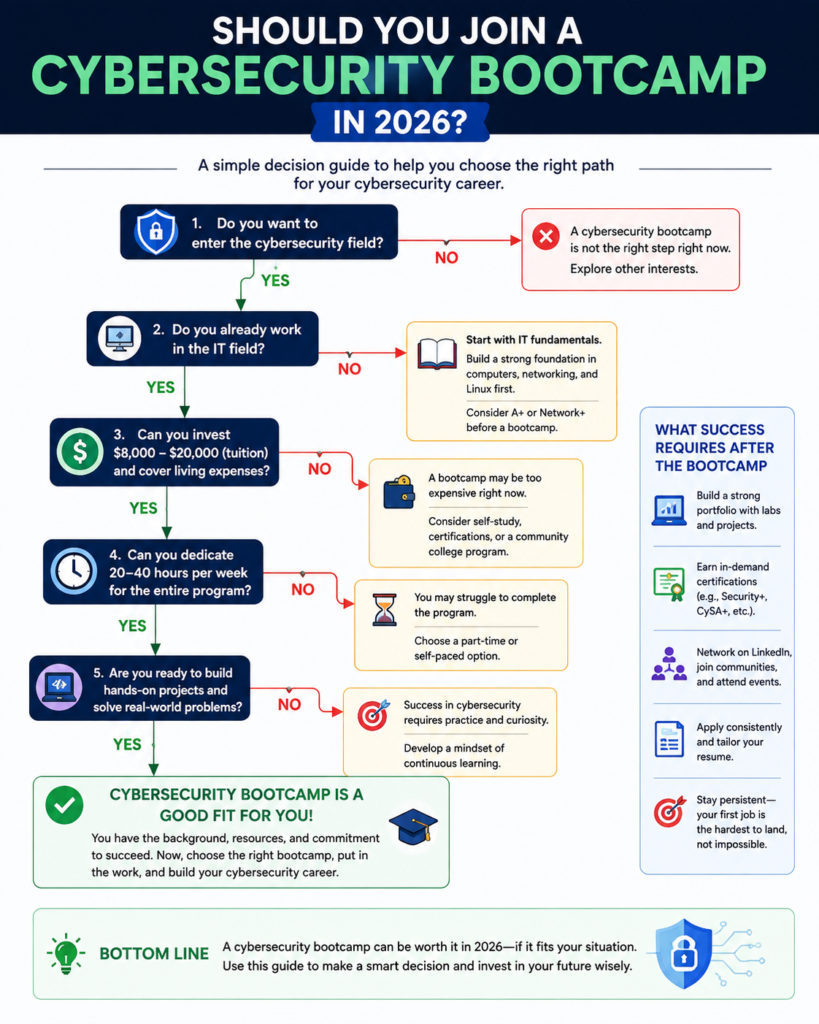
A cybersecurity bootcamp is a good fit for most people who fall into the following categories:
- They already work in the IT field and want to transition into cybersecurity
- They have enough free time to dedicate 20-40 hours per week to the bootcamp for its entire duration
- They can afford the tuition and, in the case of a full-time bootcamp, several months of lost income
- They are prepared to spend a considerable amount of time looking for a job after graduation
Who Should Not Attend a Cybersecurity Bootcamp
A cybersecurity bootcamp is a poor fit for most people who fall into the following categories:
- They have no technical background and want to get into cybersecurity
- They need a degree to get a job, such as many government jobs that require a bachelor’s for a security clearance
- They do not have enough time to commit to a bootcamp
- They expect to get a job simply by earning a certificate, without practicing or building a portfolio
How to Choose a Cybersecurity Bootcamp
When you are thinking that are cybersecurity bootcamps worth it, here are some things to look for when choosing a bootcamp:
- Ask for outcomes data that has been audited by a third party, not just the bootcamp’s sales team
- Ask what certifications are included and what exams you will have to pay for separately
- Ask what certifications are included and what exams you will have to pay for separately
- Ask what experience the instructors have – most bootcamps that are not scams will have current or former security analysts, penetration testers, or SOC engineers
- Ask what a graduate’s portfolio should include – capture-the-flag exercises, home-lab projects, and incident response simulations are all good, while many bootcamps only require slide deck presentations
- Ask what the refund policy is if you cannot complete the bootcamp or find a job after graduation
- Ask to speak with at least two people who have graduated from the bootcamp in the past 12 months, not through the bootcamp’s sales team
Are Cybersecurity Bootcamps Worth it: The ROI Math!
Here is a simple ROI math formula that will help you calculate the breakeven point for a cybersecurity bootcamp. You will get the answer for the question “is cybersecurity bootcamp worth it?”
- Payback months = Total investment / (Expected monthly salary – Monthly expenses)
- For example, if your total investment (bootcamp tuition + opportunity cost) is $18,000, and moving from a $45,000 and your expected monthly salary to a $75,000 cybersecurity role adds about $2,500, with monthly expenses of $2,000, your breakeven point is 9 months.
- Most career changers who attend a cybersecurity bootcamp in 2026 can expect to pay back their investment in 4-8 months, which is a decent ROI for any type of education.
Cybersecurity Bootcamp Success Checklist (2026)
Here is the most important factor in the answer for ‘are cybersecurity bootcamps worth it?’ Before you enroll, make sure you can answer “Yes” to most of these questions.
| Question | Yes | No |
|---|---|---|
| Can I dedicate 20-40 hours per week to learning? | ☐ | ☐ |
| Do I have enough savings to cover tuition and living expenses? | ☐ | ☐ |
| Am I comfortable learning Linux, networking, and basic scripting? | ☐ | ☐ |
| Will this bootcamp help me build a real portfolio? | ☐ | ☐ |
| Are instructors active cybersecurity professionals? | ☐ | ☐ |
| Does the bootcamp provide hands-on labs instead of only video lessons? | ☐ | ☐ |
| Does it publish independently verified job placement data? | ☐ | ☐ |
| Am I prepared to spend several months applying for jobs after graduation? | ☐ | ☐ |
Tip: If you answered “No” to more than three questions, consider improving your preparation before investing in a cybersecurity bootcamp.
Cybersecurity Bootcamp vs. Self-Study and Certifications
Some people try to skip a bootcamp and go straight to cybersecurity certifications. It is entirely possible, and many bootcamp graduates do it after they finish their initial training, but it is much harder to do on your own. You can study for the CompTIA Security+, Network+, and CySA+ exams on your own for less than $2,000, but you will not have the structure and mentorship of a bootcamp, and you will have to find your own job after passing all of the tests.
If you are a disciplined independent learner with some experience in the IT field, self-study is a viable option that will get you the same entry-level salary for a fraction of the price. If you need the structure and support of an instructor, a bootcamp is the right choice for you.
Frequently Asked Questions
How long does it take to get a return on a cybersecurity bootcamp investment?
Most people who land a cybersecurity job within 6 months of graduation recoup their investment (bootcamp tuition + opportunity cost) in 4-8 months.
Can I get a cybersecurity job with just a bootcamp and no degree?
It depends on the type of job, but most entry-level cybersecurity analyst, SOC analyst, and GRC roles in the private sector do not require a degree. Some government jobs, defense contractor positions, and roles that require a security clearance may list a bachelor’s degree as a requirement, so be sure to research the jobs that you are interested in before you decide to attend a bootcamp.
Do employers care about bootcamp certifications?
It depends on the employer, but most cybersecurity roles value skill and experience over the source of your training. A bootcamp certificate with a portfolio of relevant labs and certifications is much more valuable than the certificate itself.
What is the difference between a cybersecurity bootcamp and a coding bootcamp?
A coding bootcamp trains you to be a software developer, and most graduates find a job within a few months of graduation. Cybersecurity bootcamps have a slightly slower hiring pipeline, but the jobs are in higher demand, and there is a documented shortage of qualified cybersecurity professionals.
Is an online cybersecurity bootcamp as good as an in-person bootcamp?
It depends on the bootcamp, but online programs that offer live mentorship and hands-on labs can be just as effective as in-person bootcamps. Self-paced online bootcamps with no mentorship or live labs have much lower completion and job placement rates.
What if I have no technical background at all?
You may want to consider a short prerequisite course before you attend a cybersecurity bootcamp, as most bootcamps are designed for people with at least some technical experience. Having a basic understanding of how computers and networks work will help you get the most out of your bootcamp experience.
Are income share agreements (ISAs) a good option for a cybersecurity bootcamp?
They can be, if you know what you are getting into. Income share agreements lower your risk as a student, as you only pay a small percentage of your income for a set amount of time if you land a qualifying job after graduation. Make sure to read the fine print, as some ISAs require you to pay income tax if you fail to meet your payments.
How technical do I need to be to attend a cybersecurity bootcamp?
You should have a basic working knowledge of computers and networks, but you do not need to be technically proficient to get into a cybersecurity bootcamp. Most bootcamps are designed for people with no technical background, but it will be much harder to keep up if you have no technical knowledge whatsoever.
How do I evaluate a cybersecurity bootcamp review?
A trustworthy cybersecurity bootcamp review should discuss curriculum quality, hands-on labs, instructor experience, certifications, career support, verified job placement data, and overall student satisfaction. Look for reviews from recent graduates and independent sources rather than relying only on testimonials published by the bootcamp.
Conclusion: Are Cybersecurity Bootcamps Worth It?
A cybersecurity bootcamp could be a great way to pivot to a new career path, but it is essential to keep expectations realistic. The certificate itself is not going to be sufficient to land a job, but going through the bootcamp, completing the necessary projects, obtaining the relevant certifications, and putting in effort during the job search will all contribute to a successful transition into the field. It is also vital to compare different programs’ costs and job placement rates and pick an option that has a proven track record, mentors in the industry, and offers live training.
Next Steps For You!
Build a shortlist of programs based on the information gathered, compare the curriculum, certification, cost, and job placement data, and ask the questions mentioned above when communicating with bootcamp representatives. By being well-prepared, one will be able to maximize the chances of getting the most out of the cybersecurity bootcamp and eventually change the career path successfully. After all, the time and money invested in such programs are significant, which means that doing the research before signing up is always a good idea.
Still thinking “Is a cybersecurity bootcamp worth it?” Choose wisely, build real skills, and take the first step toward a cybersecurity career today!
Best Choosen Worth Readings For You!