
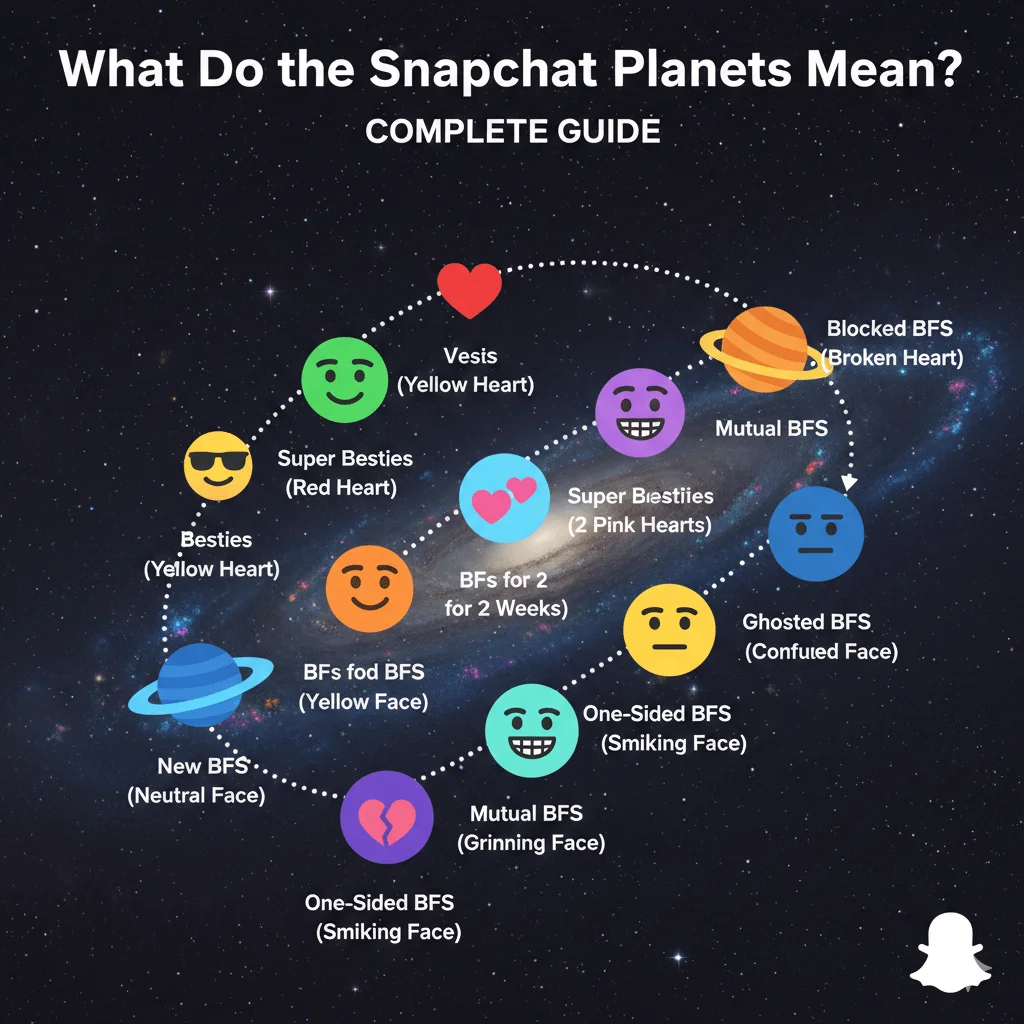
If you’ve recently noticed planets appearing on your friends’ Snapchat profiles, you’re not alone. The Snapchat Planets feature has become one of the most talked-about additions to the popular messaging app, sparking curiosity among millions of users worldwide. But what exactly do these planets mean, and how does this cosmic friendship ranking system work?
In this comprehensive guide, we’ll break down everything you need to know about Snapchat Planets, from their meanings and order to how you can view your position in your friends’ solar systems.
Table of Contents
What Are Snapchat Planets?
Snapchat Planets is an exclusive feature for Snapchat Plus subscribers that displays your closest friendships using a planetary model called the Friend Solar System. Think of it as a creative way to visualize who you interact with most on the platform.
In this system, you become the Sun at the center of your own solar system, while your eight closest friends orbit around you as different planets. The positioning of these planets isn’t random; it’s based on how frequently you interact with each friend through snaps, chats, and other engagement activities.
How the Friend Solar System Works
The concept is simple yet engaging. Your position in someone’s solar system reflects how much you interact with them compared to their other contacts. The friend you communicate with most becomes Mercury (the closest planet to the Sun), while the eighth most contacted friend becomes Neptune (the farthest planet).
What makes this feature particularly interesting is its dynamic nature. Your planet rankings can shift daily based on your current interaction patterns. If you suddenly start messaging someone more frequently, their planet might move closer to your Sun, while reduced communication with another friend could push their planet farther away.
Understanding Each Snapchat Planet and Its Meaning
Let’s explore what each planet represents in your Snapchat solar system, moving from closest to farthest:
Mercury – Your #1 Best Friend
Mercury is assigned to the friend you share the most snaps and chats with. This is your ultimate Snapchat bestie, the person you’re constantly sending snaps to, maintaining streaks with, and chatting late into the night.
Visual Appearance: Mercury appears as a red planet surrounded by five bright red hearts, symbolizing the intense closeness of this friendship.
What It Means: This person is your top priority on Snapchat. You likely communicate daily, share inside jokes, and maintain the longest streaks together.
Venus – Your #2 Best Friend
Venus represents your second-closest connection on Snapchat. While you might not interact as frequently as you do with your Mercury friend, this relationship is still powerful and meaningful.
Visual Appearance: Venus displays as a light brown or beige-colored planet with multiple hearts in pink, yellow, and blue floating around it.
What It Means: This friend receives plenty of your attention and affection. You chat multiple times per week and share a warm, diverse range of interactions.
Earth – Your #3 Best Friend
Earth holds the third position in your Snapchat solar system, representing a reliable and consistent friendship.
Visual Appearance: Earth looks just like our actual planet, featuring blue and green colors, red hearts, small stars, and even a tiny moon orbiting it.
What It Means: This is someone you can count on to respond and connect regularly. The relationship is stable, dependable, and among your top three closest contacts.
Mars – Your #4 Best Friend
Mars, the red planet, represents your fourth-best friend on Snapchat.
Visual Appearance: Mars appears as a vibrant red planet surrounded by blue and purple hearts along with scattered stars.
What It Means: Your friendship is active and energetic. You share laughs and random snaps frequently, though not quite enough to crack the top three positions.
Jupiter – Your #5 Best Friend
Jupiter, the largest planet in our solar system, occupies the fifth spot in your Snapchat friendship rankings.
Visual Appearance: Jupiter is depicted as a large orange-red planet with swirling patterns and is accompanied by colorful stars.
What It Means: This friend is someone you engage with regularly, but the frequency is noticeably less than your top four contacts. The friendship remains essential, but isn’t part of your inner circle.
Saturn – Your #6 Best Friend
Saturn, known for its distinctive rings, represents your sixth-closest friend.
Visual Appearance: Saturn appears as an orange or golden planet with its iconic ring system and surrounding stars.
What It Means: Your interactions with this person are less frequent but still meaningful. They’re part of your extended close friends group on the platform.
Uranus – Your #7 Best Friend
Uranus represents your seventh-best friend in the Snapchat solar system.
Visual Appearance: Uranus is shown as a green planet, notably without any hearts around it.
What It Means: This connection is more occasional and casual, but still recognized in your best friends list. You engage now and then, keeping them in your orbit without daily interaction.
Neptune – Your #8 Best Friend
Neptune is the final and farthest planet in your Snapchat solar system, representing your eighth-best friend.
Visual Appearance: Neptune appears as a blue planet, often without hearts, emphasizing its distance from the Sun.
What It Means: This friend is someone you communicate with the least among your top eight contacts. While interactions may be rare, they’re still significant enough to maintain this spot in your friendship rankings.
How to View Snapchat Planets
Want to check your position in a friend’s solar system? Here’s a step-by-step guide:
Requirements
First, you need an active Snapchat Plus subscription. This feature is exclusively available to premium subscribers and is not accessible through the free version of Snapchat.
Step-by-Step Process
- Open Snapchat and navigate to your friends list
- Tap on the friend’s profile whose solar system you want to view
- Look for a badge with a golden ring on their profile
- Identify the badge type: Best Friends Badge means you’re both in each other’s top eight friends
- Friends Badge means you’re in their top eight, but they’re not in yours
- Tap the badge to reveal your planet and position in their solar system
For example, if you see Mars when you tap the badge, you’re their fourth-best friend on Snapchat.
What Affects Your Planet’s Position?
The system tracks how much you interact with friends through snaps, chats, calls, and other activities. Several factors influence your planetary ranking:
Interaction Frequency
- Number of snaps sent and received
- Frequency of text conversations
- Voice and video call duration
- Story views and replies
Streak Maintenance
Keeping consistent Snapchat streaks significantly impacts your position. Long-running streaks demonstrate sustained engagement and can help you maintain a closer planetary position.
Engagement Quality
The algorithm considers both quantity and recency of interactions. Recent, frequent communication carries more weight than sporadic historical engagement.
Tips to Improve Your Planet Position
Want to become someone’s Mercury or move closer in their solar system? Here are proven strategies:
Maintain Daily Streaks
Keeping your Snapstreak alive for consecutive days shows consistent engagement. Aim for 100+ day streaks with your closest buddies to strengthen your position.
Increase Communication Frequency
- Send snaps multiple times daily
- Respond promptly to messages
- Engage with their stories regularly
- Use Snapchat’s various features (Bitmojis, filters, stickers)
Quality Over Quantity
While frequency matters, meaningful interactions carry more weight. Send personalized snaps rather than mass messages to show genuine interest in the friendship.
Stay Consistent
Sporadic bursts of activity won’t help as much as sustained, regular engagement. Make Snapchat communication a daily habit with your closest friends.
The Privacy and Mental Health Considerations
While Snapchat Planets offers a fun way to visualize friendships, it’s essential to understand the feature’s implications:
Optional Feature
Snapchat made the feature optional after concerns were raised about social comparison and ranking anxiety. Users can toggle the Friend Solar System on or off anytime through their Snapchat Plus settings.
No Notifications
You won’t receive alerts when your planet’s position changes. The rankings are visible only when you actively check someone’s profile.
One-Sided Visibility
Your position in someone’s solar system doesn’t affect their position in yours. Friendships aren’t always symmetrical on social media.
Healthy Perspective
Remember that planet positions reflect app usage patterns, not real-life friendship quality. Being Neptune in someone’s system doesn’t diminish the value of that relationship offline.
Snapchat Plus: What You Need to Know
To access the Planets feature, you need a Snapchat Plus subscription. Here’s what you should know:
Subscription Details
- Plans typically start at $3.99 per month (as of 2025)
- Available in monthly, six-month, and annual options
- Includes a free trial period for new subscribers
Additional Features
Beyond Planets, Snapchat Plus offers:
- Custom app icons
- Story rewatch indicators (see who viewed your story twice)
- Exclusive badges and profile customizations
- Priority support
- Access to experimental features before they launch publicly
How to Subscribe
- Open Snapchat and tap your Bitmoji
- Tap the Snapchat Plus banner
- Choose your preferred subscription plan
- Complete the payment process
Frequently Asked Questions
1. Can free Snapchat users see planets?
No, the Planets feature is exclusively available to Snapchat Plus subscribers. Free users cannot access or view this feature.
2. Do my friends know I checked their solar system?
No, Snapchat doesn’t notify users when someone views their Friend Solar System. Your checks remain private.
3. How often do planet positions update?
Planet rankings update dynamically based on your current interaction patterns. Changes can occur daily as your communication habits shift.
4. Can I hide my planets from others?
If you’re a Snapchat Plus subscriber, you can disable the Friend Solar System feature entirely in your settings, preventing others from seeing your planets.
5. Does being someone’s Neptune mean they don’t value me?
Not at all. Neptune indicates eighth place in app-based interactions. Real friendships have depth beyond Snapchat engagement metrics.
6. Are there more than eight planets?
No, the system only tracks your top eight closest friends, mirroring the eight planets in our actual solar system.
Final Thoughts
Snapchat Planets offers an innovative, gamified approach to understanding your digital friendships. By transforming interaction data into a visual solar system, the feature makes it easy to see who you connect with most on the platform. Whether you’re aiming to become someone’s Mercury or simply curious about your current position, this guide provides everything you need to navigate the Friend Solar System effectively.
Remember that while Snapchat Planets can be entertaining and insightful, they’re ultimately just one measure of digital interaction. True friendship extends far beyond app algorithms and planetary positions. Use this feature as a fun way to stay connected, but don’t let it define the value of your relationships.
Ready to explore your Snapchat solar system? Subscribe to Snapchat Plus today and discover where your friends orbit in your universe, and where you orbit in theirs.